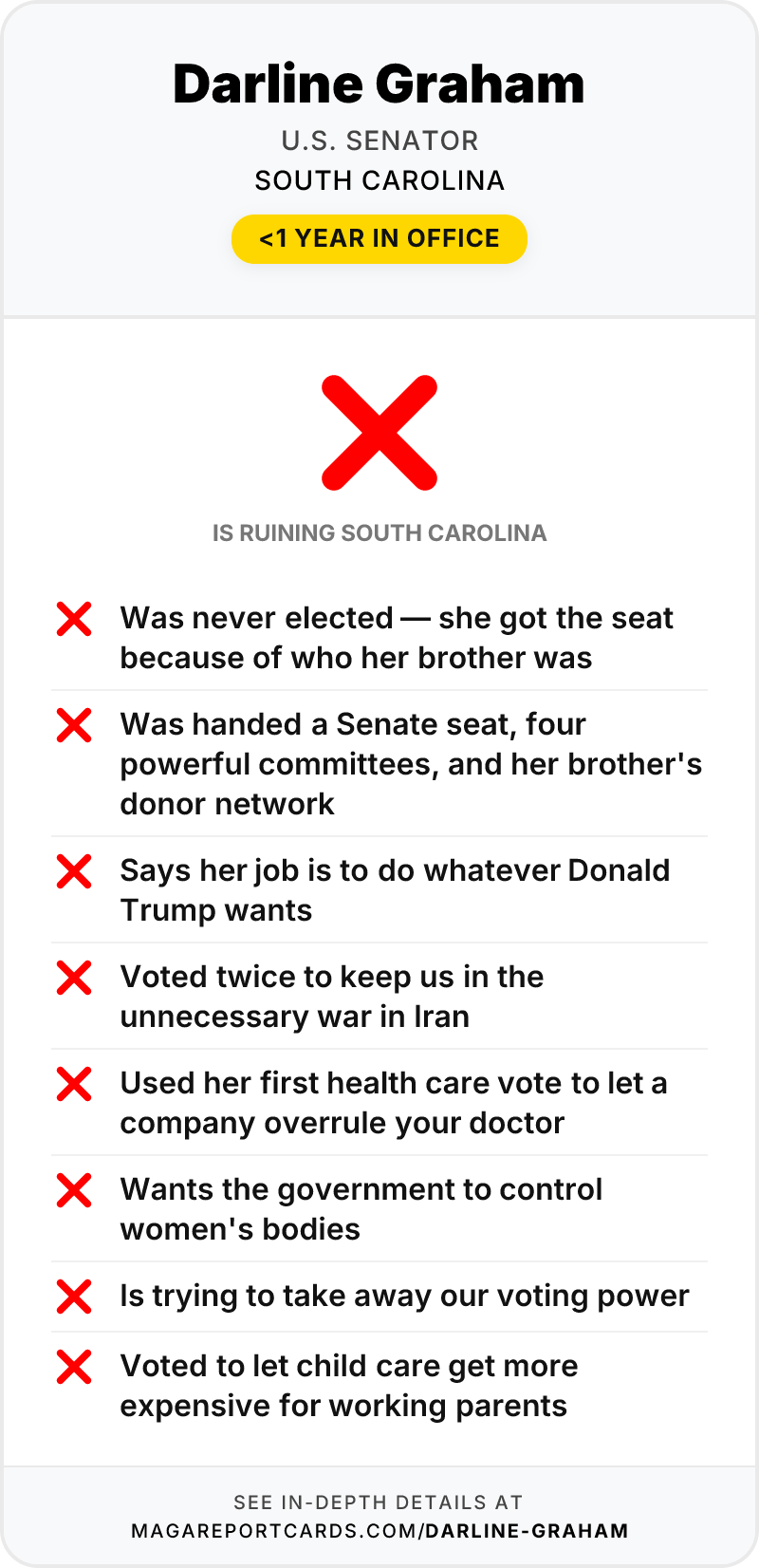
Of everything that's been said about Darline Graham since she was appointed to her late brother's Senate seat, the most interesting fact has gotten the least attention: she actually has a professional record, and it's a good one.
She spent her career in vocational rehabilitation, helping people with disabilities get past the barriers that keep them out of work. Since 2019 she has led South Carolina's Commission for the Blind. In 2022 South Carolina passed a law ending subminimum wage for people with disabilities — the practice that let employers legally pay disabled workers less than the minimum — and she was at the bill signing, then helped unwind the state's remaining subminimum wage. That bill passed the state Senate unanimously.
Disability advocates in South Carolina speak about her warmly. Kimberly Tissot, president of Able South Carolina, told The 19th: "She is a leader, but she's not the kind of leader to ever brag about what she's done."
That's a real background, and it's exactly why her first month in the U.S. Senate deserves a close look. Because the votes she cast are the ones that hurt the people she spent her career serving.
Vote one: keeping insurance-company gatekeeping inside Medicare
Two days into the job, on July 16, 2026, the Senate voted on whether to take up S.J.Res. 198 — a resolution to overturn the administration's "Wasteful and Inappropriate Services Reduction (WISeR) Model," which brings prior authorization into traditional Medicare for a set of services.
Prior authorization is the thing that makes you wait while a company decides whether to approve the care your doctor already said you need. If you are managing a disability, it is not a paperwork annoyance. The services this model puts behind prior authorization include deep brain stimulation for Parkinson's disease and essential tremor, nerve stimulators, and incontinence control devices.
The motion failed 46–50. Graham voted no.
Vote two: leaving the child care rollback in place
On July 30, 2026, the Senate voted on whether to take up S.J.Res. 199, disapproving the administration's rule "Restoring Flexibility in the Child Care and Development Fund" — the federal program that helps low-income working families afford child care.
The rule rescinds the requirement that states limit family co-payments to 7 percent of family income, along with the requirements to pay child care providers up front and based on enrollment. A resolution of disapproval can't be filibustered — this one needed only a simple majority to move forward. The motion failed 47–52. Graham voted no — against even debating it.
The bigger thing coming
Those two votes are small next to what's already law.
Trump's budget bill cut roughly $1 trillion from Medicaid over the decade. Anyone who has worked in disability services knows exactly what that means, because for disabled people Medicaid is not just health insurance — it's the program that pays for the care that lets them live in their own homes instead of an institution.
And here's the mechanism, from KFF Health News: home- and community-based services "are optional under Medicaid." When federal money shrinks and states have to cut, optional is the first thing that goes. Kim Musheno of The Arc put it plainly:
"Whenever there's pressure on state budgets like those that are caused by the One Big Beautiful Bill Act, they go after Medicaid, and then they go after optional services."
In Idaho, where the governor proposed cutting them, what's on the chopping block, in KFF's words, is "24/7 care that allows a 39-year-old with cerebral palsy to live independently; the in-home caregiving that lets a 26-year-old with brain damage from a hemorrhage at birth stay in his family home; and private duty nursing for a 19-year-old."
In South Carolina specifically, KFF projects 57,000 more uninsured residents by 2034 under the law itself — 190,000 once the expiration of the enhanced ACA premium tax credits is counted too. The state's hospital association puts its hospitals' loss at roughly $150 million a year over 15 years, about $2.4 billion in all, as the law phases out the payments that raised their Medicaid rates. Rural hospitals are where a lot of South Carolinians with disabilities get care.
Darline Graham arrived in the Senate as one more vote for the party that passed it.
She told us what the job is
None of this is a mystery, because she has explained her own understanding of the role. In her political debut she told South Carolina Republicans:
"I'm here today because I'm answering President Trump's call to serve. I want to stand up for South Carolina, and I want to fight for President Trump's agenda."
Notice the order, and notice what's missing. A senator's constitutional job includes telling a president no. She has been explicit about whose agenda she is there for.
That's what makes the disability record so frustrating rather than reassuring. She has spent her career in the public programs that help people with disabilities. She is on the Appropriations Committee — the one that decides what gets funded.
She could be the Republican who says "not this program." Instead she cast party-line no's on prior authorization and child care.
The election is Tuesday
South Carolina holds its special Republican primary on August 11, 2026. Voters get their first say on this seat since Gov. McMaster handed it over on Trump's recommendation.
Between now and then it's worth asking a simple question: what is the point of sending someone to Washington with a career's worth of expertise in a subject if the expertise never changes a vote?
Darline Graham has spent her career serving the disabled South Carolinians these cuts hit. So far she has voted with her party anyway. We deserve better.
Sources
- Darline Graham's career centered disability. Now she could help shape national policy — Sara Luterman, The 19th via PBS NewsHour, July 18, 2026
- Families Defend Disability Services Amid Medicaid Cuts — Bram Sable-Smith, KFF Health News, March 2, 2026
- U.S. Senate roll call votes #199 and #215, 119th Congress, 2nd session