If you live in a nursing home, voting is not simple. You may not drive. You may not be able to hold a pen steadily. Getting to a polling place may require someone to physically take you there. For many of the 1.2 million Americans in nursing homes, whether they vote at all depends on whether a staff member helps them.
In October 2020 — during Donald Trump's first term — the federal government told those facilities exactly what was expected of them. The guidance from the Centers for Medicare and Medicaid Services said:
"Nursing homes should have a plan to ensure residents can exercise their right to vote, whether in person, by mail, absentee, or other authorized process."
In July 2026, CMS replaced that guidance. The new version, issued under Administrator Mehmet Oz, deletes that sentence.
Gone with that sentence are the old memo's instructions on how: the list of programs facilities should run, the regulations on residents' right to send and receive ballots by mail, and the line telling nursing homes they are required to support a resident's right to vote "such as assisting with absentee or mail-in voting, or transporting residents to polling locations or ballot drop-boxes in a safe manner." In their place is a warning to facility employees about violating "federal or state voting laws," a heavy focus on preventing voter fraud, and a suggestion that facilities lean on bipartisan election workers so that voting happens "without reliance on facility staff."
What was removed, and what was put in its place
Thirteen senators, led by Elizabeth Warren of Massachusetts and Alex Padilla of California, wrote to Oz on August 12 objecting. Their letter lays out the problem plainly:
"The nation's 1.2 million nursing home residents face unique problems in obtaining access to the voting booth, and must not be denied their rights because they are disabled, elderly, lack transit, or face difficulties in obtaining a ballot or voting in person."
The senators argue the memo "may intimidate nursing home staff from helping residents exercise their constitutional right to vote and ultimately prevent nursing home residents from voting."
They flagged one detail that deserves attention. The senators read the memo as "threatening criminal penalties on nursing home staff" — "many of whom," they wrote, "are legal immigrants who have already been targeted by Trump's immigration policies." The memo itself never uses the word criminal, or the word penalty. What it does is open with the story of a social worker charged on 134 felony counts. Telling that particular workforce that story is not a neutral act.
"The removal of guidance on vote by mail procedures, combined with specific threats to investigate nursing home staff for assisting residents who are exercising their right to vote, may deter nursing homes from assisting residents with voting by mail," the senators wrote. "Ultimately, we are concerned that the changes to CMS's guidance will result in the disenfranchisement of nursing home residents."
Richard Mollot, executive director of the Long Term Care Community Coalition, told the Houston Chronicle what this looks like in practice:
"The language is important. Most nursing homes will do as little as possible; if you're not affirmatively telling them what to do, they won't do it."
That is the whole mechanism. Nobody has to ban anything. You just stop telling facilities they have a duty, put a felony prosecution at the top of the memo instead, and the assistance quietly stops.
The cases CMS used to justify it
Here is the part that should end the argument about whether this is about fraud.
CMS cited two investigations to explain the new warnings. The first is a Texas prosecution. The person in that case is Kelly Brunner.
In 2020, Brunner was the assistant voter registrar at the State Supported Living Center in Mexia, Texas, a facility for people with intellectual and developmental disabilities. Her job was to get residents ready to vote.
According to the Houston Chronicle's reporting, Brunner made technical errors in a complicated registration system. The errors were all caught quickly. No resident cast an improper vote.
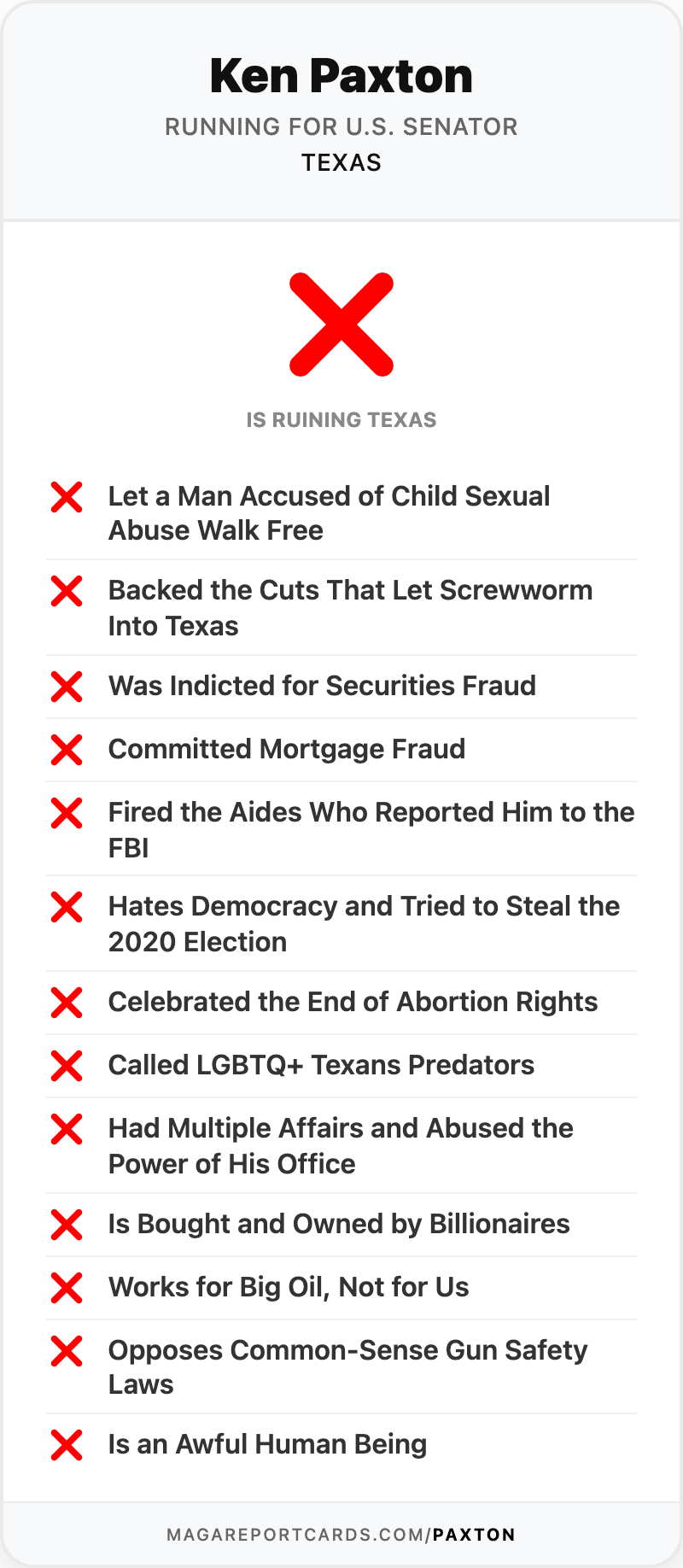
She was nonetheless criminally charged with orchestrating one of the largest election fraud cases in Texas history — a prosecution pushed by Attorney General Ken Paxton, who at the time was promoting Trump's false claims that the 2020 election was rigged.
Brunner spent $50,000 on lawyers. She pleaded guilty to minor charges to make it stop. She lost her teaching license and nearly lost her social worker's license.
She thought it was over. Then the federal government cited her, six years later, as the reason employees of long-term care facilities nationwide should be watching for voter fraud in the 2026 midterms.
The senators checked both cases the memo leans on — the Texas prosecution and an allegation about mail ballots at a Wisconsin nursing home — and wrote that "no fraudulent votes were cast in either of these cases." That is the evidence base for making it harder to help disabled people vote.
Paxton's own record on this
The prosecution that CMS is leaning on came from an attorney general with a specific history on voting.
Paxton built a career hunting voter fraud in Texas. A Texas Tribune and ProPublica investigation found that he voted six times from a home he no longer lives in — and that a formal complaint about it could be referred to his own office. He is now his party's nominee for the United States Senate.
That is the provenance of the evidence base here. Not a study, not a pattern of proven fraud — a prosecution brought by a man promoting election lies, against a social worker whose paperwork mistakes changed no vote.
Why this is a Medicare story too
It is worth noticing which agency did this.
CMS runs Medicare and Medicaid. Its authority over nursing homes exists because it pays for them: a facility that wants Medicare and Medicaid residents has to meet CMS's participation requirements. That is the leverage. When CMS issues guidance, facilities read it as coming from the agency that signs the checks.
So the agency whose entire job is the health and safety of nursing home residents used that leverage on voting instead. Not to expand access — to warn the staff off.
The senators put this in the context of a longer pattern: a "series of actions the Trump administration has taken to restrict vote by mail and undermine the right to vote based on unfounded allegations of voter fraud tied to the president's denial of prior valid election results."
What can be done
Warren has called on Oz publicly to withdraw the guidance. CMS could do that tomorrow. The memo says of itself that it "does not create new regulatory requirements and does not update the State Operations Manual," and it went out over no signature at all — just the title of one CMS office director.
Short of that, states and facilities are not required to do the minimum. The deleted sentence was a recommendation — nursing homes "should" have a plan, not "must" — which means nothing in the July memo stops a nursing home from having one anyway. What's gone is the federal government telling them to.
There is an election in November. The 1.2 million people in these facilities are among the most likely Americans to need help voting, and the least able to complain about it if that help quietly disappears.
Source
New Trump Guidance Could 'Result in the Disenfranchisement of Nursing Home Residents' — Jake Johnson, Common Dreams, August 14, 2026, citing the Houston Chronicle's reporting on the Kelly Brunner case.