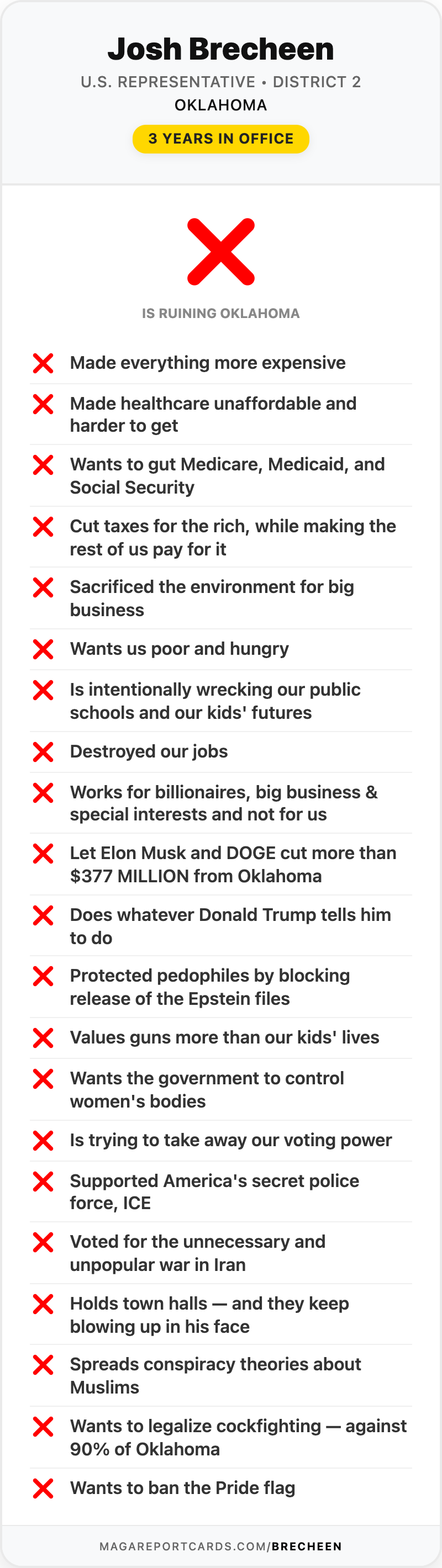
On Wednesday, August 26, 2026, Josh Brecheen held a town hall at the Donald W. Reynolds Community Center in Poteau, Oklahoma. He came to talk about the national debt, and that is where he put most of his focus.
His constituents wanted to talk about hospitals.
One of them raised a number: 45 hospitals in Oklahoma are at risk of closing. That is not a rumor from the internet. It is the finding of a report from the Center for Healthcare Quality and Payment Reform, released weeks earlier, which found 45 Oklahoma rural hospitals at risk of closure and 18 at immediate risk. Oklahoma ranks third worst in the country, behind only Texas and Kansas.
Here is how the congressman answered.
"I don't know your facts. All I can tell you is Medicaid spending was going to increase year over year. The curve was crazy. It was like the system was being built."
"I don't know your facts" is a remarkable thing for a member of Congress to say about the hospitals in his own district. The report had been public for weeks and had been covered in Oklahoma news. He voted for the Medicaid cuts that the state's hospital association calls the biggest challenge facing those hospitals.
The facts he said he didn't know
Rich Rasmussen, who runs the Oklahoma Hospital Association, has laid out why Oklahoma's hospitals are in trouble: Medicare pays less than care costs, Medicaid rates are low, Medicare Advantage plans delay payments and deny care — and the Medicaid cuts Congress approved are, in his words, the biggest challenge of all.
More than 90 Oklahoma hospitals already lose money treating patients. They stay open because of supplemental Medicaid payments that make up part of the gap.
Which brings us to what happened in July. The Oklahoma Health Care Authority filed a $218 million cut with the federal government — a 20 percent reduction to the Supplemental Hospital Offset Payment Program. That is the exact money keeping those 90 hospitals open. The filing came days after the agency had endorsed a flat budget, and it caught the Oklahoma Hospital Association by surprise.
The town hall was in Poteau, and Poteau has a hospital: Eastern Oklahoma Medical Center. EOMC is not on the at-risk list. But the proposed $218 million cut means a 52 percent reduction in what it receives — $750,000 a quarter, $3 million a year. Its CEO, Tiffany Griffis, said on August 18 that would be tough to deal with.
So the hospital in the town where Brecheen was standing stands to lose more than half of a payment stream, and the congressman's answer to a question about hospitals at risk was that he didn't know the facts.
The rescue fund, and the man from the hospital who was in the room
Brecheen did have an answer ready. He pointed to the $50 billion for rural health care that states got in last year's budget bill — $10 billion a year for five years — and said Oklahoma's share is $248 million, through something called the Rural Health Transformation Program.
That is the standard Republican answer to this question, and we have heard it in a lot of districts. It has a hole in it. The $50 billion fund was created by the same budget bill that cut $911 billion from Medicaid, including $137 billion from rural areas — so the fund covers roughly a third of the rural damage the same law caused, and the law does not require the money to reach rural hospitals at all.
This time, someone in the room could answer him directly.
Logan Hayes, the chief operating officer of Eastern Oklahoma Medical Center, told Brecheen that his hospital has applied for every Rural Health Transformation grant available so far — and that only about 10 percent of hospitals have been awarded anything.
That is the rescue fund, described by a person whose job is to apply to it.
"Hospitals are states' responsibility"
Brecheen's response was to move the problem. He said hospitals are the states' responsibility, and that he had tried to find solutions for hospitals back when he was a state senator. He started to make the constitutional case:
"There's nothing in those 18 enumerated powers of the Constitution — tax regulation, coining money, counterfeit enforcement, piracy, post…"
Set aside the constitutional theory for a moment and look at the timing.
Brecheen is telling Oklahomans that hospitals belong to the state — weeks after the state's own Medicaid agency filed to cut $218 million out of hospital payments. The state is not picking this up. The state is moving to cut too. And Brecheen's own answer to what the federal government has done is a grant program that the hospital in that same town has applied to repeatedly without success.
There is also the matter of what the federal government did to Oklahoma on his watch. An estimated 174,000 Oklahomans are at risk of losing SoonerCare coverage under the budget bill — the bill Brecheen voted for and then toured his district promoting. When a hospital loses insured patients, it does not stop treating them. It treats them for free and absorbs the loss. That is how a hospital gets onto a list like the one his constituent was reading from.
He was a state senator in Oklahoma, where he says he looked for hospital solutions. He has been in Congress since 2023, where he voted for the cuts. In both jobs the answer points somewhere else.
What the record shows
A constituent at Josh Brecheen's August 26 town hall in Poteau cited a report finding 45 Oklahoma hospitals at risk of closing and 18 at immediate risk — figures that put Oklahoma third worst in the nation. Brecheen replied, "I don't know your facts," argued that hospitals are the states' responsibility, and pointed to a $50 billion rural fund created by the same budget bill that cut $911 billion from Medicaid. The chief operating officer of the hospital in that town told him they had applied for every one of those grants and that only about 10 percent of hospitals have received anything. In July, Oklahoma's Medicaid agency had filed to cut $218 million from the supplemental payments that keep more than 90 money-losing Oklahoma hospitals open — a 52 percent cut for the Poteau hospital alone.
Source
"Brecheen on hospitals at risk: 'We've got it backwards;' says they're states' responsibility" — Tom Firme, Poteau Daily News, August 29, 2026. Brecheen's remarks on tariffs at the same town hall are covered here.