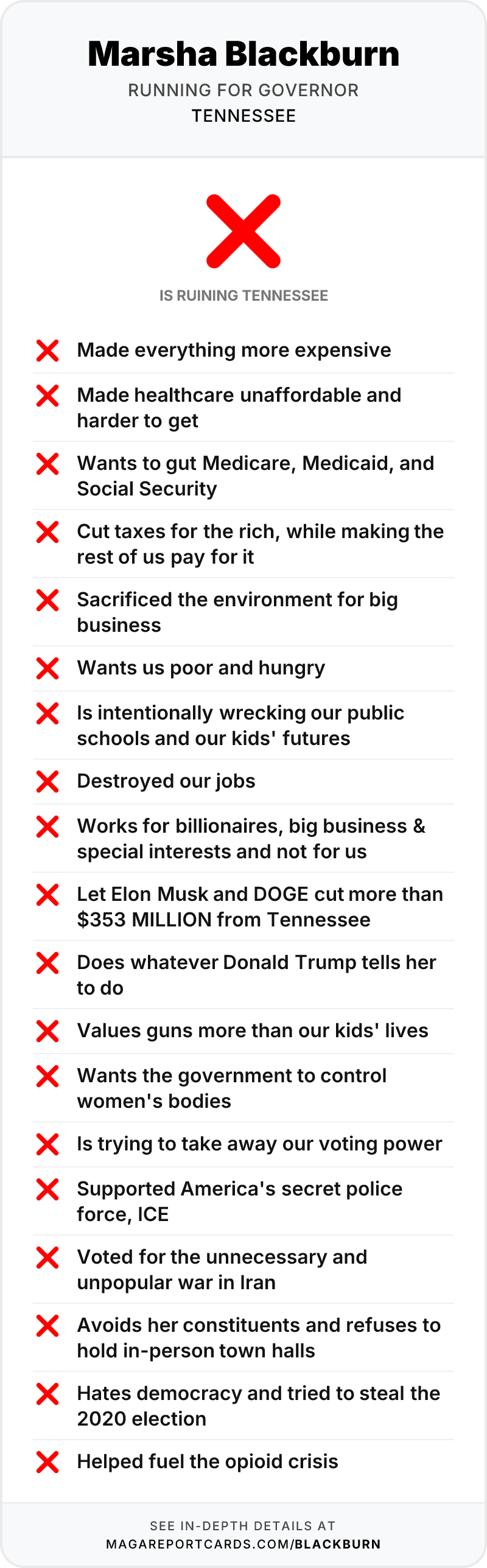
Marsha Blackburn has spent more than two decades in politics. And a new Tennessee Lookout investigation put a number on what that career has cost — or, depending on how you look at it, what it has been worth to the people paying for it.
The number is more than $100 million.
That's how much has been spent to lift Blackburn from a Tennessee state Senate seat, to the U.S. House, to the U.S. Senate, and now toward the governor's office. About half of it she raised through her own campaigns and a federal PAC. The other half was spent on her behalf by outside groups — the kind of unlimited "independent" spending that lets a handful of very rich people move real money. And the folks writing the biggest checks have been backing her for 20 years, waiting for a payoff.
What $100 million buys over 20 years
The Lookout compiled federal and state campaign records to trace the money. Here's the arc:
- In the U.S. House, Blackburn raised about $11.7 million over eight elections.
- Her 2018 Senate race is where the machine kicked into high gear — outside PACs spent $29.7 million to help her beat Democrat Phil Bredesen, about a third of her career total. Americans for Prosperity alone spent nearly $5 million.
- In her 2026 run for governor, she's already at $17.7 million — $9.5 million through her campaign and $8.2 million through two PACs boosting her.
To see how out of scale that is, look at the man with a nearly identical résumé. Retiring Memphis Democratic Rep. Steve Cohen has served about the same 20 years — and raised around $8 million his whole career. Blackburn has raised and benefited from more than twelve times that.
The donors who never left
Blackburn does have plenty of small-dollar donors — she's good at using her Trump-superfan brand to pull in small checks from around the country through WinRed. But that's not where the real money is. The real money is a small circle of backers who've stuck with her, election after election.
The Lookout found that the founders of companies like payday lender Advance Financial, private prison company CoreCivic, CoPart Auto, and Franklin Home Mortgage have donated to Blackburn's federal accounts and PACs cycle after cycle. These aren't one-time supporters. They're regulars.
And when Blackburn jumped into the governor's race and opened a state version of her PAC, those same backers suddenly got to write far bigger checks:
- Advance Financial, the payday lender, is her second-largest backer for governor — $550,000 to PACs supporting her as of the June 30 filing deadline.
- Logistics entrepreneur Spencer Patton and his wife are a close third at $521,200.
- Billionaire Jeff Yass — the main money behind the anti-tax, now pro-school-voucher group Club for Growth — started with a $1,000 check to Blackburn's first House race back in 2002. This year, Yass and his group have poured in $4 million, the most of any single person or group.
Think about that payday-lending money for a second. A payday lender makes its profit off short-term loans at eye-popping interest rates, often to people who are already strapped for cash. Now it's one of the biggest funders of a woman running to be the state's chief executive — the official whose administration helps shape how businesses like that get regulated. That's not a coincidence. That's a business decision.
This is an investment, and they expect a return
You don't have to guess at the logic. Brendan Glavin, director of insights at the watchdog group OpenSecrets, told the Lookout that high-dollar donations, over time, can work almost like an investment in politicians.
And the return gets bigger if she wins this race. In Glavin's words:
"Governors have direct power or control over things like the budget. Even though the legislature makes decisions, the governor can wield a lot of influence in ways senators can't."
That's the whole point. A senator is one of a hundred. A governor signs the budget, runs the agencies, and controls the contracts. For a private prison company that lives on state incarceration and detention deals, or a payday lender that wants to be left alone, a friendly governor is worth a lot more than a friendly senator. Twenty years of checks start to look less like support and more like a down payment.
Outside money doing the dirty work
A big chunk of that $100 million never had to follow the normal rules, because it flowed through outside PACs that can raise and spend unlimited amounts. Blackburn's biggest backers set up two of them — Team Tennessee and the Tennessee Freedom Fund — to run TV ads for her, fund her turnout operation, and attack her Republican opponent, Congressman John Rose.
It lets Blackburn keep her hands clean. The nasty ads and the heavy spending happen "independently," while she stays above it all — and the donors funding the machine don't have to sit across the table from the voters they're trying to influence.
The Lookout reached out to Blackburn's campaign with detailed questions about her donors and how much influence they buy. She didn't respond — not once, despite multiple attempts. That's become the pattern with Blackburn. She hasn't held an in-person town hall in years, she skipped a public forum and wouldn't say whether she'd debate in her own primary, and now she won't answer questions about who's funding her. She'll take the money. She just won't explain it.
Follow the money
None of this is a surprise to anyone who's watched her career. Oracle and CoreCivic are both in the top ten of the organizations whose PACs and employees fund her this cycle, and her own report card names Oracle among her top funders. What the Lookout's tally adds is the sheer scale of it — and the reminder that these relationships go back two decades, long before this governor's race.
So when Marsha Blackburn asks Tennesseans to make her their governor, it's fair to ask the question the $100 million answers: whose governor would she actually be? The payday lenders, the private prison company, and the billionaires have already placed their bets. They're not betting on you.
Source
This post is based on Adam Friedman's investigation for the Tennessee Lookout.