On September 25, 2024, the House voted on H.R. 9747, the stopgap bill to keep the government funded. Tucked inside it was a provision letting the Federal Emergency Management Agency spend its Disaster Relief Fund at full speed instead of the trickle a stopgap normally allows — a fund Congress had appropriated $20.26 billion to for the year.
The fund needed it. FEMA had been operating under "Immediate Needs Funding" — a restricted mode where the agency pays only for immediate life-saving work and freezes reimbursements for long-term rebuilding. As the National Association of Counties explained, the bill "frees up about $20 billion for the U.S. Federal Emergency Management Agency (FEMA) Disaster Relief Fund (DRF), which will take the DRF out of Immediate Needs Funding" — unlocking reimbursement for county recovery projects.
The bill passed 341 to 82. Every one of the 82 no votes was a Republican.
Gus Bilirakis was one of them. Roll Call 450: Nay.
The next night, Helene made landfall
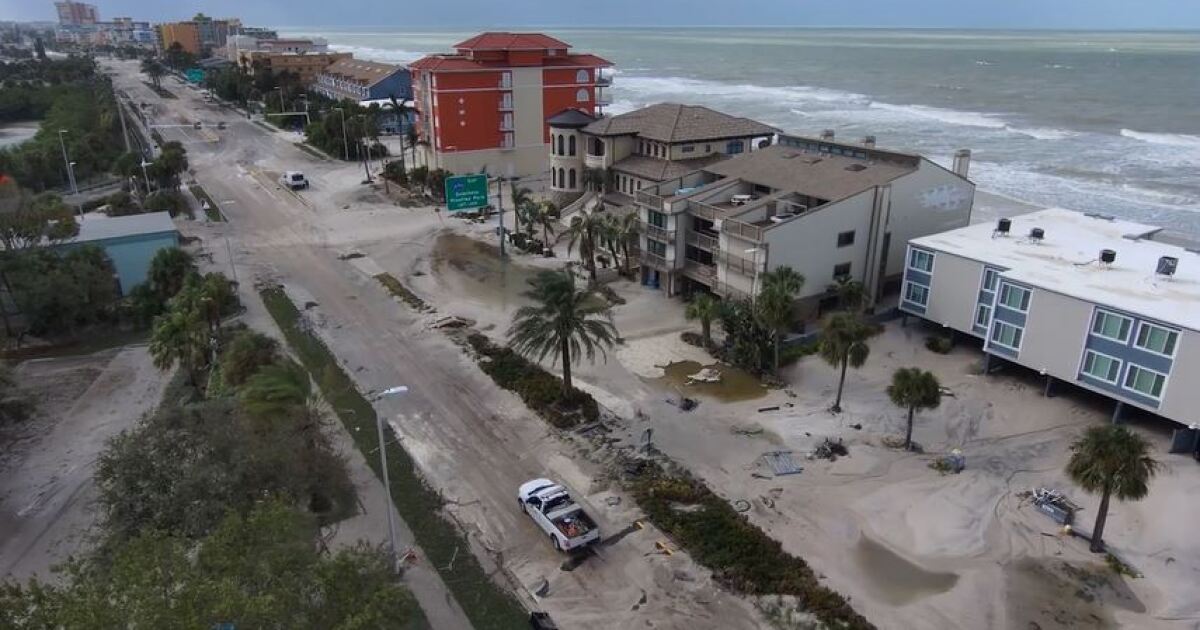
Hurricane Helene came ashore on Florida's Gulf coast on the night of September 26, 2024 — roughly 24 hours after that vote. Two weeks later, on October 9, Hurricane Milton hit the same stretch of coastline.
Bilirakis represents Florida's 12th District. His own district offices are in Pasco, Hernando and Citrus counties, all on or near the water.
Pasco County logged 9,430 storm-related incidents in the days after Helene, with assessments still ongoing. Hernando County counted three properties destroyed and 529 with major damage. Across the Tampa Bay region, Pinellas County alone assessed 27,735 properties and found 267 destroyed and 16,516 with major damage.
Five days later, he told his constituents to apply for FEMA money
On September 30, 2024, Bilirakis's office published a Hurricane Recovery Resource Guide — five days after the vote. The page was updated on October 11, after Milton, which is the version that reads:
"As our community recovers from the aftermath of Hurricane Helene and Hurricane Milton, I want to ensure all my constituents have access to the resources and support you need... In this guide, you will find information about applying for Federal Emergency Management Agency (FEMA) disaster assistance, SBA loans and other federal agency disaster support programs."
And then, two paragraphs down:
"Please know that I am working with my colleagues in Congress to ensure all Floridians have the necessary federal resources we need to rebuild and fully recover from these disasters."
Working with his colleagues in Congress to make sure Floridians have the federal resources they need. Five days earlier, 341 of those colleagues had voted to free up $20 billion of exactly that, and he had voted against it.
The guide goes on for thousands of words explaining FEMA's Individuals and Households Program, the maximum grant amounts, how to appeal a denial, what documents to bring. It notes that "Pasco, Hernando and Citrus counties have been designated as a Major Disaster area and approved for Individual Assistance." Every dollar of that flows out of the Disaster Relief Fund he voted against unlocking.
What the vote was actually about
To be fair about it: the disaster money was not the reason most of the 82 voted no. The week before, House Republicans had tried to pass a six-month funding bill carrying the SAVE Act, the voter-registration measure Trump wanted. It failed on the floor when their own members balked. Speaker Mike Johnson then went back with a three-month bill without the SAVE Act attached, and the holdouts voted no on that.
So this was a protest vote about a voter-registration bill and the length of a spending patch.
That is the point. When the disaster fund was riding on the bill — with a major hurricane already forecast into the Gulf and headed for Florida — Bilirakis treated it as a bargaining chip he could afford to lose. The money passed anyway, over his objection, and his constituents spent it.
The pattern
This is not the first time Bilirakis has taken credit for something he had no hand in. In October 2018 his campaign ran a 30-second ad about fighting opioids in Pasco County that put the words "Bilirakis Interdict Act" on screen while the county sheriff praised him. The INTERDICT Act is a real law — it funds fentanyl-detection equipment for Customs and Border Protection — and it was sponsored by Rep. Niki Tsongas, a Massachusetts Democrat. Bilirakis was not a sponsor or a cosponsor. His campaign's answer was that he "voted for the act ... he participated in hearings about the need for it and worked to support its passage."
And it fits what he's told his constituents about federal spending generally. He is a member of the DOGE Caucus, and in February 2025 he toured Pasco, Hernando and Citrus counties hosting "DOGE Community Conversations" — workshops where he split residents into small groups and asked them what they would fund, expand or trim in the federal budget. "It's absolutely necessary that we make the cuts, but I want to make sure they are educated decisions," he said.
FEMA's Disaster Relief Fund is federal spending. So is the Individual Assistance his own guide walks people through, line by line, with the phone numbers of his three district offices at the top.
Source
House vote: Roll Call 450, H.R. 9747, September 25, 2024. Disaster Relief Fund apportionment: Public Law 118-83, sec. 134, and the fund's FY2024 appropriation of $20,261,000,000 in Public Law 118-47. Disaster fund detail: Congress enacts a Continuing Resolution to avert government shutdown through December 20, 2024, National Association of Counties. Damage figures: Helene wrecked tens of thousands of homes in the Tampa Bay region, WUSF, September 30, 2024. Photo: sand pushed onto Gulf Boulevard by Helene (Pinellas County Communications, September 28, 2024).