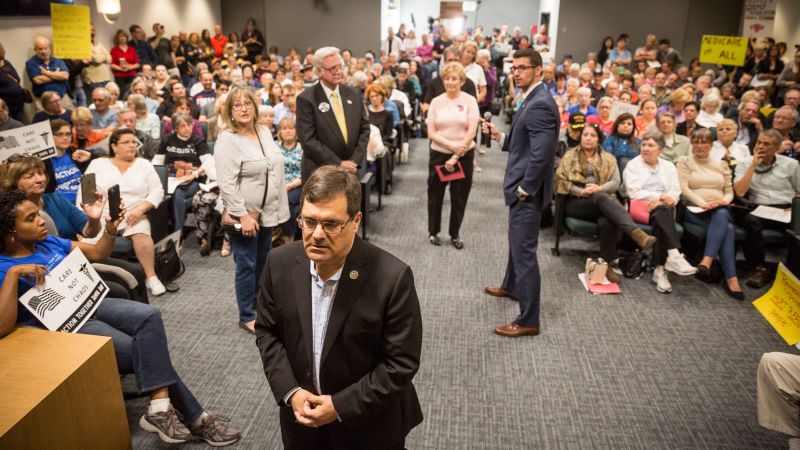
On a Saturday morning in February 2017, about 250 people packed a town hall in New Port Richey to tell their congressman what they thought about repealing the Affordable Care Act.
Minutes in, Bill Akins — the chairman of the Pasco County Republican Party — stood up and said this:
"There is a provision in there that anyone over the age of 74 has to go before what is effectively a death panel."
There is no such provision. There never was. PolitiFact rated the death-panel claim "Pants on Fire" back in 2009, when Sarah Palin invented it.
The room knew it. According to CNN's account of the meeting, audience members — including several doctors — shouted that Akins was wrong. Many yelled "liar."
Gus Bilirakis nodded.
What he did next made it worse
Bilirakis could have said the obvious thing: there is no death panel, that provision does not exist, let's talk about the real bill.
Instead he interjected that Akins was referring to the Independent Payment Advisory Board. CNN's reporter noted that over the two-and-a-half-hour meeting, speakers kept coming back to the death-panel claim, and Bilirakis repeatedly cited the IPAB.
Afterward, CNN asked him about it directly. His answer:
"The board exists, OK? And I've voted to repeal the board."
And Akins, arguing afterward with a pro-Obamacare attendee, used exactly that to win it. Sheriff's deputies stepped in to separate the two men.
"You called me a liar. The congressman said the death panel does exist."
That is what a member of Congress lending his authority to a lie sounds like in real time. Bilirakis didn't say the words "death panel." He just declined, over two and a half hours, to tell his own constituents that their county party chairman was making it up, and handed him a talking point instead.
The board he pointed at
Here is what the Independent Payment Advisory Board actually was.
It was a 15-member panel created by the Affordable Care Act. If Medicare's per-person spending growth ran above a target, it was supposed to send Congress recommendations for slowing that growth, and Congress could override them.
The law explicitly barred it from rationing care. It was barred from raising Medicare payroll taxes, from raising beneficiary premiums, and from increasing what beneficiaries pay out of pocket. It had no authority over anyone's individual medical treatment, at 74 or any other age.
And it never existed as a functioning body. President Obama never appointed anyone to it. Neither did President Trump. Medicare's spending growth stayed below the trigger, so its process was never activated. It never met a single time.
Then Congress abolished it. Section 52001 of the Bipartisan Budget Act of 2018 repealed the IPAB, and Trump signed it on February 9, 2018 — twelve months after the town hall.
So the "death panel" Bilirakis kept pointing to was a board that was never appointed, never convened, never issued a recommendation, was legally forbidden from doing the thing it was accused of, and no longer exists.
Nine years later he is on the committee that writes the rules
This was not a stray moment from a backbencher. Bilirakis sits on the House Energy and Commerce Committee's Health Subcommittee — one of the panels with jurisdiction over Medicare and Medicaid — and on its Communications and Technology Subcommittee, and he chairs its Commerce, Manufacturing, and Trade Subcommittee.
His funders are drawn from the industries those panels regulate. Since 2020, the political action committee of GuideWell, the parent company of Florida Blue, has given him $32,500. The PAC of BioMarin Pharmaceutical, a drugmaker, $32,500. AT&T's $37,500, Verizon's $32,000, Comcast's $32,000, per FEC filings compiled by Who Bought My Rep.
Which is the part worth sitting with. There is no government board deciding whether a 74-year-old gets treatment. There are insurance companies that deny prior authorizations, and there are formularies, and there are networks. Those are run by people who write him checks and appear before his subcommittees.
He spent a Saturday morning declining to correct the fiction and has spent nine years since on the committee that governs the real thing.
What else was said in that room
The rest of the town hall is worth remembering, because Bilirakis heard it.
Brian Staver, 58, told the room his 14-year-old daughter was born with a genetic disease and that his family had spent thousands on hospital bills before the ACA. "She is now able to get the medication she needs to save her life," he said.
Bilirakis told CNN afterward that it was "a great discussion" and "a good listening session," and that "every member of Congress should do this." He also said the popular pieces — pre-existing conditions, keeping kids on a parent's plan to 26, the ban on lifetime caps — "are bipartisan issues and they need to be included in the replacement."
Nine years on, no replacement has been written. In December 2025, Bilirakis was one of 185 House Republicans we track who voted for a bill that left the enhanced Affordable Care Act premium tax credits to expire — a choice that raises premiums for the same people who sat in that room.
Source
'Death panel' disputes erupt at Florida GOP congressman's town hall — Eric Bradner, CNN, February 11, 2017. IPAB detail: Independent Payment Advisory Board, healthinsurance.org. Photo: Bilirakis at the New Port Richey town hall, February 11, 2017 (CNN).