In May 2026, at President Trump's urging, South Carolina's governor called a special session of the legislature to redraw the state's congressional map. The target was not a secret. It was the 6th District — a majority-minority district where Black residents are the largest group, held by Rep. Jim Clyburn since 1993, and the only Democratic-held congressional seat in South Carolina.
Sheri Biggs went on Newsmax to explain why the state should have none.
"South Carolina is very red. We're very strong in our beliefs and I think our map should reflect that."
And then, more plainly:
"Right now, we have one congressman that's Democrat. And I think a 7 and 0 would definitely reflect our values."
HuffPost's Kelby Vera reported the remarks on May 28, 2026.
"Our values"
Start with the phrase, because it's the whole argument.
Biggs isn't saying the current map is drawn wrong, or that the district lines split a county, or that the 6th is malapportioned. She's saying that a state whose people mostly vote Republican should have a delegation that is entirely Republican — that any seat held by the other party is a mismatch with what South Carolina believes.
That's not how representation works. It's how a one-party state works.
South Carolina is a red state. It is not a unanimous one. In 2024, Trump carried South Carolina with 58.2% — and 40.4% of the state voted for Kamala Harris. In three of the state's seven congressional districts that same night, the Democratic candidate took between 37% and 42% of the vote.
Under Biggs's standard, all of those voters should end up with zero representatives in Washington, on the grounds that their views are not the state's "values."
The people whose votes she's describing as un-South-Carolinian are, disproportionately, the Black voters who are the largest group in the 6th District.
What the plan would have done
The redistricting push came after a Supreme Court ruling weakening Voting Rights Act protections for minority districts, and Trump pressed for it directly, as the Associated Press reported on May 18, 2026. Gov. Henry McMaster's stated reason was to maximize Republican seats so Democrats couldn't take the House and try to impeach Trump.
Clyburn's response:
"It ain't about Jim Clyburn's district ... This is about turning the clock back to Jim Crow 2.0."
Republicans in her own state killed it
Here is the part that puts Biggs's position in relief.
The plan failed — and it failed because South Carolina Republicans wouldn't do it.
On May 26, 2026, state senators declined to advance the map, NPR's Sam Gringlas reported. It was the first day of early voting for the June primary. State Sen. Richard Cash, a Republican, gave his reason:
"Neither my conscience or common sense is going to let me stop an election that is already underway."
Clyburn's read on it: "A critical number of Republicans did not believe in putting a man over the law."
So the line Biggs drew — that a 7-0 map would "reflect our values" — was rejected by Republican legislators in her own state, with conscience one of the reasons they gave. Cash's state Senate district is in Anderson County, inside the congressional district Biggs represents.
It's a pattern, not a soundbite
A month after the map died, Biggs went further in the same direction.
On June 25, 2026, she became one of eight original cosponsors of a constitutional amendment to repeal the 17th Amendment — the amendment that lets voters elect their own U.S. senators. Under that resolution, South Carolinians would never cast a Senate ballot again; state legislators would choose.
She is also an original cosponsor of the SAVE Act, which would require documentary proof of citizenship — a passport, or a birth certificate presented together with a photo ID — handed over in person, just to register to vote.
Erase the opposition's one seat. End direct election of senators. Add a paperwork barrier to registering.
Every one of those moves takes a decision away from voters and gives it to people already holding power. When Biggs says a 7-0 map would reflect South Carolina's values, she is being straightforward about which values she means.
The thing about safe seats
There's a practical argument here too, and it should land with Republicans.
Biggs's own seat is already about as safe as a seat gets: she won SC-03 in 2024 with 71.8% of the vote. A 7-0 map doesn't just silence Democrats — it makes every Republican in the delegation answerable to a primary electorate and to nobody else, permanently.
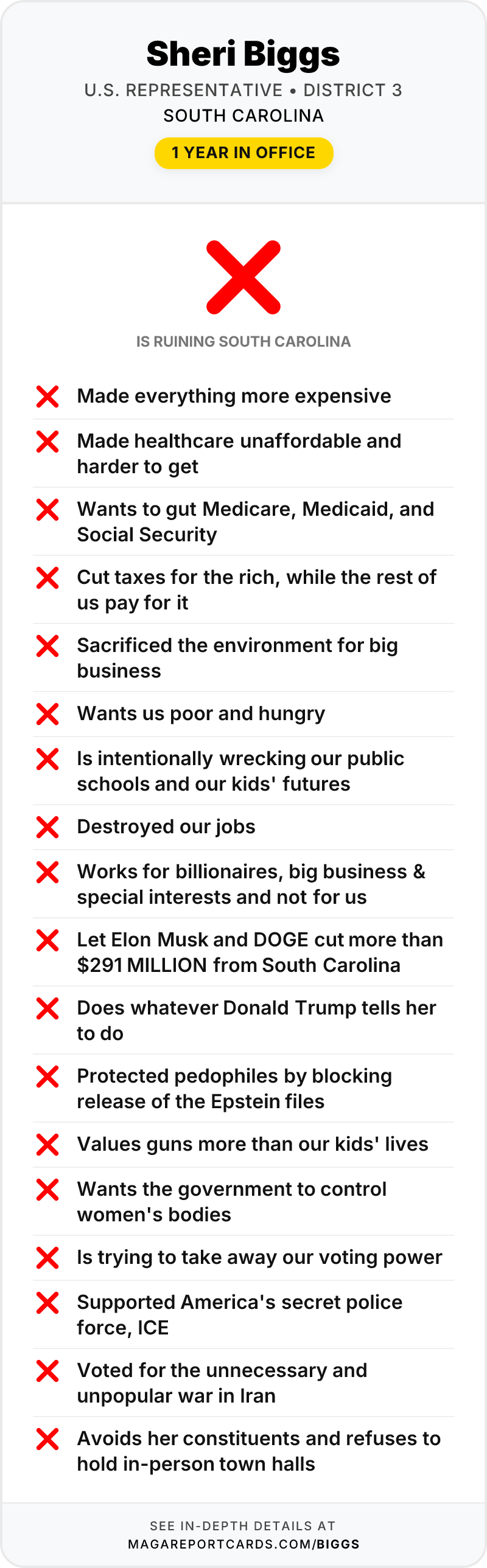
That is a system where the only voters a member has to worry about are the ones who already agree with her. It is also a system in which a member never has much reason to hold an in-person town hall. Biggs takes constituent questions by telephone — her first such call ran about 50 minutes, with an estimated 30,000 people on the line.
The map she wanted would have made that the whole state's arrangement.
Source
Kelby Vera, "Rep. Says South Carolina 'Values' Should Mean 0 Dem Seats," HuffPost, May 28, 2026. Photo: official congressional portrait via Wikimedia Commons.