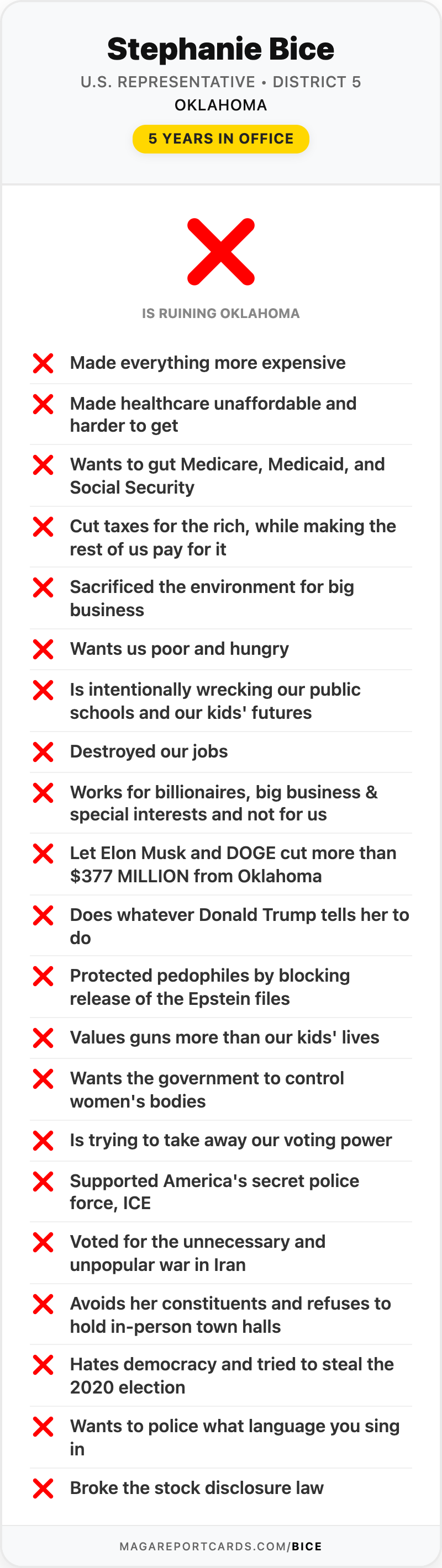
There is a subcommittee in the U.S. House whose job is figuring out how members of Congress should talk to the people who elected them. It is called the Subcommittee on Modernization and Innovation, and Stephanie Bice is its chairwoman.
Right now, through the end of this month, that subcommittee is asking the public for ideas. The August 3 announcement says Bice and Ranking Member Norma Torres are "seeking actionable ideas to modernize how the House and the Legislative Branch, generally, work on behalf of the American People," and are "particularly interested in bold, creative ideas." Submissions close August 31.
Here's a bold, creative idea for the chairwoman: stand in a room in Oklahoma City and answer questions from the people who live there.
She has been asked that, on the record. Her answer was that the phone reaches more people.
What she told a constituent who asked
On a telephone town hall in late July 2025, a caller got through — by the caller's own account, only by pretending to ask about something else — and put it to her directly. Oklahoma Watch's Em Luetkemeyer reported the exchange:
"Without dodging my question or giving me the okey doke, can you tell me why you are not holding in-person town halls, where you can look your constituents in the face, eye-to-eye, and answer tough questions?"
"These town halls, telephone town halls, are a joke, and are screened, carefully screened. I had to pretend to be asking another question. I would have never gotten this question in."
Bice did not say she would consider it. She defended the phone line, and the reason she led with was arithmetic:
"Let me make this very clear: I can reach several thousand constituents when I dial out for these telephone town halls. I am never going to get that kind of engagement if I'm doing in-person town halls. I am lucky to get a couple hundred, and that's on a great day," Bice said. "I do not dodge my constituents."
She said it was her 30th telephone town hall, and, later in the call: "I do these because they are effective, and I will continue to do them."
Note the argument. It is a volume argument: thousands beats hundreds, so the format that reaches thousands wins. She offered two more reasons on that call — that the phone lets committee chairmen dial in to help answer questions, and that seniors can listen from home instead of driving somewhere on a winter night. Not one of the three is a reason she cannot also stand in a room.
Her own witness testified that the volume argument is wrong
On December 17, 2025, Bice gaveled in a hearing in room 1310 of the Longworth Building. Its title: "The Future of Constituent Engagement with Congress."
In her opening statement, she said this:
"Communicating with our constituents is absolutely essential for doing our jobs, the jobs we were elected to do. Assisting with casework, responding to questions, and explaining our positions on the issues of the day requires interacting with our constituents in effective and meaningful ways."
And this:
"Rather than assume that they will read our letters and emails, we should figure out how to meet our constituents where they are at today, tomorrow, and into the future."
Then she introduced her first witness. She read his credentials into the record herself: Dr. Michael Neblo of Ohio State University, who — in her own words from the dais — "has designed 'Deliberative Town Halls' for the U.S. Congress, the Chilean Constitutional Convention, and the Australian, Nigerian, and U.K. legislatures."
Neblo's testimony was about exactly the thing Bice had told a caller, months earlier, was not worth her time. He told her subcommittee that at best only one in five constituents contacted their member last year, that just 13% of citizens trust Congress, and that the silence isn't apathy:
"They are frustrated because they believe Congress does not care what people like them think and only listens to organized interests and party activists, so they see no reason to engage."
Then the numbers that answer Bice's volume argument directly. Only 9% of surveyed citizens said they wouldn't engage if invited to a forum they believed was authentic and consequential. When his team runs deliberative town halls, he testified, "previously disengaged citizens prepare, show up, and contribute more than those who already call your office," and 94% call the experience "very valuable for our democracy."
And on which channels people actually respect:
"Citizens rated such forums as the most legitimate and effective way to communicate. Mass emails and social media scored lower."
Neblo also drew the distinction that sits at the center of this whole story:
"Lobbyists might be clients of Congress, but citizens want to be partners in self-government."
That went into the record of Bice's own hearing, from the witness she invited. Then she went back to dialing out.
Four months later, she got money for it
On April 17, 2026, Bice and Torres announced that funding had been approved for a "first-of-its-kind Constituent Engagement Innovation Project" — a plan to let members pick from a wider range of vendors for the software that handles constituent mail.
Bice's quote in the release:
"This project represents a major breakthrough in improving how lawmakers engage with constituents. Having easy access to the latest tools and services for connecting with constituents can dramatically improve our district outreach efforts and ensure we are engaging constituents where they are."
Where her constituents are is Oklahoma City. A software procurement reform is a fine thing to do. It is not a substitute for being in the room, and Neblo told her committee why: an office can have "stellar customer service and constituents will still find that problematic," because "citizens want to be partners in self-government," not customers.
The one in-person event she scheduled was in the wrong district
A few weeks after that phone call, an in-person "Coffee with Congresswoman Bice" turned up on the calendar for September 26, hosted by the WesTen District.
Her Democratic opponent, 2020 Oklahoma Teacher of the Year Jena Nelson, posted a map. As Raw Story reported, the venue was outside Oklahoma's 5th District.
"Well, folks, I was going to acknowledge that my opponent finally scheduled an in-person forum event in CD-5 after four long years, but it turns out the venue isn't even in CD-5," Nelson wrote. "Apparently, she can't remember what she gerrymandered out of her own district."
The event came off the host's website. Nelson later posted an email from the venue: "WesTen District has cancelled the September 26 Coffee with Congresswoman Bice due to scheduling conflicts."
By Nelson's count, that was the first in-person forum Bice had put on the calendar in four years. It was in the wrong district, and then it was gone.
Why this is worse than an ordinary dodge
Plenty of members hide from their constituents. We've written about Jim Baird, who skipped the town hall 250 people held for him, and about Kevin Hern, whose office wouldn't say where he was while he toured a foreign mega-prison. Bice's colleagues in Oklahoma are not a high bar.
What makes Bice different is the gavel. She is not a backbencher avoiding a hard room. She holds the chair of the one subcommittee in the House whose stated purpose is improving how Congress connects with the American people. She convened the hearing. She picked the witness. She wrote the press release about engaging constituents "where they are." She is, this month, publicly inviting the country to send her ideas about it.
And the answer she has already given to the most basic idea anyone could send her — look your constituents in the face — is that the numbers are better on the phone.
What Oklahomans wanted to ask about
It's worth remembering what the questions were. That July 2025 call was mostly about the budget bill Republicans had just passed. Oklahoma hospital leaders were warning it could cut federal reimbursements to Oklahoma hospitals by $8.7 billion over the next decade and eliminate nearly 15,000 jobs. Oklahoma Watch reported the same bill put 131,000 Oklahomans at risk of losing SNAP benefits.
Those are the questions the caller said had to be disguised to get asked at all. Meanwhile Bice's other signature project has been a resolution declaring the national anthem should only be sung in English, which has sat untouched in committee for over a year.
We deserve a representative who will stand in a room in her own district and take the question she doesn't want.
Sources
The Subcommittee on Modernization and Innovation Seeks Input on the Future of Congressional Modernization, Committee on House Administration, August 3, 2026; the official transcript of the December 17, 2025 hearing "The Future of Constituent Engagement with Congress"; and Em Luetkemeyer's reporting for Oklahoma Watch, published by KOSU on August 4, 2025. Photo: official congressional portrait.