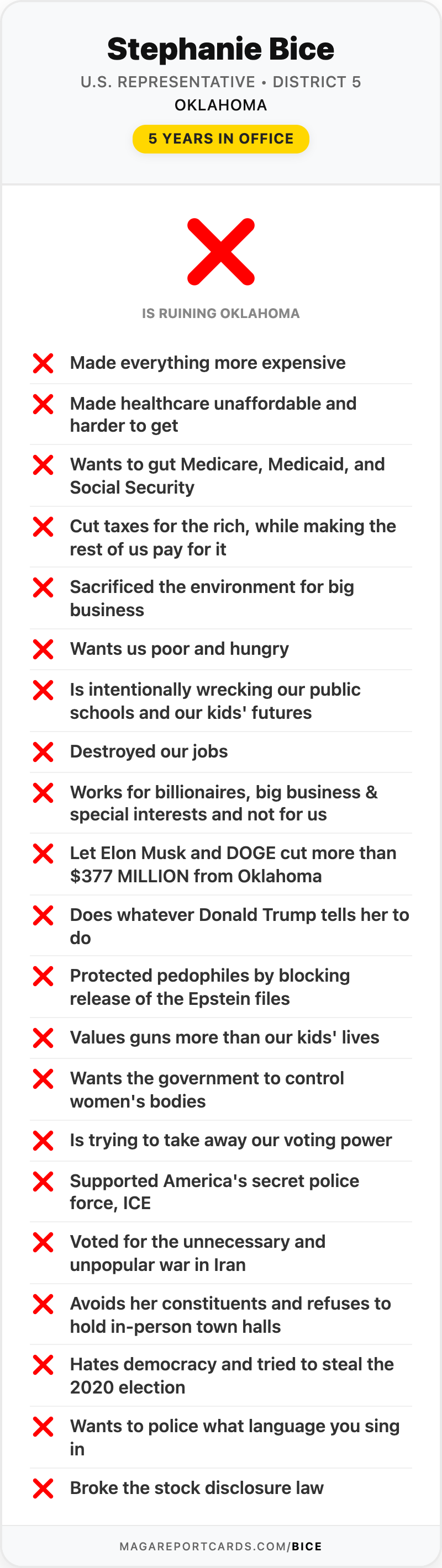
Stephanie Bice was among the first members of Congress to openly support Donald Trump's war with Iran. Seven months in, she has told a room of students she doesn't agree with how he's fighting it.
She hasn't told the House. There, she keeps voting to let it go on.
What she said in private
On August 27, 2026, Bice spoke to a gathering of Republican students at Oklahoma State University. The Oklahoman obtained a recording, and on September 29 it reported what she said: the congresswoman who was "among the first in Congress to openly support the Iran War, now says she doesn't agree with President Donald Trump's strategy in the seven-month conflict."
According to the recording, as quoted by the Democratic group American Bridge, Bice told the students:
"What I worry about is that we're falling behind and we don't have the right strategy."
And:
"I think we waited much too long."
That second line was a complaint that the war came too late, not that it started at all: she said she supported the military action and that the U.S. "waited about eight to 10 weeks" while Iranian protesters were being beaten and killed. Asked by The Oklahoman about the recording, she said in a statement, "Now that we've crippled the regime, we need to end the conflict and focus on lowering prices at the pump."
This is the same talk where, as we reported earlier this month, Bice said Trump renaming Lake Ontario "does not help the case" and repeated a Republican executive's complaint of "Trump fatigue." At the time, only those remarks had come out. The Iran comments are new.
What she did in public
The House has voted six times this year on resolutions ordering U.S. forces out of the war with Iran. Stephanie Bice voted no on every one of them:
| Date | Resolution | Result | Bice |
|---|---|---|---|
| March 5 | H.Con.Res. 38 | Failed | No |
| April 16 | H.Con.Res. 40 | Failed | No |
| May 14 | H.Con.Res. 75 | Failed | No |
| June 3 | H.Con.Res. 86 | Passed | No |
| July 23 | H.Con.Res. 89 | Passed | No |
| September 15 | H.Con.Res. 93 | Passed | No |
Two of those failed by a hair. In April, the resolution lost 213 to 214. In May, it tied 212 to 212, and a tie fails. Either one needed exactly one Republican to switch. Bice could have been that vote. Both times she voted no.
The last vote is the one that matters most here. On September 15 — nineteen days after she told Oklahoma State students "we don't have the right strategy" — Bice voted against ending the war again. The House passed that resolution anyway, 220 to 204, the third time since June it has told the president to stop. The same day, the Congressional Budget Office put the war's direct cost at $38.1 billion through August 1.
Both things can't be true
If Bice thinks Trump doesn't have the right strategy and the country is "falling behind," she has a vote. The whole point of the war powers resolutions is that Congress, not the president, decides whether the country stays at war. A member who believes the strategy is wrong can say so where it counts.
Bice chose to say it in a room of college Republicans, off camera, and to vote the other way on the House floor. Her public line, once the recording came out, was that the conflict should end — not that the strategy was wrong. The only reason voters in Oklahoma's 5th District know she thinks that is that someone recorded it.
She isn't the only Republican on our roster whose words about this war have moved faster than their votes. Ashley Hinson and Mike Rogers (MI), Jon Husted, Andy Biggs and Mike Johnson, and John James and Tom Tiffany have all said it should end — and the ones who had a vote used it to keep it going.
The bottom line
Stephanie Bice was among the first in Congress to back Trump's war with Iran. On August 27 she told Republican students at Oklahoma State that "we don't have the right strategy" and "we waited much too long" — meaning the attacks should have started sooner — in audio obtained by The Oklahoman. Asked about it, she said the conflict should end. She has voted against all six House resolutions to end the war this year — including two that fell one vote short, and one on September 15, nineteen days after that talk.