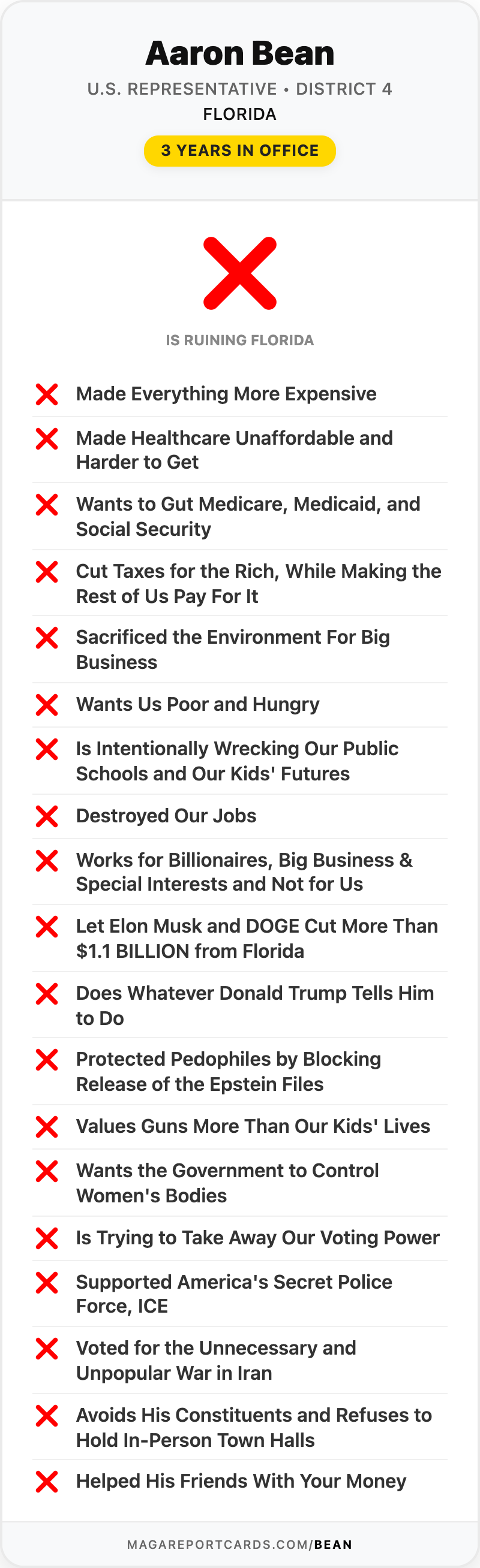
On April 15, 2026, Aaron Bean dropped a bill in the House with a name that tells you exactly what it does: the Abolish the CMMI Act.
It is two sentences long.
SEC. 2. The Center for Medicare and Medicaid Innovation is hereby abolished.
SEC. 3. Section 1115A of the Social Security Act (42 U.S.C. 1315a) is hereby repealed.
That's the whole bill. No replacement. No transition. No plan for the programs currently running inside it. Just: abolished, repealed.
Four months later, H.R. 8293 has zero cosponsors. Not one other House Republican put their name on it. It was referred to two committees on the day it was introduced, and nothing has happened since.
What Bean is actually trying to abolish
The Center for Medicare and Medicaid Innovation — everyone calls it the Innovation Center, or CMMI — is the office inside Medicare that tests new ways to pay for and deliver care. It was created by the Affordable Care Act in 2010, which is the part Bean cares about. But what it does day to day is unglamorous and specific.
According to the Government Accountability Office's March 2026 report, the Innovation Center had 24 models actively being tested as of January 2025. Bean's bill repeals the statute they all run under. Among them:
- The GUIDE dementia program. CMS launched it on July 1, 2024 as a nationwide test running eight years. It pays for care navigation, a 24/7 support line, caregiver training — and up to $2,500 a year in respite care so an unpaid family caregiver can get a break. CMS's own description of the problem is blunt: family caregivers "bear significant mental, physical, emotional, and financial burdens."
- The Medicare Diabetes Prevention Program, which pays for coaching for people with prediabetes.
- The expanded Home Health Value-Based Purchasing Model, which covers about 12,000 home health agencies and pays them more when patients stay out of the hospital.
- Bundled payments, kidney care, oncology care, and rural hospital models — the whole portfolio.
Section 1115A is the legal authority for every one of them. Repeal it and they don't get reformed. They stop.
The programs that worked die too
Here is the part Bean's press release leaves out.
The GAO report his allies keep citing found that four of the 70 models the Innovation Center has tested cleared the very high legal bar for being rolled out nationwide. To clear it, Medicare's Chief Actuary has to certify the model will reduce federal spending — and CMS has to determine it won't cut anyone's coverage or benefits. All four cleared it. GAO's words: "These four models achieved net savings during the testing period."
What they saved, per GAO's own table:
| Model | Savings |
|---|---|
| Home Health Value-Based Purchasing (2016–2020) | $949 million in Medicare savings |
| Prior authorization for repeat non-emergency ambulance rides (2014–2020) | $1 billion over 5 years |
| Pioneer Accountable Care Organization Model (2012–2016) | $384 million in the first 2 years |
| Medicare Diabetes Prevention Program (2012–2015) | $2,650 saved per person in the first 15 months |
Two of those four are still operating inside the Innovation Center today. Bean's bill abolishes the center they live in.
GAO also noted something Bean's press release skips entirely: beyond the four full expansions, the Innovation Center "has also incorporated elements into Medicare and tested successor models that iterate upon previous concepts." The Pioneer ACO didn't just end — its pieces were folded into the Medicare Shared Savings Program, which is now how millions of people on Medicare get their care coordinated. Bean counts that as a failure.
Bean's numbers are real. His conclusion doesn't follow.
To be fair to him, the figures in his press release are not made up. The Congressional Budget Office did project $2.8 billion in savings for 2011–2020 and the center instead increased federal spending by $5.4 billion. GAO found the center obligated $11.4 billion from 2011 through 2024.
But GAO also found that annual spending "peaked at $1.3 billion in fiscal year 2015 and have since decreased by nearly 40 percent to $789 million in fiscal year 2024." The trend Bean is describing as runaway waste has been shrinking for a decade. And GAO made no recommendations — it laid out the numbers for Congress and stopped there. It did not recommend abolishing anything.
Bean's own framing gives away that the numbers aren't really the point:
"It's time that we fight back against the bloated federal government and eliminate agencies that should never have been established in the first place."
"Should never have been established in the first place" is not a finding about cost-effectiveness. It's a position about the Affordable Care Act, which is where this center came from, and it's the same position Bean has held since long before any of these numbers existed. Back in 2013, as a Florida state senator, his health care plan would have rejected $51 billion in federal money offered to Florida over the following decade rather than expand Medicaid under that law.
Trump's own health agency is building on the thing Bean wants destroyed
This is the strangest part.
In May 2025, the Trump administration's own Innovation Center director, Abe Sutton, published the agency's new strategy: "CMS Innovation Center Strategy to Make America Healthy Again." It opens by saying the Innovation Center "has played a critical role in advancing a policy agenda that helps Americans live healthier lives," and lays out three pillars for its future work: promote evidence-based prevention, empower people to achieve their health goals, and drive choice and competition.
That document is the vehicle for a big piece of this administration's health agenda — prevention, drug pricing, Medicare Advantage testing, state partnerships. It is being run out of the office Bean introduced a bill to abolish, eleven months later.
Florida has more to lose here than most
Bean represents Florida's 4th District — Nassau County, Clay County, and part of Jacksonville. Florida is one of the oldest states in the country, and the dementia numbers show it. According to the Alzheimer's Association, there are 579,900 people living with Alzheimer's in Florida and 877,000 Floridians providing unpaid care for someone with dementia.
The GUIDE program's $2,500 respite benefit exists for exactly those 877,000 people. It is one of the few things Medicare does that helps the caregiver rather than only the patient. Bean's bill deletes the legal authority it runs on and offers nothing in its place.
He sits on the Ways and Means Committee — one of the two committees his own bill was referred to, and one of the two panels in the House with jurisdiction over Medicare. He is not a backbencher shouting from the sidelines on this. He is on the committee that would have to move it. It hasn't moved.
A pattern, not an accident
A two-sentence bill with no replacement, no cosponsors, and no committee action isn't legislating. It's a press release with a bill number attached — and we've seen it before. Bruce Westerman has now filed the same health care bill five times without ever picking up a single cosponsor.
The difference is what happens if this one ever did move. Bean is not proposing to fix the Innovation Center, audit it, cap it, or narrow its authority. He is proposing to delete the section of law that keeps the dementia caregiver program, the diabetes prevention program, and roughly two dozen other Medicare experiments alive — including the handful that Medicare's own actuary certified would save taxpayers money.
Bean also voted with his party to let the health insurance tax credits expire and spike premiums. And when constituents organized their own town halls in Fernandina Beach in 2025 to ask him about health care and federal cuts, he announced he "will not be attending any of the fake 'town hall' meetings" — even though the organizer said they were open to anyone.
He'll file a bill to abolish the office that pays for your mother's respite care. He just won't stand in a room and explain why.
Source
Aaron Bean Wants to Abolish Center for Medicare and Medicaid Innovation — The Floridian, April 20, 2026. Photo: The Floridian.