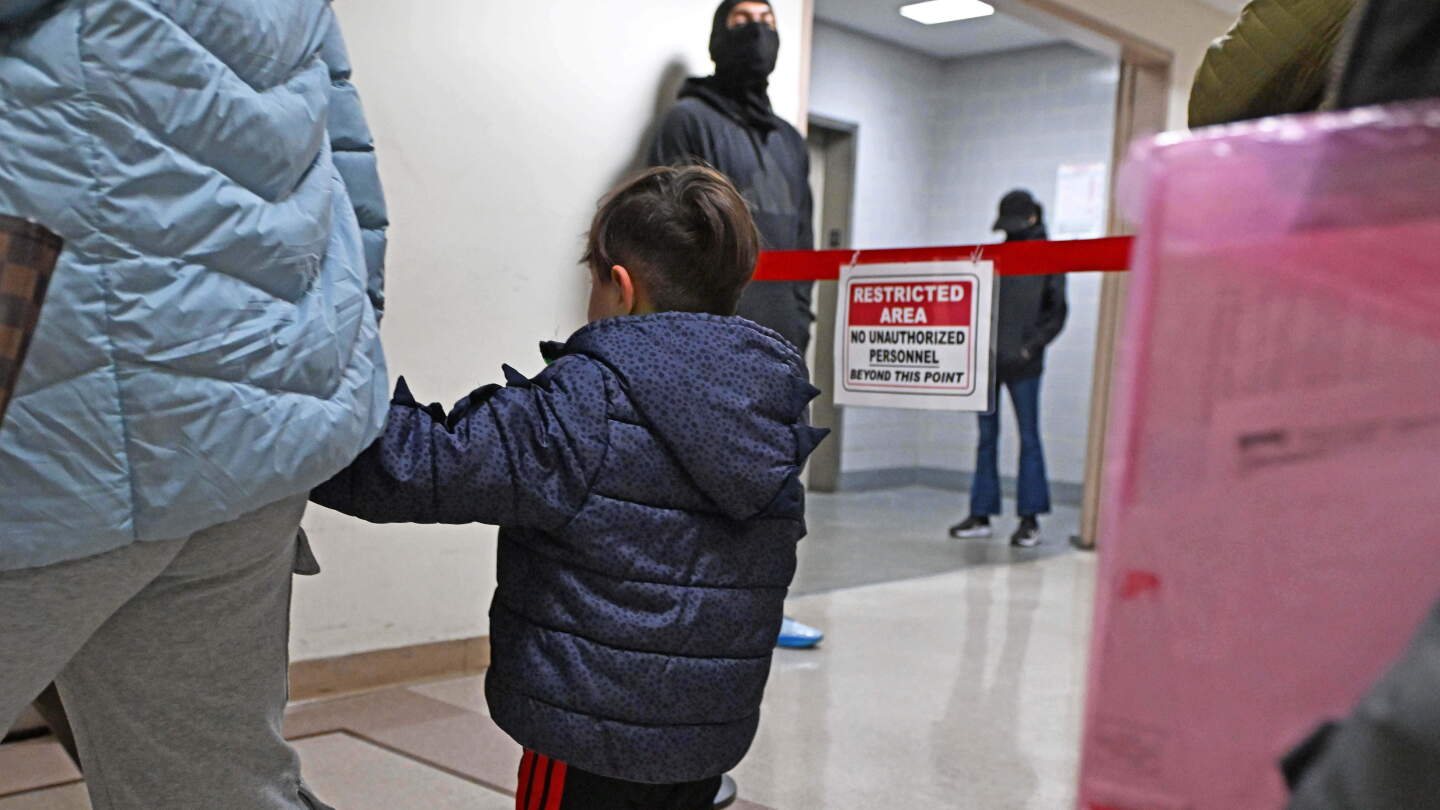
This week in an immigration courtroom in Arizona, a 1-year-old baby appeared with nobody to represent them. The judge gave the baby an instruction: file an asylum application before the next hearing, or face deportation.
There was a lawyer in the room. Just not the baby's.
The attorney worked for the U.S. Committee for Refugees and Immigrants, one of the organizations the Trump administration had just paid to represent children exactly like this one — but had never taken the baby's case, and, according to court filings made Thursday, said nothing while it happened.
That gap is the whole complaint. An attorney shows up and covers the hearing. The child is still, in the law's eyes, standing there alone.
"The USCRI attorney did not speak up — let alone suggest that it is facially absurd to ask an unrepresented baby to do anything — despite knowing the baby would be ordered deported if unable to file the complicated application by the next hearing."
That's from a filing in the ongoing lawsuit between a network of legal nonprofits and the federal government, first reported by NOTUS.
Consider what was actually being asked for. The asylum form runs 12 pages, and comes with another 12 pages of instructions explaining how to fill it out. It asks you to explain in writing who harmed you, or who you fear will, and why you cannot safely go home.
The person ordered to produce one is a year old.
How a baby ended up alone in a courtroom
For years, one contract held this system together. The Acacia Center for Justice passed federal money to nearly 100 legal organizations around the country, which together represented more than 24,000 children — kids with no lawful immigration status and no parent or legal guardian in this country able to care for them.
That contract ended July 31. Nothing durable replaced it.
We wrote about this in July, while it was still a warning rather than a courtroom scene. The administration had stopped paying the legal nonprofits — NPR reports the payments stopped back in November, after the lawyers refused to hand over confidential information about their child clients. The groups said that information was protected by attorney-client privilege. So they didn't apply for a new contract.
The lawyers kept showing up anyway. Michael Lukens, who runs the Amica Center for Immigrant Rights, told NPR his organization and others are still representing their young clients without being paid, because he says it is the only way to keep those children's representation from breaking off mid-case.
Now the nonprofits have gone back to court and asked a judge to look at whether the government is actually obeying the law. Their filing does not mince words. The administration, they wrote, has spent the weeks since the contract lapsed
"purporting to enter into multiple cooperative agreements to create a façade of compliance with the law and this Court's order, but the result is chaos that has forced countless children to face their immigration court proceedings alone."
This isn't a policy preference. It's written into the law.
Here is the part that should end the argument.
In 2008, Congress passed the William Wilberforce Trafficking Victims Protection Reauthorization Act, and Republican President George W. Bush signed it on December 23 of that year. Buried in it is a plain instruction to the Secretary of Health and Human Services. The Secretary "shall ensure, to the greatest extent practicable," that unaccompanied children have counsel to represent them in legal proceedings — specifically to "protect them from mistreatment, exploitation, and trafficking."
Read that last phrase again. Congress didn't give these kids lawyers as a favor. It gave them lawyers because a child alone in a legal system is exactly the child a trafficker finds.
Congress has appropriated money for that representation in the years since. And when the administration moved to cut the funding off, a federal court in Northern California ordered it to keep paying — an order still at the center of the case, Community Legal Services in East Palo Alto v. HHS.
So the law says do it. Congress funds it. A judge ordered it. And a 1-year-old was told to file their own asylum paperwork.
Who's getting the money instead
The administration did spend money. It just didn't spend it on the people who had been doing the work.
The U.S. Committee for Refugees and Immigrants — the group whose attorney sat silent in Arizona — got a $20 million contract. And in the first week of August, HHS handed $158 million to a Utah anti-trafficking group called Our Rescue. NPR reported that it was a no-bid contract, running six months from August 7 through February 6, 2027.
Our Rescue used to be called Operation Underground Railroad. It was founded by Tim Ballard, the man played by Jim Caviezel in the 2023 movie Sound of Freedom — a film heavily promoted in conservative media. Within months of its release, Ballard faced accusations of sexual exploitation. He has repeatedly denied them, and was quietly removed from the group.
Its CEO today is Derek Benner, who led Homeland Security Investigations — the investigative arm of ICE — during Trump's first term.
What Our Rescue is not known for is immigration law. NPR could not establish that it has immigration attorneys on staff at all. Lukens put it bluntly:
"HHS is trying to give a contract to a nonprofit that is highly problematic in their history and has no expertise in providing legal services to unaccompanied children. This all to me boils down to children are going to be harmed and that seems to be the point of a lot of these actions."
This was also the administration's second try. The day before, it had announced plans to give up to $150 million to Burke Law Group, a small Houston firm whose specialty is advising companies on environmental and regulatory matters. Only two of its 24 attorneys specialize in immigration and asylum. A co-founder served in the first Trump administration at Interior and the EPA; a founding partner currently holds a senior job at the EPA. After NPR and other outlets reported those ties, the firm withdrew.
What the government says
The Office of Refugee Resettlement says the silence in these courtrooms is a transition problem, not an abandonment. Its attorneys have to figure out which children still have lawyers before stepping in, a spokesperson told NOTUS: "This assessment remains ongoing because some [legal service provider] transitions appear unclear or incomplete."
An ORR official, Richard Debaney, told the court last week that attorneys had covered every hearing for the 1,800 children in the office's care, and that "appearances have proceeded without complications."
Two things about that. First, "without complications" is a strange way to describe a baby being told to file for asylum. Second, 1,800 is only the number of children in government custody. About 24,000 are classified as unaccompanied. The rest have been released to sponsors, usually family members — and they still have hearings, and they still face a government attorney whose job is to deport them.
What happens to a kid without a lawyer
This is not a paperwork problem. It decides outcomes.
The most detailed public analysis of this comes from TRAC, a research group that analyzes federal immigration court records. It looked at children's cases filed and decided between 2012 and 2014. Among kids who had an attorney, 73% were allowed to remain in the United States and 12% were ordered removed. Among kids who didn't, 15% were allowed to remain and 80% were ordered removed.
A lawyer is the difference between mostly staying and mostly going. Everybody involved knows that, which is why Congress wrote the requirement down in the first place.
And the courtroom these children walk into now is faster and harsher than the one in that study. A ProPublica investigation this summer found unaccompanied kids being detained and deported at about three times the rate of Trump's first term — including an 8-year-old girl ordered deported even though her own mother had already won asylum.
The money was never the problem
Congress is not short of cash for immigration. In June it put $70 billion into ICE and border enforcement, passing the House by two votes with not a single Republican voting no. That money bought agents, vehicles, surveillance towers, and agreements that deputize local police for immigration enforcement — and it has been very good business for the private prison companies holding people in them.
The government lawyer standing across the courtroom from that 1-year-old is fully funded through September 2029.
The comparatively tiny sum that pays for the child's side of the room is the part that got held up, argued over, and handed to an anti-trafficking group that may not employ a single immigration lawyer.
That is a choice, and it's worth being honest about what kind. When you can't repeal a law — and nobody has repealed this one — you can still starve it. Let the contract lapse. Sign new ones with people who don't do the work. Call the wreckage a transition. The law stays on the books, and the kid stands up alone anyway.
A year-old baby cannot file an asylum application. Everyone in that Arizona courtroom knew it — including the one lawyer standing there on the government's dime. Saying so out loud was not, apparently, part of the contract.
Source
This post is based on reporting by Jackie Llanos for NOTUS, with additional reporting by Sergio Martínez-Beltrán for NPR.


