In March 2026, Mark Alford went on Missourinet to talk about a hospital in Bates County, Missouri — a rural county in his district.
"They have just a few days' cash on hand, and they have other issues that we're trying to work through."
He had a bill for it, he said. And he explained why it mattered:
"It's very important that we keep our rural hospitals open for business."
He is right that it's important. He is the reason it's harder.
What he voted for first
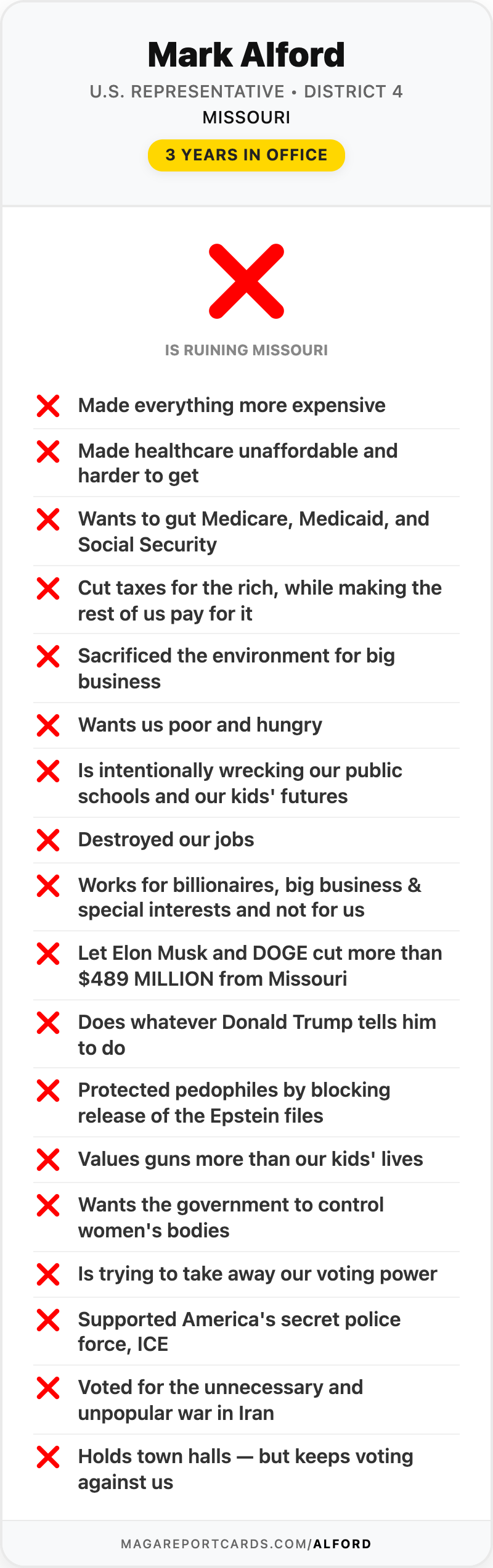
On July 3, 2025, the House passed H.R. 1 — the budget bill Republicans called the One Big Beautiful Bill Act. The Clerk of the House records the vote. Alford voted Aye.
That law cuts Medicaid spending by more than $900 billion over ten years, according to KFF Health News.
In Alford's own district, the Joint Economic Committee puts the combined Medicaid and Affordable Care Act coverage losses at 27,243 people in MO-4 — 14,043 losing Medicaid, which is the law he voted for, and 13,200 losing Affordable Care Act coverage.
Here's the part that connects the two halves of this story. When somebody loses Medicaid, they don't stop getting sick. They show up at the emergency room without insurance, and the hospital eats the cost. That is precisely how a small rural hospital ends up with a few days' cash on hand.
Alford voted for the thing that empties the hospital's bank account. Then he went looking for a way to keep it open.
The rescue bill
On February 26, 2026 — nearly eight months after that vote — Alford introduced H.R. 7727, the Sustaining Rural Healthcare Act.
The idea is narrow and, on its own terms, reasonable. Right now a hospital can't be designated a "critical access hospital" — which unlocks better Medicare reimbursement — if it sits within 35 miles of the next nearest hospital. Alford's bill would let the government make exceptions.
"Right now, the law is that you cannot be deemed a critical access hospital if you're within 35 miles from the next nearest hospital," he told Missourinet. "It will do it based on the hardship and not just the mileage, but the travel and the hardship of getting to this hospital."
Missouri has 58 designated rural hospitals, by Alford's own count in that interview. Ten full-service rural hospitals in the state have closed in the last twelve years, according to the Cecil G. Sheps Center at the University of North Carolina.
So how is the bill doing?
It has three cosponsors — Glenn Thompson of Pennsylvania, Jill Tokuda of Hawaii, and Henry Cuellar of Texas. It was referred to the Ways and Means Committee on the day it was introduced, and Congress.gov shows no action since. No hearing. No markup. Nothing, for five and a half months, under a Republican House.
A $900 billion cut passed in a day. The patch has been sitting in a drawer since February.
"But the law had a rural fund"
It did. H.R. 1 created a $50 billion Rural Health Transformation Program, spread over five years, and Republicans pointed to it constantly while the bill was moving.
Do the arithmetic: $50 billion over five years against more than $900 billion in Medicaid cuts over ten. It is not a replacement. It's a fraction.
And the money doesn't necessarily reach hospitals. In Michigan, the state hospital association expects less than 10% of the state's $173 million first-year rural health allocation to actually go to rural hospitals — against $6 billion in Medicaid losses over the decade.
Nationally, more than 40% of rural hospitals are already operating in the red.
This is a pattern, not an accident
Alford is not the only Republican doing this. Sen. Shelley Moore Capito of West Virginia cast one of the 50 votes that passed the same bill in the Senate, then signed on to rural-hospital rescue legislation a year later, saying that "far too many hospitals are facing challenges that threaten their ability to maintain operations."
Alford is also one of the 197 Republicans who voted to let Affordable Care Act premiums spike — the other half of the 27,243 people in MO-4 losing coverage.
The rural hospital bill is real legislation, and it might help a hospital or two if it ever passed. But it is not a defense. A member of Congress who cared about that Bates County hospital's cash position had a much more direct way to protect it, and it was available to him on July 3, 2025.
He'll be in the room
Alford is one of the few Republicans who still holds real town halls — 15 stops in four days last August, including one where more than 100 people packed a Lions Club hall in Harrisburg and pressed him for more than two hours, Medicaid cuts high on the list.
He won his August 4 primary and faces Democrat Jordan Herrera in November. So there will be more rooms, and the question is short:
You voted for the $900 billion cut. Why should anyone believe the three-cosponsor bill is the real you?
Sources
"Missouri's Mark Alford Pushes Fix To Give Rural Hospitals 'Financial Lifeline'" — Missourinet, March 10, 2026.
Sarah Jane Tribble and Tony Leys, "Earlier Lifeline for Rural Hospitals Faces Test Under 'Big Beautiful' Law" — KFF Health News, August 3, 2026.
Roll Call 190, July 3, 2025 — U.S. House Clerk. H.R. 7727 — Congress.gov. Photo: U.S. House of Representatives.