On June 12, 2025, the House voted 214–212 to claw back $9.4 billion Congress had already approved — more than $8 billion from foreign aid programs and $1.1 billion from public broadcasting. Adrian Smith voted yes. He'd telegraphed his support for days, and afterward he called it another "step toward fiscal responsibility."
Before that vote, Nebraska Public Media had told anyone who would listen exactly what the cut would cost. The organization runs most of the public TV and radio stations in the state. It stood to lose about $4 million a year — up to 16% of its entire budget. And it warned that the loss "could put essential services, including emergency alert systems, at risk."
Smith represents Nebraska's 3rd District: the rural three-quarters of the state, the part where those transmitters are often the signal you actually get. He voted for the cut anyway. Then he voted for it again on July 18, 2025, when the Senate's version came back to the House.
Eight months later, the prairie caught fire.
March 12, 2026
The Morrill Fire started that afternoon northeast of Bridgeport. Driven by high wind, low humidity and extreme drought, it raced east across the prairie and grew past 600,000 acres — the largest wildfire Nebraska has ever recorded. It burned through Morrill, Garden, Arthur, Keith and Grant counties. Three other big fires burned at the same time: the Cottonwood Fire in Lincoln and Dawson counties, the Road 203 Fire near Halsey in the Nebraska National Forest, and the Anderson Bridge Fire in Cherry County.
All of it is central and western Nebraska. All of it is Adrian Smith's district.
One person died. Gov. Jim Pillen confirmed it two days later at a briefing in Ogallala:
"One Nebraskan lost their life – Rose White. I won't go into the circumstances. Hurts a little bit, but a grandma that was trying to get away."
She was 86 years old, in Arthur County. In the same briefing, Pillen said what every emergency manager says after a fast fire: it is important that people heed evacuation warnings and orders from officials.
That only works if the warning reaches them.
Smith's own words
A week later, Smith wrote a column about the fires. He called it "the worst wildfire crisis Nebraska has ever experienced" — more than 826,000 acres, "destroying homes, infrastructure, and forcing families to evacuate with little notice."
He's right. That's what happened. Wind-driven grass fire moves faster than word of mouth, and in Morrill, Garden, Grant, Arthur and Keith counties there isn't much between you and the weather except a radio.
Which is the part of his own column Smith did not connect to his own voting card. Eight months before he wrote "evacuate with little notice," he voted to cut the budget of the organization that had just said in writing, the day before the vote, that the money at stake "underpins our statewide emergency communications."
What the money actually paid for
The rescissions package wiped out everything Congress had appropriated for the Corporation for Public Broadcasting for fiscal years 2026 and 2027. CPB — the nonprofit that had distributed that money since 1967 — announced two weeks later that it was shutting down.
Federal money is a small slice of what national outlets like NPR and PBS run on. That was never who it was for. It goes disproportionately to the small rural affiliates that a commercial market won't support, in places like the Nebraska Panhandle. Nebraska Public Media's general manager, Stacey Decker, put it this way after the vote:
"These aren't just numbers on a spreadsheet. Federal investment underpins the journalism we produce, the educational resources we share with children and families, the remarkable stories we tell about our state."
Nebraska Public Media also carries the state's severe-weather and emergency alerts, live-streams the Legislature, and covers state government daily. Losing 16% of your budget doesn't take one of those away cleanly. It takes a little out of all of them.
Who told Nebraska what was burning
Here's the detail that ought to settle the argument.
The report of Rose White's death — the one quoted above, the one that told the rest of the state a Nebraskan had been killed — was written by Jackie Ourada and Macy Byars of Nebraska Public Media News.
The newsroom that covered the worst fire in Nebraska history is the newsroom Adrian Smith voted twice to take $4 million a year away from.
It's not that public media was the only thing working. It wasn't. NOAA's satellite fire-detection system spotted the Morrill Fire at 1:40 p.m. Mountain Time that Thursday, and the county was alerted 13 minutes later — federal infrastructure, doing exactly the job it exists to do, on the day it mattered most. In Keith County alone, a local fire chief counted about 32 fire departments coming in on mutual aid to help the volunteer crews.
Nearly all of that is public. Nearly all of it is the kind of spending that gets called waste in a press release.
This is a pattern, not an accident
Smith is not the only Republican who defunded the emergency-information system in his own backyard and then watched a disaster roll through it. In Florida, Rep. Kat Cammack introduced the Defund NPR Act in February 2025 and voted for the same rescissions package in July — and WUFT in Gainesville, home of the Florida Public Radio Emergency Network, lost about 20% of its operating funds in hurricane country.
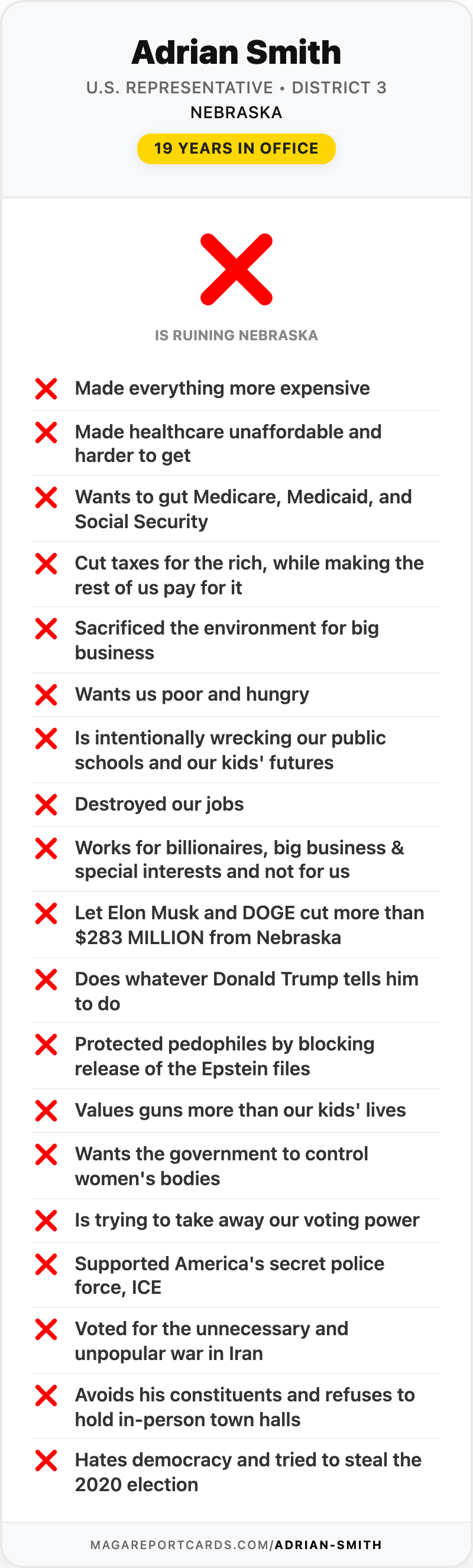
And Smith has a habit of describing federal spending as a burden right up until his district needs it. A year after the Republican tax law passed, he wrote an op-ed telling Nebraskans the tax cuts were "working for Nebraska" — while the same law stands to cost the state up to $4 billion in Medicaid over a decade and has already stripped food assistance. He has represented the 3rd District since 2007. Nineteen years is long enough to know what a $4 million hole does to a rural network.
We deserve better
Nobody is saying a public radio budget would have saved Rose White. We don't know that, and we're not going to pretend we do.
What we know is this. The people whose job is running Nebraska's emergency alerts said it in advance, in writing, and said it again the day before the second vote: cutting this money put those alerts at risk. Adrian Smith voted for the cut twice. Eight months later the largest fire in state history swept his district, a woman died trying to outrun it, and Smith wrote a column about families evacuating with little notice.
He called the vote a step toward fiscal responsibility. In the counties that burned, it's just less warning.
Sources
- Nebraska House GOP members vote to cut $9.4B federal funding from foreign aid, NPR, PBS — Nebraska Examiner, June 12, 2025.
- Governor says Nebraska grandmother died in Morrill Fire trying to escape — Nebraska Examiner / Nebraska Public Media News, March 14, 2026. Photo: Courtesy of the Governor's Office.