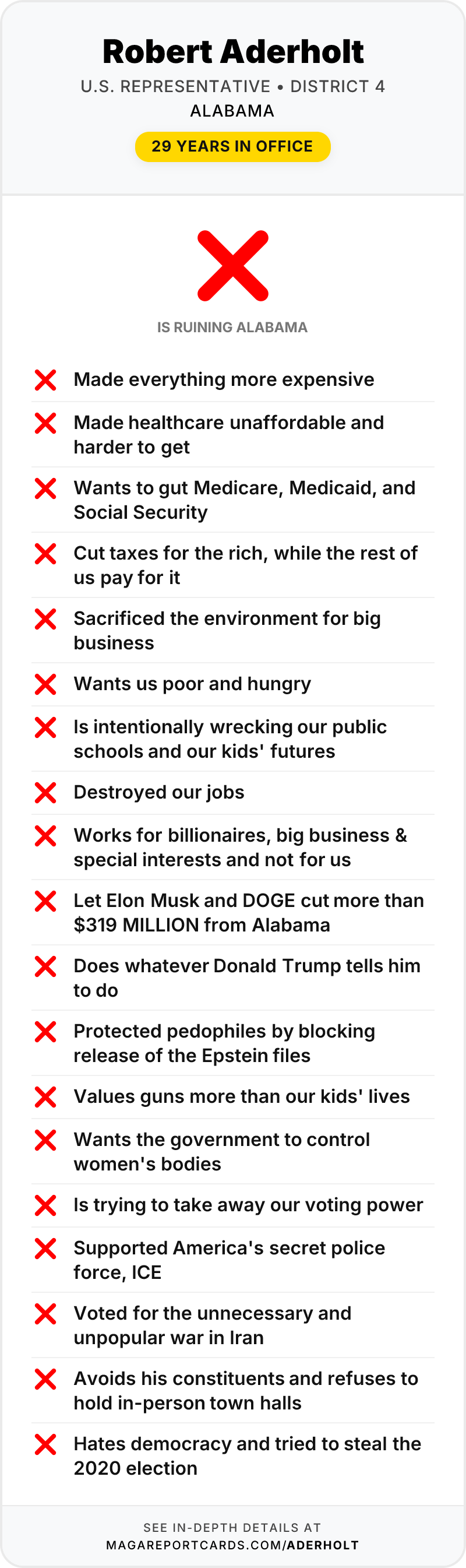
Most members of Congress vote on spending bills. Robert Aderholt writes one.
He chairs the House Appropriations Subcommittee on Labor, Health and Human Services, and Education — the panel that decides how much money goes to public schools, community health centers, medical research, worker training, and the agencies that enforce wage laws. It is one of the most powerful chairmanships in Congress, and he has spent 29 years in the House to get it.
In June 2026, his subcommittee advanced its bill for the coming year. The House Appropriations Committee approved it on a party-line vote, 34 to 28.
Aderholt described it this way:
"This bill advances educational opportunities, restores accountability and ensures taxpayer dollars are directed toward core functions like biomedical research, biodefense infrastructure and rural health."
Here is what is actually in it.
Adult and youth job training are not cut. They are deleted.
From the official summary of the bill prepared by the Appropriations Committee's Democrats:
- WIOA Adult Job Training — eliminated. A cut of $876 million.
- WIOA Youth Job Training — eliminated. A cut of $948 million.
- Senior Community Service Employment for Older Americans — eliminated. A cut of $395 million. That is the program that places low-income people over 55 into part-time community jobs.
- Job Corps cut in half — down $880 million.
- Workforce Innovation and Opportunity Act state grants cut by $1.8 billion, or 62 percent.
- The Employment and Training Administration overall: down $3.3 billion, or 32 percent.
- The entire Department of Labor down $3.7 billion — 27 percent below the prior year.
Worker protection agencies — the ones that investigate wage theft and unsafe workplaces — lose $240 million.
The schools
The Department of Education takes a $8.1 billion cut, 10 percent below the prior year. Inside that:
- Title I grants — the money that goes to schools serving low-income children — cut by $1.9 billion.
- English Language Acquisition — eliminated. $890 million gone.
- Title II-A, the teacher training grants — eliminated.
- Preschool Development Grants — eliminated. $315 million.
- Federal Supplemental Educational Opportunity Grants, which help the poorest college students, cut by $364 million.
And abstinence-only education gets a $5 million raise.
The health care
- $2 billion cancelled for operating Affordable Care Act insurance plans.
- The Agency for Healthcare Research and Quality — eliminated entirely. That's the federal agency that studies patient safety in hospitals.
- Nearly $1 billion terminated from the Patient Centered Outcomes Research Trust Fund.
- Major cuts to CDC HIV/AIDS prevention and the Ryan White program.
- Cuts to maternal and child health programs, and to programs providing contraception.
Committee Democrats put the total bill at $201.8 billion — $19.1 billion, or 9 percent, below the prior year. Republicans describe the discretionary allocation as $189.3 billion, a 3 percent cut. Either way, the direction is the same.
Then came the press releases
On June 16 — a week after the committee approved that bill — Aderholt's office announced that he had secured $35 million for Alabama hospitals and health centers, with $22.1 million going to four rural hospitals in his own district.
His explanation:
"One thing that I wanted to do is try to help local health centers and hospitals, especially in rural areas, to make sure they don't close and make sure that everybody has access, regardless of their zip code and regardless of where they live."
Regardless of your zip code.
The same bill that carries that $22 million eliminates the adult job training program, eliminates the youth job training program, eliminates the jobs program for low-income seniors, and takes $1.9 billion from schools that serve poor kids. Those cuts don't check zip codes either.
This is the appropriator's oldest trick, and Aderholt is running it from the chair. Write a bill that takes a great deal away from a lot of people quietly, put a line in it that gives a visible amount back to a few people loudly, and hold the press conference about the second part.
Alabama's 4th is not a district that can absorb this
Look at who lives there.
In AL-04, 36,500 households — about 13% of every household in the district — rely on SNAP to eat, including 17,377 households with children and 12,922 with someone 60 or older, according to USDA data. The Joint Economic Committee's House Democrats project that 23,527 people in his district will lose health coverage from Medicaid and Affordable Care Act cuts — 20,900 losing Affordable Care Act coverage and 2,627 losing Medicaid. He voted for the budget bill behind the Medicaid cuts.
This is a rural, low-income district in a state with some of the worst health and education outcomes in the country. We added up what Alabama's Republicans in Congress are costing the state.
A district like AL-04 is exactly who Title I is for. It is exactly who adult job training is for. It is exactly who the senior employment program is for. Aderholt did not lose a vote on those programs — he wrote the bill that ends them, and he chairs the subcommittee that could have written it differently.
Nobody gets to ask him about it
If you live in Alabama's 4th and you want to ask your congressman why the bill he wrote eliminates job training, you will have to find him first.
When constituents in Northport organized their own town hall in March 2025 and left an empty chair for him, he didn't come. He says he prefers "one-on-one" meetings at his district offices — private conversations, where nobody else hears the question or the answer.
He has represented this district since 1997. He is on the ballot again in November.
We deserve better.
Sources
- House panel approves $189 billion Labor-HHS-Education spending bill — Alabama Political Reporter, June 11, 2026.
- FY27 Labor, Health and Human Services, and Education bill summary — House Appropriations Committee Democrats.
- Aderholt secures $35 million for Alabama hospitals, steers $22 million to rural facilities — Sawyer Knowles, Yellowhammer News, June 16, 2026.