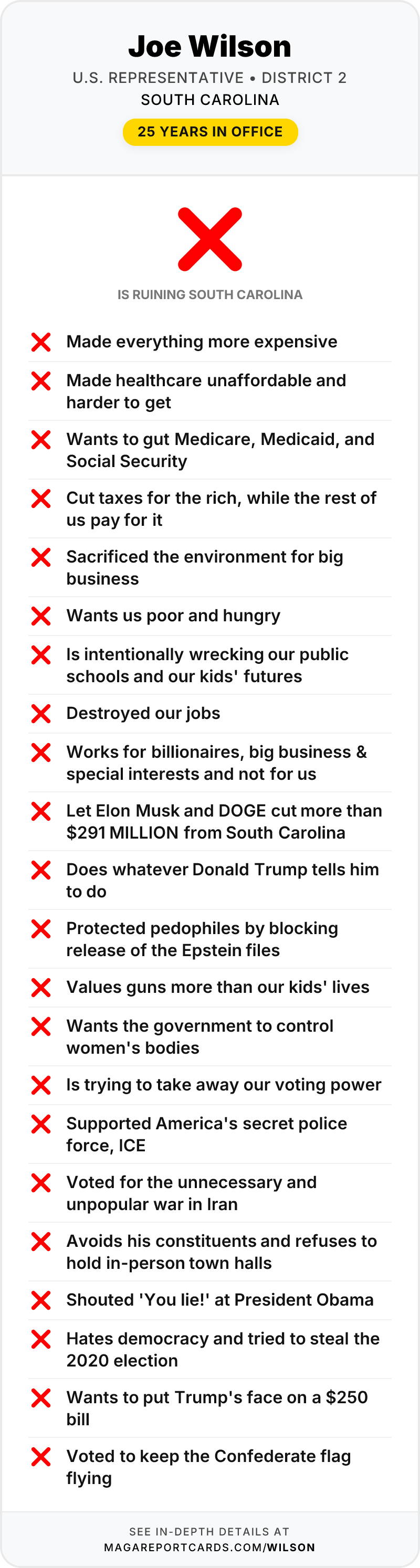
Joe Wilson has represented South Carolina's 2nd District since 2001. For years he has sat on the House Armed Services Committee, which decides how the Pentagon spends its money.
On Tuesday, ProPublica reported that a defense contractor's CEO told the FBI that Wilson was part of a cash-for-contracts deal. According to that account, Wilson "was very clear and knew what the ask was." He wanted as much in campaign money as the contractor was giving another South Carolina congressman, in exchange for his support.
FBI agents were looking into it. Then President Trump's FBI fired them, and the case died.
Who is Navatek, and what did its CEO say?
Navatek was a small Navy research contractor based in Hawaii. Its CEO, Martin Kao, wanted to turn it into a billion-dollar company fast. His method, he later admitted to federal agents, was to give campaign money to members of Congress in exchange for government contracts. A former executive told ProPublica the research Navatek sold the Navy "looked like a college senior's graduation project."
Kao is not a reliable witness on his own. He is serving an 87-month federal prison sentence for bank fraud and for bilking a COVID-19 relief program out of nearly $13 million. A judge also sentenced him to 33 months for illegal campaign donations to Sen. Susan Collins and a super PAC that backed her.
But ProPublica reports that the FBI agents who took his confession found that much of it lined up with records they had seized from Navatek. So they kept going.
In South Carolina, Kao told agents, Navatek had cash-for-contracts deals with three members of Congress: the late Sen. Lindsey Graham, Democratic Rep. James Clyburn, and Joe Wilson.
What happened with Wilson
According to ProPublica's reporting:
- In 2019, Navatek and the University of South Carolina asked Graham, Clyburn and Wilson to find $9.5 million for a Navy power research project. Congress passed it that December. Up to that point, Navatek's executives had given none of the three any campaign money.
- That changed within days. A Navatek executive pledged $750 to Wilson's campaign at a fundraiser at a Capitol Hill bar for lobbyists. In the weeks after, Kao and his lobbyist gave Wilson's campaign $3,500.
- Kao said he got a private lunch with Wilson by giving to his campaign. At that lunch, Kao told the FBI, Wilson asked for the same amount Clyburn was getting. Kao said Clyburn had asked for $100,000.
- By August 2020, company records show Navatek had heard that Wilson's committee would support part of its next funding request. Navatek had asked Congress for $20.5 million in total.
- Kao told agents he planned to give Wilson more money by the end of the year. He never got the chance. He was arrested on September 30, 2020.
Kao's lobbyist, a family friend of Wilson's, denied there was any "pay to play." He said he gave money because Wilson "is a friend and I want to see him re-elected." The FBI never formally named Wilson as a subject of its investigation, but ProPublica reports that agents were actively looking into his dealings with Kao and told their bosses that he and the other two lawmakers could become subjects later.
Wilson's office didn't answer the questions
ProPublica sent Wilson's office a detailed list of questions. His communications director didn't address any of them. Here is what he said instead:
"Congressman Wilson does and has always abided by campaign donation regulations set forth by the Federal Election Commission."
That isn't a denial. Nobody asked whether Wilson filled out his campaign finance forms correctly. The question is whether he promised his support on a defense budget committee in exchange for campaign money from a company that wanted that budget. Clyburn's office at least said a donation "would never cause" him to increase his support. Wilson's office wouldn't say even that much.
How Trump made sure no one would ever find out
By December 2024, the lead FBI agent, Michelle Ball, believed she had enough to move forward. In a memo, she wrote that the FBI had "uncovered a lengthy history" of a contractor making donations "in exchange for government contracts." She wrote whole sections about the three lawmakers. A Justice Department prosecutor had joined the case that summer, and the team talked about using undercover agents.
Then Trump took office. In May 2025, the FBI's Washington field office shut down the public corruption squad that had helped investigate Trump. According to ProPublica, FBI Director Kash Patel purged the office's anti-corruption unit. Ball was fired in October 2025. The other agent on the case was pushed out in early 2026. The prosecutor quit after Trump's appointees barred the Justice Department's anti-corruption section from bringing new cases.
ProPublica's verdict: "The case is dead." No one is left to check whether Kao was telling the truth about Joe Wilson.
This is the same contractor in the Susan Collins scandal
Navatek isn't new to this site. Last month we wrote about how Susan Collins steered millions to Navatek while its CEO funneled illegal money to her. That was part one of ProPublica's series. This is part two, and it shows the same pattern in South Carolina. A contractor with thin results gets federal money, and the lawmakers who wrote it into the budget get campaign checks.
Wilson's committee seat is exactly what a contractor like that wants. His own report card shows that the weapons makers whose budgets his committee writes are among his biggest funders, including Boeing ($34,000) and Honeywell ($34,000) since 2020.
What the record shows
A convicted defense contractor told the FBI that Joe Wilson asked for as much campaign money as Clyburn was getting, which Kao said was $100,000, in exchange for supporting the company's Navy funding. Wilson's campaign took $3,500 from the CEO and his lobbyist after Congress approved $9.5 million for the company's project. FBI agents were investigating that account when the Trump administration fired them and shut down the work. Wilson's office would not answer ProPublica's questions about any of it.