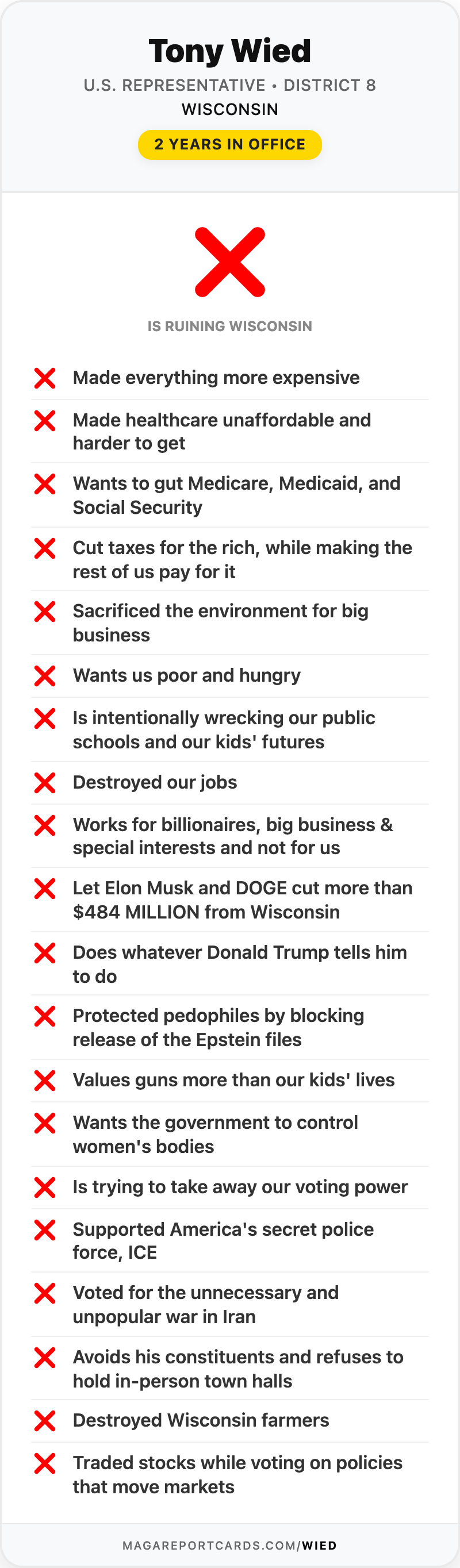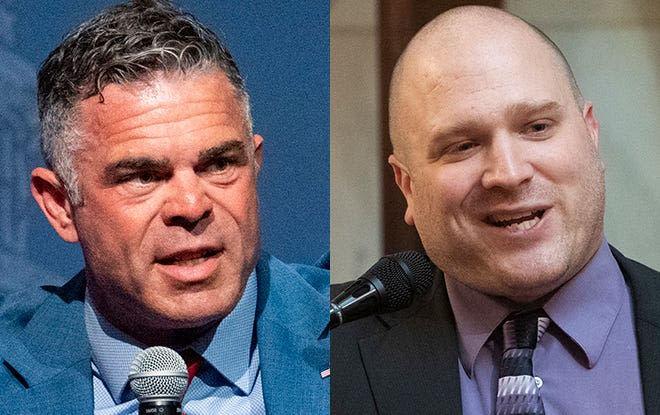
In July 2026, Tony Wied — the Republican congressman for Wisconsin's 8th District — agreed to be the headline guest at a birthday fundraiser for a state legislator near Green Bay.
The legislator is Rep. Shae Sortwell. And there's a reason the Milwaukee Journal Sentinel wrote about the invitation.
What police found in 2013
The story dates to January 2013, before Sortwell was elected to the Assembly but after he had started working in state and national politics.
A relative found five four-inch bruises on Sortwell's child and took the child to a hospital in Two Rivers. That set off a four-day investigation involving police officers, social workers, a child forensic officer, a child advocacy staff member and a nurse practitioner.
According to the Journal Sentinel's account of the investigative records, Sortwell told officers that the Bible was "very specific" about corporal punishment. He said he and his wife used an object to discipline the child, and he estimated he had struck the child three days before the hospital visit. He described corporal punishment as causing "some pain, but damage is not intended."
The responding officer called the marks left on the child "not reasonable" — and told Sortwell he would have arrested him had he been working the day the incident was reported.
Police recommended a felony child abuse charge against Sortwell, and a felony failure-to-act charge against his wife.
The Brown County District Attorney's office never filed them, citing an inability to prove guilt beyond a reasonable doubt and the parental reasonable-discipline defense available under Wisconsin law.
What that means, and what it doesn't
Being fair here matters, so let's be precise.
Sortwell was never charged, and never convicted. A prosecutor looked at the file and decided the case couldn't be proven. That decision is real and it counts. Sortwell himself now blames a "disgruntled family member," and says "the police appropriately did their jobs and looked into the concern and then forwarded their findings onto the Brown County Attorney's Office who rightfully decided to drop the matter."
But "not chargeable" and "nothing happened" are different things. A relative found bruises. A hospital saw them. Investigators built a file. And the man at the center of it explained to police, in his own words, that he had hit the child with an object and that scripture instructed him to.
None of that is the relative's allegation. That is what the police reports say he told them.
Wied's part
Nobody is asking Wied to prosecute anyone. He's a congressman, not a district attorney.
What he did was make a choice about his own name. Sortwell is running for reelection in northeast Wisconsin, and a headline appearance by the area's member of Congress is a real asset — it fills a room and it signals that the party's federal leadership is behind you.
Wied agreed to be that asset.
Then the Journal Sentinel asked him about it. According to the paper, Wied did not reply to multiple requests for comment on whether he supports Sortwell despite the allegations.
That's the part that's on Wied, and it's the part he could have fixed in one sentence. He could have said he'd looked at the record and concluded a man never charged deserves to be treated as such. He could have said he didn't know and would look into it. He could have pulled out.
Instead: nothing. Multiple times.
The pattern of not answering
This is not a one-off for Wied. Declining to engage with his own constituents is arguably the defining feature of his time in Congress.
He does his town halls by telephone rather than in person. After the head of the House Republicans' national campaign arm told members to stop holding in-person town halls, Wied's first-ever town hall was held over the phone on March 10, 2025 — and later that month constituents protested outside his office, urging him to talk face to face.
And when he does use his platform, he uses it on things happening somewhere else. In July he published a Fox News op-ed about socialism in New York — we wrote about that one, because his own district was losing jobs and health coverage at the time.
The through line is a politician who is available for the events he chooses and unavailable for the questions he doesn't.
Why a fundraiser is a fair thing to ask about
Politicians raise money together constantly. Most of it is unremarkable, and voters shouldn't have to audit every rubber-chicken dinner in Wisconsin.
But an endorsement is a transfer of credibility. When a member of Congress lends his name to a colleague's campaign, he is telling the voters of that district: this person is fine, I vouch for him. That is exactly the kind of judgment a voter is entitled to examine — especially when there's a police file with five bruises in it and the candidate's own explanation on the record.
The voters of northeast Wisconsin asked, through their newspaper. Wied decided they didn't need an answer.
Source
Wied to fundraise with lawmaker once referred for felony child abuse — Clara Strecker, Milwaukee Journal Sentinel, July 10, 2026. Photo: Milwaukee Journal Sentinel.