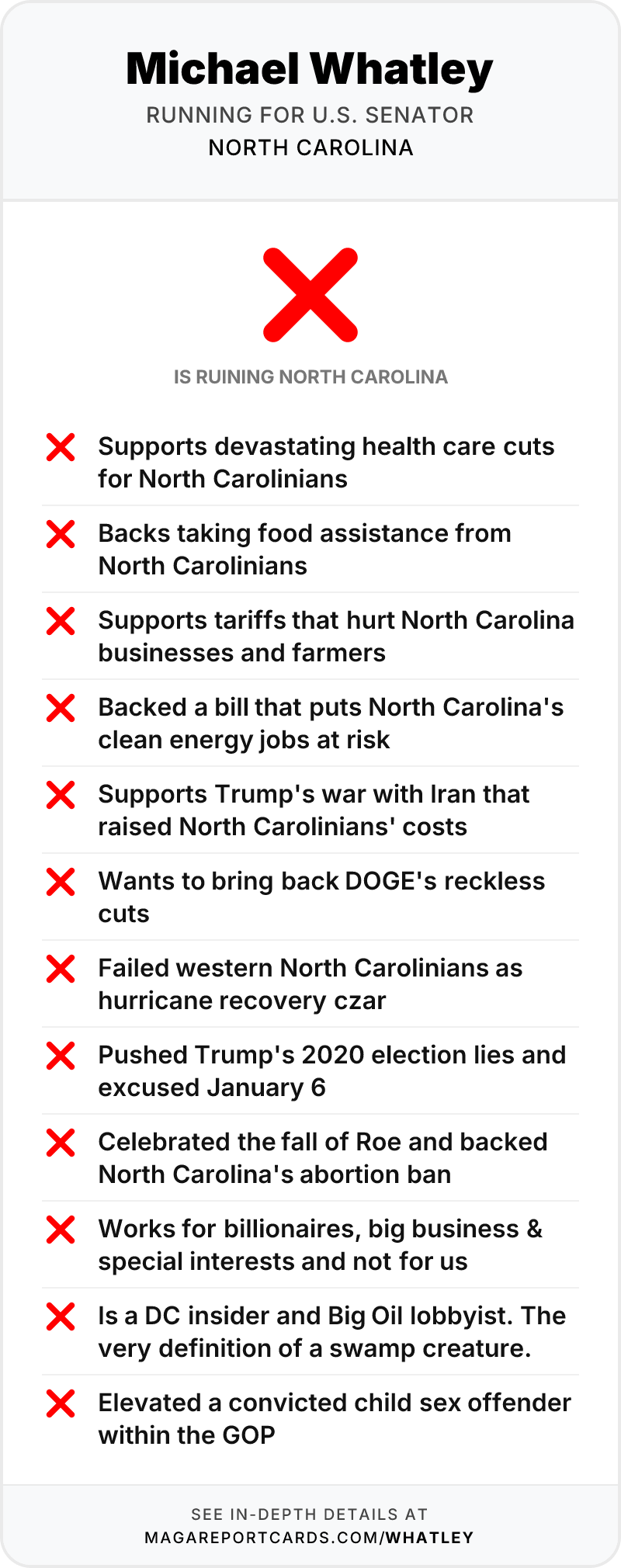
One of the loudest arguments in Michael Whatley's Senate campaign is that the other guy is dangerous. Whatley kicked off his general election on March 4 at the Charlotte lodge of the Fraternal Order of Police, flanked by law enforcement, pledging to end "soft-on-crime policies" and to put "dangerous criminals behind bars, not back on our streets." At that same event he said he was honored "to fight every single day to keep our kids and our communities safe. It is the number one priority for us."
In August, back at the same lodge, he said of former Governor Roy Cooper: "This is a man who is going to have a pro-criminal agenda the moment that he gets to the Senate."
Seven days after he said that, a man who is required to register as a sex offender for the rest of his life stood up at a Whatley campaign stop and led the room in prayer.
The Associated Press reported it on September 11.
What happened in New Bern
On August 28, the Craven County Republican Party hosted Whatley and Dr. Mehmet Oz — the former daytime TV host who now runs Medicare and Medicaid for Trump — at the county party's headquarters in New Bern.
Pastor Daimon L. King opened it. He asked God to grant the event "integrity and honesty," and to right wrongs "hammered down on the conservative movement."
King is 60. He leads a church in New Bern, presents himself as a pro-Trump Black conservative, and has served as a precinct chairman for the Craven County GOP. He has praised Trump and attacked "fake news" from the pulpit in sermons he posts to YouTube.
He has also been sentenced to prison twice for crimes involving children.
Roughly 30 years ago, King was a marching band assistant at a high school outside Raleigh. He was charged with statutory rape and indecent liberties involving a 15-year-old student, convicted in 1998, and served nearly five years before he was paroled. In 2010, he pleaded guilty to having sex with an underage female relative and served close to three years. North Carolina law requires him to stay on the sex offender registry for life.
The day after the rally, King posted on his church's Facebook group that "the atmosphere was charged with prayer and patriotism," and that he and his congregation "fully support and are behind" Whatley.
The campaign says it didn't invite him. Its own account posted him.
Whatley's campaign would not make him available for an interview. Spokesman DJ Griffin sent a statement instead: Whatley does not know King, and the event "was NOT planned nor organized by the Whatley campaign nor did the campaign invite any of the guests." Griffin said the hosts — the Craven County GOP — invited King.
That is a narrow denial, and it does not survive contact with the campaign's own social media. Whatley's campaign posted a video from the event on X. King is in it. While Whatley and Oz took turns denouncing fraud in the medical system, King stood conspicuously in the background of the shot, nodding along and flashing a double thumbs-up.
So the campaign's position is that it did not invite the man, did not know the man, and then broadcast footage with the man in the frame to its own followers.
Update, September 30: The "NOT planned nor organized" line has now fallen apart entirely. The Daily Beast obtained the event's virtual flyer, and it reads: "Paid for by Whatley for Senate and Laurie Buckhout for Congress." And Whatley himself described setting it up: when Oz asked where to stop, Whatley said, "Well, let me call the chair of the Craven County GOP." Afterward he posted that it "was great to host @DrOz on Friday night in Craven County."
It is worth noting who signed that statement. DJ Griffin is the same spokesman who, two months ago, answered questions about police being called on reporters at Whatley's events by describing them as "left-wing activists" who were "posing as 'journalists.'" This is a campaign whose reflex, when asked an uncomfortable question, is to attack the person asking it.
This is the second one
If this were a one-off, it would be an embarrassment. It is not a one-off.
Since March, Whatley has been dogged by his ties to Harvey L. West Jr., a former small-town police officer who pleaded guilty in 2000 to five counts of taking indecent liberties with a child and served six years in prison. West chaired the state party's 1st Congressional District committee, and Whatley — as state party chairman — appointed him to the Plan of Organization Committee, the body that writes the party's rules.
We went through that record in August. Republicans in Whatley's own party warned him about West for years, by name and on the record. One district chair wore a #MeToo shirt to a 2021 meeting to force the subject; she says Whatley gaveled the meeting closed. He reappointed West anyway. Democrats have since spent more than $2.3 million on ads built around a photograph of Whatley and West standing together.
And here is the part that turns a coincidence into a pattern. West told the AP that he knew about King's convictions — and that he warned other Republicans about the pastor when King was being considered for a party position.
"I just said, 'Hey, y'all might want to take a look at this,'" West said.
Somebody in the North Carolina Republican Party was told. The rally happened anyway.
The party wrote a rule about this three months ago
The state GOP did eventually respond to the West story. At its convention in Greensboro on June 13, 2026, it adopted language barring anyone convicted of a felony involving violence, sexual abuse, or child abuse from running for, being appointed to, or holding party office.
Look closely at how narrow that rule is, and why.
Republicans from Mecklenburg County had proposed something broader: no one convicted of any felony could serve as a party officer at the county, district, or state level. Asheville Watchdog reported that some delegates raised the concern that the broader ban "would prevent those pro-Trump zealots who stormed the Capitol on January 6, 2021, from becoming, or continuing as, state Republican Party leaders." The Mecklenburg proposal was sent back to committee to die. The narrow, leadership-backed version passed.
The result, as the Watchdog put it, is a rule that "enables at least 18 North Carolinians convicted of J-6 related crimes — immediately pardoned by President Trump when he won reelection — to now serve in party leadership."
That carve-out is Whatley's position too. He has called the January 6 prosecutions "ridiculous persecution" and backed the Trump administration's fund to pay the rioters — including pardon recipients who were later convicted of child sex crimes.
Why this lands where it does
Chris Cooper, a political scientist at Western Carolina University and no relation to the former governor, told the AP that both cases could be particularly damaging as Whatley tries to shore up support among hard-right conservatives. That is happening at a moment when the release of the Epstein records has taken suspicions about powerful people and institutions that had circulated for years on the right and pushed them into a much broader public debate.
"The far right has not coalesced behind (Whatley) and these kinds of revelations will make that problem even greater," Cooper said.
He is describing a political cost. The simpler point is about the standard Whatley set. He and the super PAC backing him have built this race on the claim that Roy Cooper is careless about violent crime — to the point that the super PAC ran a fake local news site blaming Cooper for a murder that happened in South Carolina. Whatley asks voters to judge his opponent by the company his policies keep. He has not applied that test to the company standing in his own campaign video.
What it adds up to
Michael Whatley says Roy Cooper will bring a "pro-criminal agenda" to the Senate. At the August 28 campaign stop for Whatley in New Bern, the opening prayer was given by a pastor who has been imprisoned twice for crimes involving children and must register as a sex offender for the rest of his life, and Whatley's campaign then posted video from that event with the pastor visible in it. That is the second convicted child sex offender to become an issue in his campaign this year. Republicans warned Whatley about the first one, Harvey West, for years, and he kept appointing West to the committee that writes the party's rules. West says he warned the party about the pastor too.
Source
Brian Slodysko, Associated Press, "Convicted sex offender offered opening prayer at rally for GOP Senate nominee in North Carolina", September 11, 2026.