Four months after the Capitol attack, the House of Representatives fined a member of Congress from North Texas for refusing to wear a mask on the House floor.
She appealed. Her letter is a public document, and it is worth reading, because it tells you what she thinks the Constitution is for.
How the rule came to exist
On January 12, 2021 — six days after the Capitol was stormed — the House adopted a rule fining members who wouldn't wear masks on the House floor: $500 for a first offense, $2,500 for each one after, deducted straight out of the member's paycheck.
The reason was specific. Three Democratic lawmakers had tested positive for COVID-19 after sheltering in a secure room during the January 6 attack alongside Republican colleagues who wouldn't put on masks. Rep. Debbie Dingell, introducing her own bill to fine maskless lawmakers that same day: "Either have some common sense and wear a damn mask or pay a fine."
Beth Van Duyne had been sworn in nine days earlier.
The violation, and the appeal
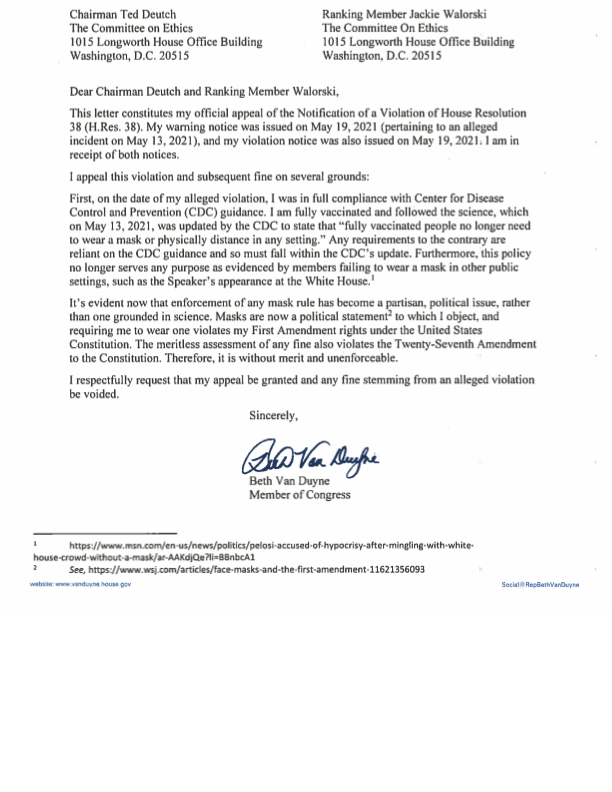
According to Van Duyne's own letter, her warning notice — for an alleged incident on May 13, 2021 — and her violation notice were both issued on May 19. On May 24 she filed a formal appeal with the House Committee on Ethics, addressed to Chairman Ted Deutch and Ranking Member Jackie Walorski.
She gave two grounds. Here's the first, in her words:
"First, on the date of my alleged violation, I was in full compliance with Center for Disease Control and Prevention (CDC) guidance. I am fully vaccinated and followed the science, which on May 13, 2021, was updated by the CDC to state that 'fully vaccinated people no longer need to wear a mask or physically distance in any setting.'"
She then added that the House policy "no longer serves any purpose as evidenced by members failing to wear a mask in other public settings, such as the Speaker's appearance at the White House" — and footnoted a news story about Nancy Pelosi.
That's an argument about the CDC and about Pelosi. Neither one is the House rule she was fined under. The House writes its own floor rules; the CDC does not set them, and another member's conduct elsewhere is not a defense.
Then came the second ground:
"It's evident now that enforcement of any mask rule has become a partisan, political issue, rather than one grounded in science. Masks are now a political statement to which I object, and requiring me to wear one violates my First Amendment rights under the United States Constitution. The meritless assessment of any fine also violates the Twenty-Seventh Amendment to the Constitution. Therefore, it is without merit and unenforceable."
Read that again
Two constitutional claims in one paragraph, over a piece of cloth.
The First Amendment claim is that being required to wear a mask is compelled political speech. She footnoted a Wall Street Journal article on masks and the First Amendment. But the House floor is a workplace with rules the members themselves vote on, and members have always been subject to floor rules — on dress, on decorum, on conduct.
The Twenty-Seventh Amendment claim is the remarkable one. The 27th Amendment is one sentence long, and it is about congressional pay: no law changing the compensation of Senators and Representatives takes effect until an election of Representatives has intervened. It exists to stop Congress from voting itself a raise mid-term.
Van Duyne's argument is that a $500 penalty for breaking a floor rule is a change to her compensation, and therefore unconstitutional.
If that were true, the House could never fine a member for anything. That is presumably the point.
The committee said no
On June 25, 2021, the House Committee on Ethics published the outcome: "A majority of the Committee did not agree to the appeal."
Under the rule, an appeal fails unless a majority of the committee affirmatively agrees to it. Not enough members were willing to say she had a point.
The fine stood.
Why a five-year-old $500 fine still matters
Because it is a clean, documented look at how she reasons when it costs her something.
The stakes could not have been lower. A mask on the floor of the House. Instead of wearing it, or paying $500, or saying "I disagree with this rule," Van Duyne wrote to the Ethics Committee that the rule violated her free-speech rights and the constitutional amendment about congressional pay. She asked that the fine "be voided."
That instinct — to treat any constraint on herself as a constitutional outrage — shows up elsewhere in her record. She voted to reject Pennsylvania's electoral votes hours after the mob that had chased her colleagues into that same secure room. She voted against impeaching Trump for inciting it, and against creating the committee to investigate what happened. The Constitution's limits on a president she liked did not strike her as urgent. The Constitution's implications for her own $500 fine did.
The mask fight was never really about science, and her letter says so out loud: "Masks are now a political statement to which I object." That's a choice about identity, not health. We've watched where that goes — a candidate in California campaigned alongside a politician who said a mask mandate made her feel like Rosa Parks pushed to the back of the bus, and never apologized. A Kansas senator who is also a physician spread COVID misinformation and is still repeating it six years later.
And Van Duyne isn't the only North Texas Republican whose conduct the Ethics Committee has had to look at. Her neighbor Lance Gooden is currently under House Ethics investigation over a spending matter referred by the independent Office of Congressional Conduct.
The people of Texas's 24th District sent her to Washington to work on their health care, their food costs and their jobs. In her fifth month there, she was spending her time arguing that a mask fine was unconstitutional.
We deserve better.
Sources
Statement of the Chairman and Ranking Member of the Committee on Ethics Regarding Representative Beth Van Duyne — House Committee on Ethics, June 25, 2021, including the full text of Van Duyne's appeal letter (the document pictured above).