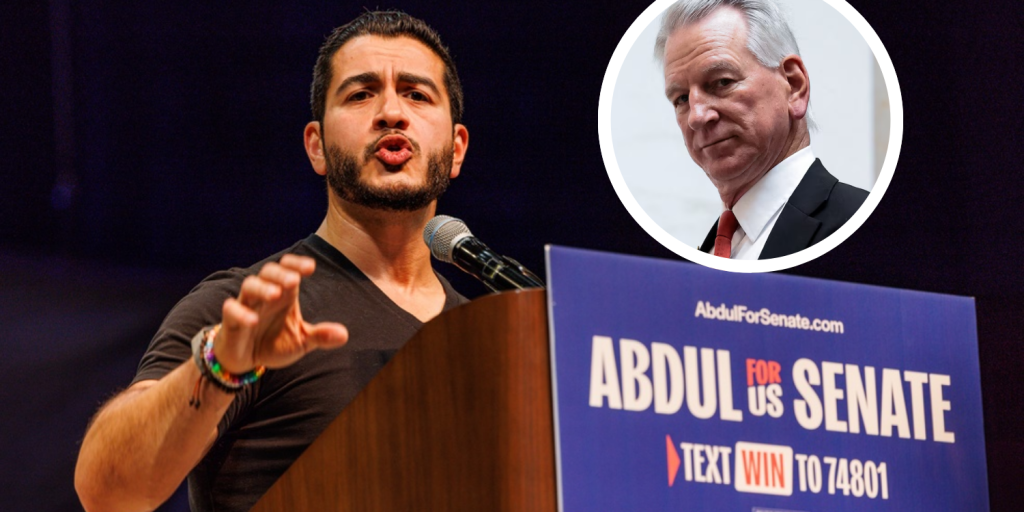
On August 24, 2026, Abdul El-Sayed — the Democratic nominee for U.S. Senate in Michigan, and a Muslim — went on Fox News and said this:
"The idea that you have somebody like Tommy Tuberville, who barely was good at coaching football, is trying to ban Sharia law when there's less than 1% of the Muslim community in America, as if somehow Muslims are out here trying to push Sharia law, that seems to me to be deliberately targeting the Muslim community because they're different."
That is a criticism of a senator's legislation. It contains a jab about football and an argument about a bill.
Tommy Tuberville's reply, posted on X the next day:
"Sounds like something a terrorist sympathizer would say."
What that sentence actually does
A sitting United States senator called a major-party nominee for the United States Senate a terrorist sympathizer.
Not "he's wrong about the bill." Not "here's why Sharia is a threat." A man criticized his legislation, and the senator's answer was that criticizing it is what a terrorist sympathizer sounds like.
There is only one thing distinguishing El-Sayed from everyone else who has criticized this legislation — including a George Mason University law professor who told a House Judiciary subcommittee in February that the House companion of Tuberville's own deportation bill is "manifestly unconstitutional". El-Sayed is Muslim.
Tuberville did not say that. He didn't have to.
The legislation El-Sayed was criticizing
Two of the Senate's anti-Sharia bills are Tuberville's own. He introduced both on October 15, 2025: S. 3008, the "No Shari'a Act," which would bar the application of Sharia in the United States where it would violate constitutional rights, and S. 3009, the "Preserving a Sharia-Free America Act," which would amend immigration law so that advocating for Sharia is grounds to be denied a visa, declared deportable and removed from the country. It is the House companion of that second bill the George Mason professor testified against.
A third is Sen. John Cornyn's. On February 12, 2026, Cornyn introduced S. 3887, the "Defeat Sharia Law in America Act," which would amend the Civil Rights Act so that a business covered by its public-accommodations section that provides goods or services "by implementing Sharia law" counts as discriminating on the ground of religion. Tuberville is its only co-sponsor. He signed on the day it was introduced.
CAIR's Alabama chapter called that bill an "unconstitutional attack on religious freedom," noting that Sharia, "like Jewish Halacha, provides Muslims with guidance for their daily life and religious practice, requiring them to offer their five daily prayers, fast in Ramadan, give in charity, stand up for justice, obey the laws of the land in which they live, and advocate for the religious rights of their neighbors."
El-Sayed's factual point in the Fox interview is not in dispute. Muslims are a small share of the U.S. population, and Sharia — a religious framework — does not have standing over the U.S. Constitution.
This is not a one-off
Tuberville's answer to El-Sayed reads worse next to what he has already posted.
In March 2026 he put up a photo of the September 11 attacks beside a photo of New York's Muslim mayor, captioned "The enemy is inside the gates." We laid that out, along with the rest of the machinery — a 50-member congressional caucus, a state bill, a governor and an attorney general, all mobilized against a Sharia takeover that traced back to a hate group's blog post and five houses in Little Rock, two of them occupied by Christians.
The bigger picture is a spending decision. Republicans have put more than $10 million into television ads mentioning Sharia or Islam negatively this cycle — about ten times the total of each of the last four cycles. A pollster who studies this found anti-Muslim sentiment spikes during election cycles, not after terrorist attacks.
Tuberville isn't improvising. He's reading from a budget.
He's running to govern Alabama
Tuberville is not running for reelection to the Senate. He is running for governor of Alabama.
A governor signs bills, appoints judges, runs the state police, and decides which Alabamians the state protects. Alabama has Muslim citizens — doctors, students, small-business owners, engineers at the Huntsville research corridor, people whose families have been in Birmingham for generations.
The man asking to run their state has said, in public, that a Muslim who criticizes his bill sounds like a terrorist sympathizer.
Every Alabama Muslim watching that exchange now knows what happens if they say the same thing El-Sayed said.
What the record shows
On August 24, 2026, Abdul El-Sayed criticized Tommy Tuberville's anti-Sharia legislation on Fox News, arguing it targets Muslims for being different. On August 25, Tuberville publicly called that "something a terrorist sympathizer would say." Tuberville wrote two of the Senate's anti-Sharia bills himself and is the sole co-sponsor of a third, S. 3887, which CAIR's Alabama chapter calls an "unconstitutional attack on religious freedom." He is running to be governor of Alabama.
Source
Tuberville fires back at El-Sayed over Sharia law criticism: 'Sounds like something a terrorist sympathizer would say' — Yellowhammer News, August 25, 2026. Image via Yellowhammer News.