Over the past 16 years, the teen birth rate in America fell by about 72%. That's according to CDC data — and it's one of the biggest public health wins of our lifetimes. Experts credit more comprehensive sex education, better access to contraception, and changing behavior around sex.
The federal program that funded a lot of that work is the Teen Pregnancy Prevention Program. Congress created it in 2010, and Republicans and Democrats have funded it together ever since — including in the 2026 budget bill, even after the White House tried to zero it out.
This summer, the Trump administration rewrote it. The new version steers the money toward abstinence, marriage promotion, and fertility tracking.
What changed
The original law was simple: fund programs that are "medically accurate and age-appropriate" and that actually reduce teen pregnancy, then keep funding the ones proven to work in rigorous studies.
The new grant terms, reported by States Newsroom, point somewhere else:
- Applicants must teach "body literacy" — two separate modules, one for girls, one for boys.
- The girls' module must treat ovulation as the "central event and primary indicator of hormonal health and fertility," and must cover the advantages and disadvantages of "ovarian suppression" versus approaches that address "root causes." As a nurse practitioner quoted in the story notes, "ovarian suppression" likely refers to one of the most common ways birth control works — temporarily suppressing ovulation.
- The boys' module must cover the physiology of arousal and how "repeated or artificially stimulated arousal may affect neural development and behavior over time."
- Programs must provide "reproductive goals counseling" and "should affirm marriage and parenthood as meaningful and value components of adult life."
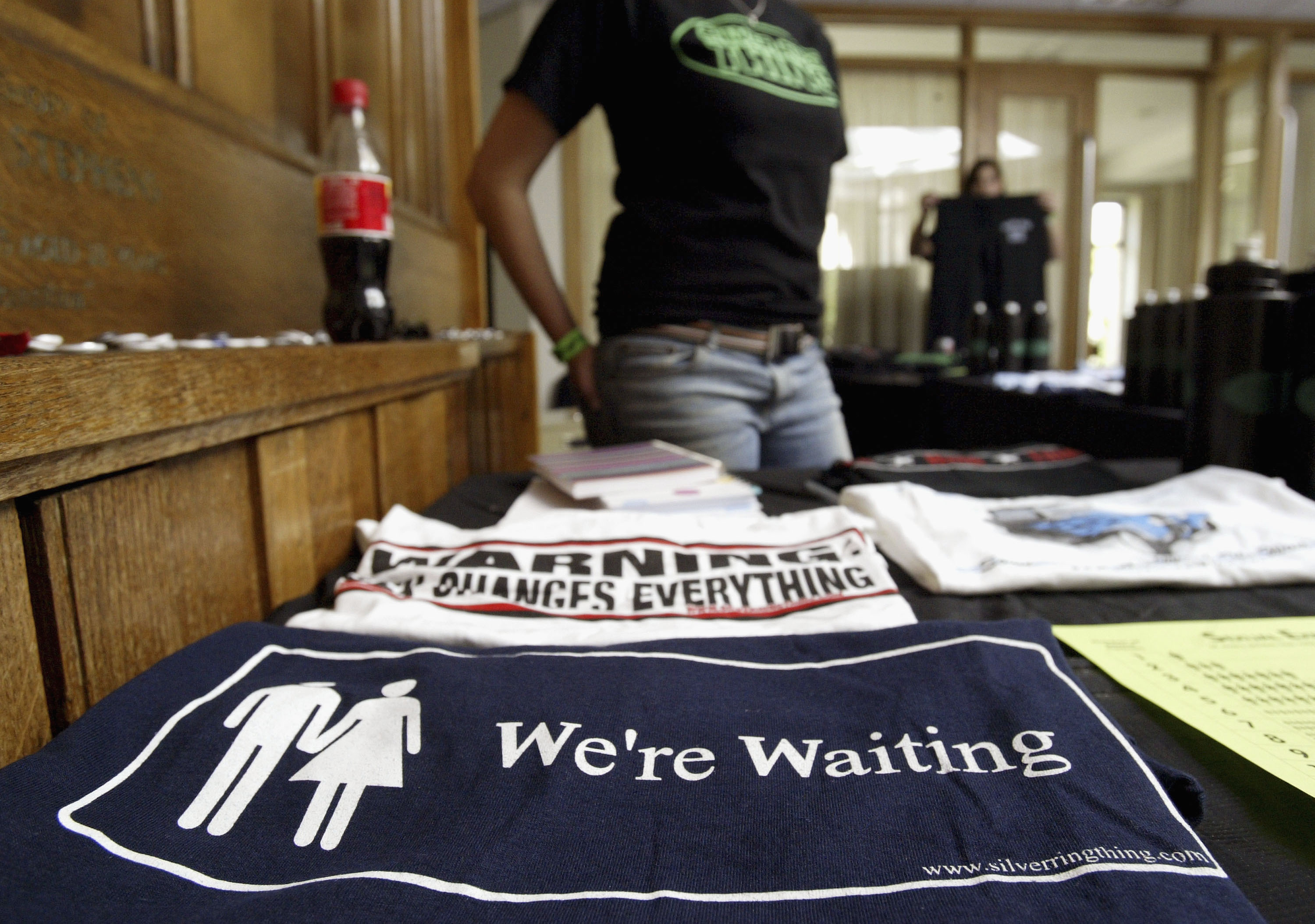
- One of the program's stated pillars tells grantees to "incorporate sexual risk avoidance education" — the federal term for abstinence-only.
That last one matters. There is already a separate federal grant program for abstinence-only education. What just happened is that a different program — one with a much higher bar for scientific evidence — got turned into more of the same.
There's also a new gatekeeping step: applications must pass an "alignment review" with agency priorities, conducted by political appointees.
The research is not ambiguous
This isn't a case where reasonable people weigh two equally supported approaches.
Academic studies have repeatedly found that abstinence-only approaches produce higher rates of teen pregnancy and teen births — even after adjusting for other socioeconomic factors.
Meanwhile, the American College of Obstetricians and Gynecologists warns that the "restorative reproductive medicine" framework behind the new rules can be "ineffective and redundant" and can delay patients from getting real medical treatment when it's presented as the best or only option.
So the government took a program built specifically to fund what works, and rebuilt it around what doesn't.
53 grants killed overnight
The rewrite came with cancellations. Fifty-three grantees got letters telling them their funding was terminated without notice. Most were told their programs were misaligned with agency priorities and that they normalized sexual activity for minors. Three of them, along with the sex-ed group SIECUS, sued over it on July 14.
What that looks like on the ground:
Children's Aid, New York City. The 170-year-old organization had a $936,700 grant, eligible for funding through 2028. In mid-May, after a meeting with HHS, staff expected renewal — they'd gotten nothing but positive feedback. At the end of June, the cancellation letter arrived, effective immediately.
"It was an overnight shutdown with no transition period for staff, or for young people that were relying on these resources." — Rhonda Braxton, VP of health and wellness, Children's Aid
Nine people are expected to lose their jobs. 1,200 young people a year in the South Bronx, Harlem and Washington Heights lose the program. A group of high-school-age peer educators lost the summer job they'd already lined up.
Healthy Futures of Texas. CEO Ginger Mullaney's group had a nearly $2 million grant funding 11 programs — including ones serving youth in foster care and runaway and unhoused youth. It was canceled too, which stunned her: the organization had already rewritten all of its materials to comply with the administration's executive orders, and the new curriculum had been approved. "We felt like we had already made all the necessary changes to comply," she said.
She also pointed out a practical problem with the replacement. The government used to publish a list of more than two dozen programs certified as effective through academic evaluation. That list is gone — but applicants are still told they must use an "evidence-based program."
"We don't know what (programs are) considered evidence based." — Ginger Mullaney
Who's positioned to get the money instead
The new funding notice awards extra points to applicants who have never received the funding before.
Alison Macklin of SIECUS says that, based on what she's seeing locally, the new terms are paving the way for crisis pregnancy centers to apply for and win these federal dollars. Those are anti-abortion organizations that typically offer free ultrasounds and pregnancy tests with a religious mission, and mostly don't provide or refer for contraception.
States Newsroom reported earlier this year that such centers have already taken in nearly $500 million in state and federal taxpayer money since the Supreme Court overturned Roe v. Wade in 2022.
"They've been given an inch, so they're trying to take a mile." — Alison Macklin, SIECUS
This isn't only coming from the executive branch
The approach now baked into the grant terms has champions in Congress. Republican Sen. Cindy Hyde-Smith of Mississippi introduced a bill in 2025 directing federal health agencies to promote restorative reproductive medicine training through Title X and the HHS Office of Population Affairs. That bill didn't advance — but the administration has now written much of the same philosophy into how the money moves.
It also fits a broader pattern at HHS. Secretary Robert F. Kennedy Jr. has repeatedly pointed to falling sperm counts in men, including teenage boys, as an explanation for lower birth rates — despite no scientific evidence supporting that claim for young men. As experts note, the national birth rate is lower largely because teen births have dropped so sharply. Which is to say: the thing they're treating as a crisis is the public health success this program helped produce.
The bottom line
A bipartisan program that helped cut teen births by nearly three-quarters has been rewritten around a method the research says makes teen pregnancy more common, gatekept by political appointees, with 53 organizations cut off overnight and teenagers left without the programs they were counting on.
The people who lose here are teenagers — including kids in foster care, kids without stable housing, and kids in the areas with the greatest need. They didn't get a vote on this.
Source
This post is based on reporting by Kelcie Moseley-Morris for States Newsroom, published by Talking Points Memo.


