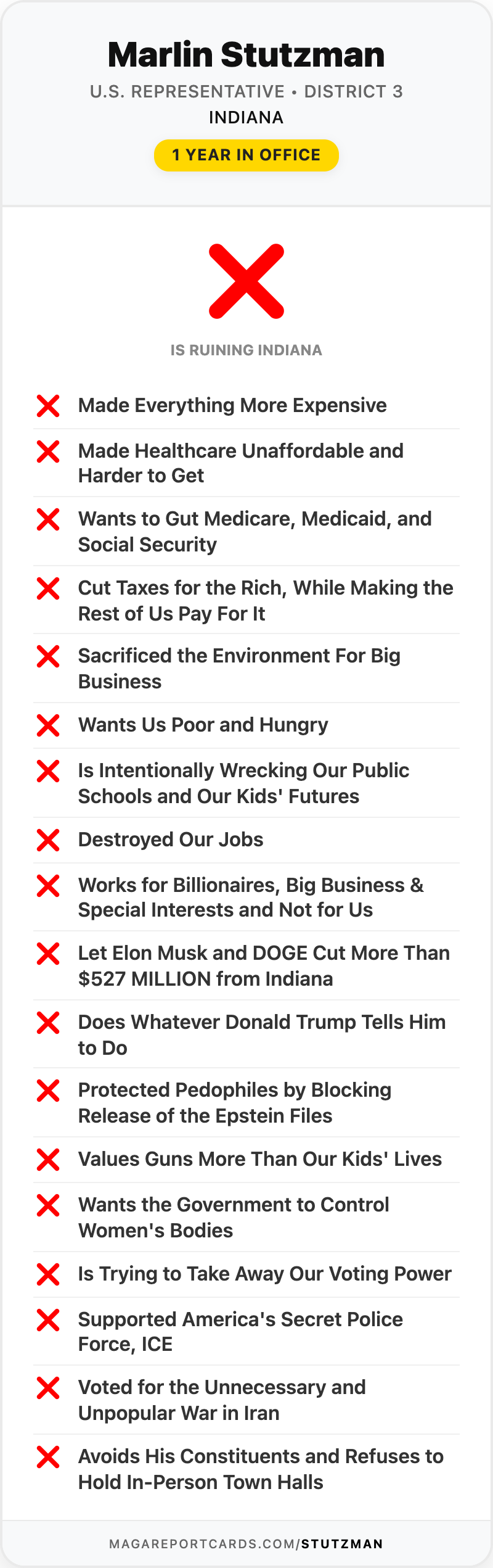
On June 3, 2026, Marlin Stutzman introduced H. Res. 1339 in the U.S. House of Representatives. Its full title runs to 48 words. The short version: it endorses Prime Minister Benjamin Netanyahu's plan to phase out the $38 billion in U.S. military aid to Israel and replace it with a "mutual defense cooperation and joint economic investment" arrangement.
You can argue about whether that's good policy. What's remarkable is where it came from, and Stutzman has told reporters the story himself.
"A couple of folks from Israel floated the idea"
Austin Campbell of Responsible Statecraft asked Stutzman how the proposal originated. His answer:
"When a couple of folks from Israel floated the idea of going from the supplemental of $38 billion over 10 years to a trade agreement and defense agreement, we just continued to have those conversations."
Then, before he traveled to Israel, Stutzman contacted Israel's ambassador to the United States, Yechiel Leiter, and asked him whether this was — in Stutzman's own words — "a direction that you guys would be comfortable with us going."
Read that sentence as a job description. A member of the United States Congress asked a foreign government's ambassador for advance clearance on a direction of American policy.
The Jerusalem meeting
On May 27, 2026, Stutzman and Rep. Abe Hamadeh of Arizona met Netanyahu at his office in Jerusalem. Stutzman told the Washington Post that after reviewing a draft of the resolution, Netanyahu said "I like it" and added, "This is the direction I've been wanting to go for a long time." Hamadeh is the resolution's only cosponsor.
One week later, the resolution was in the House hopper. Stutzman's own press release does not treat any of this as awkward. It says so plainly:
"Rep. Stutzman introduced this resolution exactly one week after meeting with Prime Minister Netanyahu in Jerusalem and receiving his enthusiastic support for the legislation."
And then, right below, the release offers readers two documents: the text of the resolution, and — as a selling point — "A letter of support from Prime Minister Netanyahu."
A foreign head of government's endorsement letter, published by a congressman's office as the case for his own bill.
What's actually in it
The resolution isn't only about money. Its "resolved" clauses commend Netanyahu's proposal, back a new memorandum replacing military assistance, condemn antisemitism — and express gratitude to Netanyahu and the Israeli people for their "courageous partnership with the United States in military operations against Iran."
Its findings recite the operations by name: Israel's "Operation Rising Lion" against Iranian nuclear facilities in June 2025, the American strikes alongside it under "Operation Midnight Hammer," and the joint U.S.-Israeli "Operation Epic Fury," launched February 28, 2026.
That is the war Congress never voted to authorize. Five months after it started, the Pentagon's own records showed at least 624 American service members wounded in it. The House had already told the president to get out: on June 3, 2026 — the same day Stutzman filed this resolution — it passed an almost identical war powers resolution, 215–208, and Stutzman voted no. It passed another one 214–208 on July 23, and he voted no again, with 206 other Republicans.
So the sequence is: back a war Congress never authorized, then write a resolution praising the partnership that fought it, at the request of the partner.
Stutzman has been candid about the other pressure he feels. On why the aid structure needs to change, he told Responsible Statecraft: "Young people are questioning, why are we spending all this foreign aid?" And: "Israel gets wrapped up in that."
He was also asked about civilian deaths in Gaza. His answer:
"Have Israelis killed innocent people? The possibility is obviously there because it's a war zone."
The money
Pro-Israel PACs have given Stutzman $48,892, according to TrackAIPAC, which builds its totals from FEC filings and last updated his card on July 5, 2026. AIPAC's own political action committee is the largest single PAC contribution in his donor file, at $11,494.
We're not saying the check bought the resolution; we have no evidence of that and we don't write things we can't source. We're saying this: the money, the ambassador call, the Jerusalem meeting, the endorsement letter and the resolution all point the same direction, and none of them point toward Fort Wayne.
What Fort Wayne got instead
While Stutzman was drafting American policy toward a foreign government with that government's input, here is what was happening in Indiana's 3rd District, where he voted for the budget bill:
- An estimated 24,639 people in IN-03 are projected to lose health coverage by 2034 from the Medicaid and Affordable Care Act cuts — 12,939 losing Medicaid and 11,700 losing Affordable Care Act coverage — according to Democrats on the Joint Economic Committee.
- 23,057 households in the district rely on SNAP to buy groceries, including 11,728 with children and 7,455 with someone 60 or older.
Constituents have tried to ask him about it. In March 2025, hundreds of people filled the Allen County Public Library in downtown Fort Wayne for an "empty chair" town hall — Stutzman was one of three Indiana Republicans represented on stage by a chair with nobody in it, and the station reported it had received no response from his office. In July 2025 the state Democratic party held a "People's Town Hall" at the same library and left a chair at the end of the panel table with a sign reading "Rep. Marlin Stutzman"; the Allen County Republican chairman called it a stunt and asked why Stutzman "or any other Republican" would appear at a Democratic event.
He had a week to get from a meeting in Jerusalem to a filed resolution in Washington. In Fort Wayne, when every other member's town halls were being scheduled for the March 2025 recess, 21Alive reported that Stutzman "does not currently have any town halls scheduled" — and that he had cancelled a sit-down interview with the station that week over a scheduling conflict.
Sources
- Rep. Stutzman: I consulted Israelis before proposing defense measure — Austin Campbell, Responsible Statecraft, June 24, 2026. Photo: Nathan Howard/Reuters.
- REP. STUTZMAN INTRODUCES RESOLUTION TO TRANSITION U.S.-ISRAEL RELATIONS — Office of Rep. Marlin Stutzman, June 3, 2026
- H. Res. 1339, 119th Congress — full text, introduced June 3, 2026