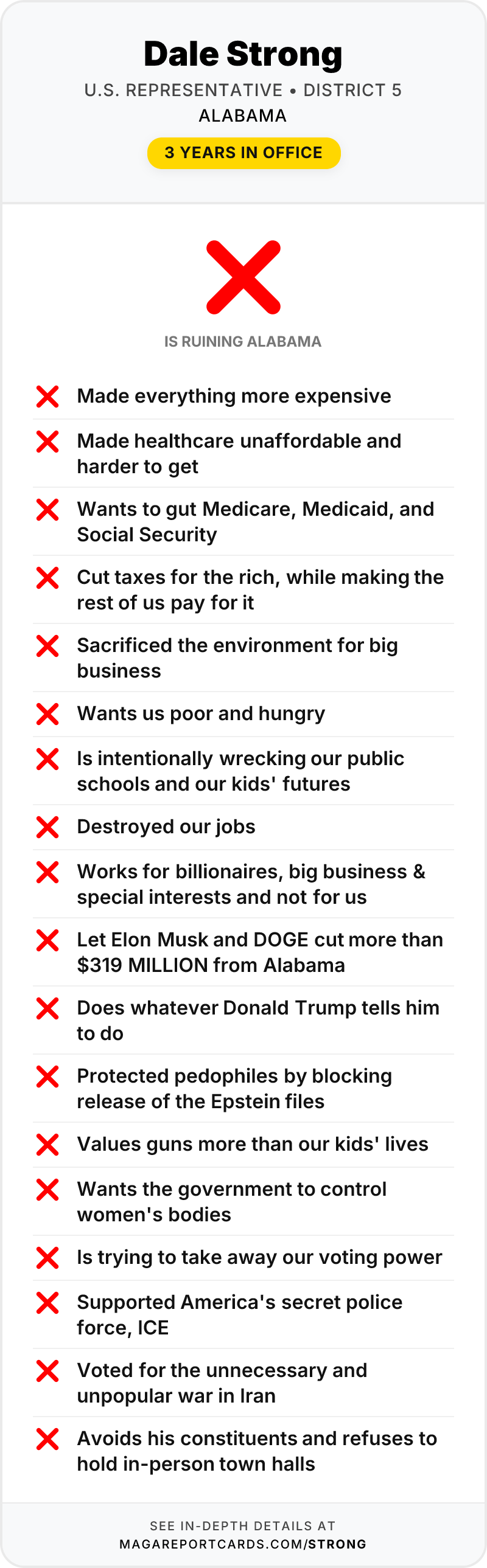
In March 2025, dozens of people turned out in Huntsville for a protest called "Where Are You, Dale." They wanted Dale Strong to hold an in-person town hall.
Strong went on a Huntsville radio show and gave two reasons for not going. The first was that he'd never been asked:
"There's been no communication. You know this right here is orchestrated."
The second was about the people asking:
"Indivisible is a group that's headed by George Soros. It's left-wing liberals. You look at it — they're mad because Kamala and Joe lost. They're mad because Trump won, and they're mad because they're getting exposed with all the waste, fraud and abuse that's going on this country."
That's from 1819 News, a conservative Alabama outlet — not from anyone trying to make him look bad. The organizers went ahead and planned an "empty" town hall in Athens for March 22, 2025, to be held whether or not their congressman turned up.
The invitation problem got solved
On July 27, 2026, Andrew Sneed — the Democrat on the ballot against Strong this November — invited him to a series of four public town halls across North Alabama. Not a debate. Sneed said so explicitly:
"To be clear, this will not be a debate nor will it be a format for 'gotcha' type questions."
The series is called "Hear Every Voice." Alabama Political Reporter laid out the schedule: August 17 in Scottsboro, August 26 in Decatur, September 9 in Athens, October 6 in Huntsville. All free, all open to the public and the press, with local moderators — former state Rep. Mike Ball at the first two.
By the time the story ran on August 3, according to Sneed's campaign, neither Strong nor anyone on his staff had responded to the invitation.
So the 2025 excuse is gone. There has now been communication. It came from a named person, and the dates and rooms are public.
He hadn't answered.
What he says he does instead
Strong isn't shy about his constituent-service numbers. He told 1819 News he'd had more than 1,500 meetings and events, reached over 35,000 people through telephone town halls, and held mobile office hours in rural areas.
That's real work, and it isn't nothing. But notice what every one of those formats has in common: he chooses who's in the room, or there is no room.
Strong's April 2025 telephone town hall wasn't advertised to the public in advance, and his office gave out no phone number or schedule. There's no follow-up question, no visible audience, and no video of a congressman being asked something he'd rather not answer. It is the format members switch to when the other one gets uncomfortable — a substitution we've now watched play out in Arkansas and South Carolina.
And in July 2026, Strong described his own campaign this way:
"I'm not running against him. I'm presenting my case to the people, the more than three quarters of a million people in North Alabama."
He's presenting his case to three-quarters of a million people. Just not in a room where any of them can talk back.
What those people would ask about
Alabama's 5th District has specific, documented things going wrong that its congressman has never taken a question about in a public room.
Health coverage. An estimated 22,103 people in AL-05 are projected to lose health coverage from Medicaid and Affordable Care Act cuts — 20,100 losing Affordable Care Act coverage and 2,003 losing Medicaid — according to a district-level analysis by the Joint Economic Committee's House Democrats.
Groceries. 28,867 households in the district — about 9% of all households — use SNAP, according to USDA data. That's 12,584 households with children and 11,333 with someone 60 or older. Strong himself said in July that "grocery prices right now are the biggest thing that we need to be focused on."
Federal jobs. Huntsville is home to roughly 21,000 federal workers. Strong told a Huntsville audience in February 2025 that the DOGE cuts would ultimately benefit the city — "These jobs, while we may lose a couple, we will gain many of them in the end." The people protesting outside his office had a view about that.
Every one of those is a question with a number in it. Every one of them is answerable.
The tell is the silence
Strong could say no. He could say the format doesn't work for him, or that he won't share a stage with his opponent, or that his schedule is full through October. Any of those would be an answer.
Instead, as of Sneed's August 3 announcement, he had said nothing at all — and in 2025, at least, he gave a reason.
There are four dates on the calendar, four rooms booked, and an open invitation with his name on it. The election is November 3.
Source
"Sneed plans four North Alabama town halls, invites Strong" — Alabama Political Reporter, August 3, 2026.