There is a way to tell whether a politician actually wants a bill to pass. It isn't the press release. It's the boring procedural vote nobody covers — the one that decides whether the bill gets a vote at all.
On June 9, 2026, Pete Stauber faced that vote twice on his own bill. He voted no both times.
The bill was his
In September 2025, Stauber co-authored the Faster Labor Contracts Act with Rep. Donald Norcross, a New Jersey Democrat. It's a real bill about a real problem: workers vote to form a union, and the employer simply runs out the clock instead of bargaining. Under the bill, an employer has to start negotiating within 10 days, a federal mediator steps in after 90 days, and after another 30 days the dispute goes to binding arbitration.
Stauber's own news release said it takes an average of 458 days to reach a first contract. He leaned hard on his biography:
"As a former police office who organized my union, I've seen firsthand how unfair and frustrating this process can be for some. That's why I am proud to partner with Representative Norcross to hold employers accountable and ensure workers have a real voice at the negotiating table, because when our workers succeed, our entire nation succeeds."
That's from the Mesabi Tribune's write-up of the September 2025 introduction, which also carried praise for him from Teamsters general president Sean O'Brien and from Local 346 in Duluth. Nearly 20 national unions endorsed the bill.
Good bill. Good instinct. Then it needed him.
The night at the union hall
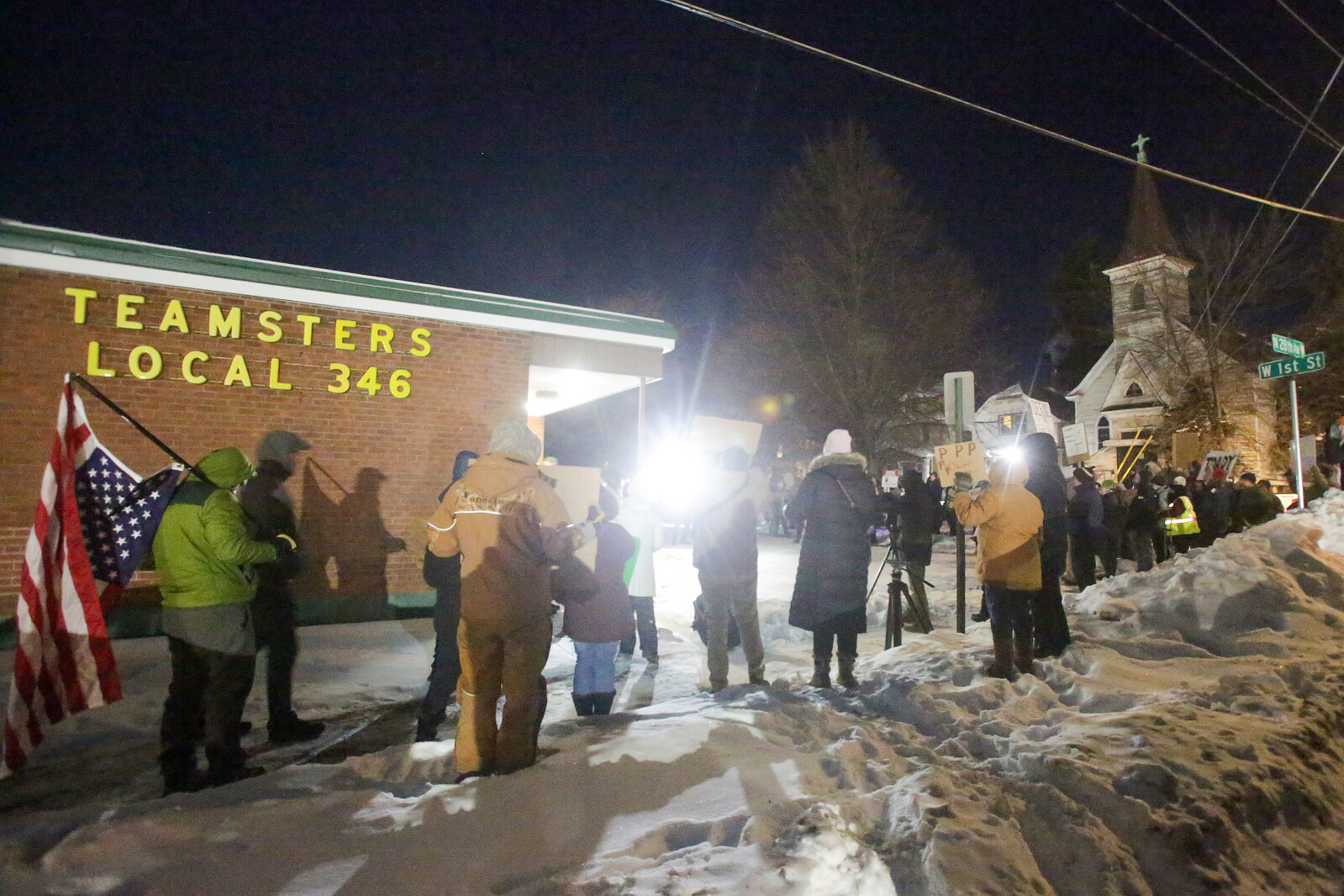
On the evening of Wednesday, January 28, 2026, Stauber went to the Teamsters Local 346 hall in Duluth's Lincoln Park neighborhood to talk to members about the bill.
Constituents heard he'd be there. They filled the sidewalks on both sides of the building in subzero cold, holding signs, hoping for a word about ICE operations in Minnesota and about copper-nickel mining.
They didn't get one. Stauber left through the back.
The Duluth News Tribune editorial board wrote it up two days later, and it is worth reading in full. Two things happened that night:
- The press was shut out. Only WDIO-TV was let in. Reporters and photojournalists from other outlets — including card-carrying members of the Minnesota Newspaper and Communications Guild — were stopped at the door. A TV journalist from Northern News Now was physically pushed out by a man in a Teamsters jacket. (Local 346's secretary-treasurer, Zak Radzak, apologized: "We do not condone the physical contact of anyone.")
- Stauber snuck out the back rather than take questions from the people standing outside.
The editorial board's verdict on the congressman was blunt: he "has long been avoiding gatherings open to the public," and his tele-town halls — "with attendees handpicked and the questions of the softball variety" — are not a substitute. "Controlled conference calls aren't accountability."
One constituent outside the hall told the paper: "You don't get much opportunity because he has not made himself available to any of us for a very long time."
Stauber's office didn't respond to the News Tribune's request for comment about the meeting.
So: a room full of union members got the pitch. The neighbors outside in the cold got a back door.
The two votes that decided it
The bill never got scheduled for a floor vote, so Norcross had to force it there with a discharge petition — a rare maneuver where a majority of the House signs a paper to yank a bill out of leadership's hands. The 218th signature went on it on May 20, 2026.
The Teamsters thanked the seven Republicans who signed it by name: Mike Lawler, Nick LaLota, Brian Fitzpatrick, Don Bacon, Max Miller, Riley Moore, and Rob Bresnahan.
The bill's Republican co-author was not on that list.
That set up two procedural votes on June 9, and both of them were the real vote. Here is the official record from the House Clerk:
| Roll call | Question | Result | Stauber |
|---|---|---|---|
| 2026-212 | On Motion to Discharge, H.Res. 1140 | Passed, 220–199 | Nay |
| 2026-215 | On Agreeing to the Resolution, H.Res. 1140 | Passed, 221–201 | Nay |
| 2026-216 | On Passage, H.R. 5408 | Passed, 230–193 | Yea |
On the motion to discharge, exactly 9 Republicans voted yes. On the rule, 11 did. Stauber — the bill's Republican co-author — was in neither group.
Then, once the bill was safely on the floor and 210 Democrats had guaranteed it would pass, he voted yes. Twenty Republicans did.
Read the sequence again. He voted twice to keep his own bill from getting a vote. Had his position won, the Faster Labor Contracts Act would have died in Speaker Johnson's desk drawer without ever reaching the floor. Only after that failed did he vote for it.
Then he took the credit
The next day, Stauber's office put out a press release headlined "Stauber Legislation to Speed Up First Contracts for New Unions Passes House."
Timothy W. Andrew, a Duluth attorney who has represented labor unions since 1992 and is a state bar–certified labor and employment law specialist, called it out in the News Tribune in June:
"He was happy to be a cosponsor of the bill when it made him look independent and pro-worker. … That is the definition of having it both ways. Union members know the difference between solidarity and political convenience."
Andrew's point about the press release: "What he disingenuously failed to mention was that when the bill needed help getting to the floor, he voted against it."
His advice to voters in the 8th District: "judge Stauber not by the headline he posted afterward, but by the vote he cast when the bill's future was on the line."
We have watched another Republican work this exact play — Maria Elvira Salazar handing out oversized novelty checks for money that came from bills she voted against, then telling a camera she couldn't remember the votes. The mechanics are identical. Vote where the party wants you, then send the press release where the voters are.
What "friend of labor" is supposed to mean
Stauber's district is union country — the Iron Range, the Duluth port, the building trades. He built his political identity on being the Republican who organized his police department's union. He sells that story constantly.
The rest of his record on working people is easier to read than the June 9 sequence:
- He voted against the bipartisan infrastructure bill, saying he would "not be complicit in paving a destructive and irreversible path towards socialism" — then, weeks later, announced nearly $9.4 million in FAA grants to 29 airports in his district without mentioning that the money came from the bill he'd voted against.
- When Trump doubled steel tariffs to 50%, Stauber thanked him for protecting "our way of life on the Iron Range." In February 2026 he voted against ending Trump's tariff emergency on Canada — Minnesota's largest export market, which bought nearly $7.1 billion in Minnesota goods in 2023. That resolution passed anyway, 219–211, with six Republicans crossing over. He wasn't one.
- In February 2026, union workers stood outside his Hermantown office asking him to address what ICE raids were doing to the region.
The Faster Labor Contracts Act is the clearest case because he co-wrote it. He knew what it did, he knew who it helped, and he told a hall full of Teamsters he was for it. When the House asked him whether it should get a vote, he said no. Twice.
We deserve better.
Sources
- Duluth News Tribune, Local View: Stauber's faster-contracts flip-flop was pure hypocrisy, by Timothy W. Andrew (June 27, 2026)
- Duluth News Tribune Editorial Board, Our View: Snubs by Stauber, Teamsters unacceptable (Jan. 30, 2026)
- Office of the Clerk, U.S. House of Representatives — roll call votes 212, 215 and 216 (June 9, 2026)
Photo: Constituents rally outside the Teamsters Local 346 hall in Duluth while Rep. Pete Stauber met with members inside, Jan. 28, 2026. Dan Williamson / Duluth Media Group.