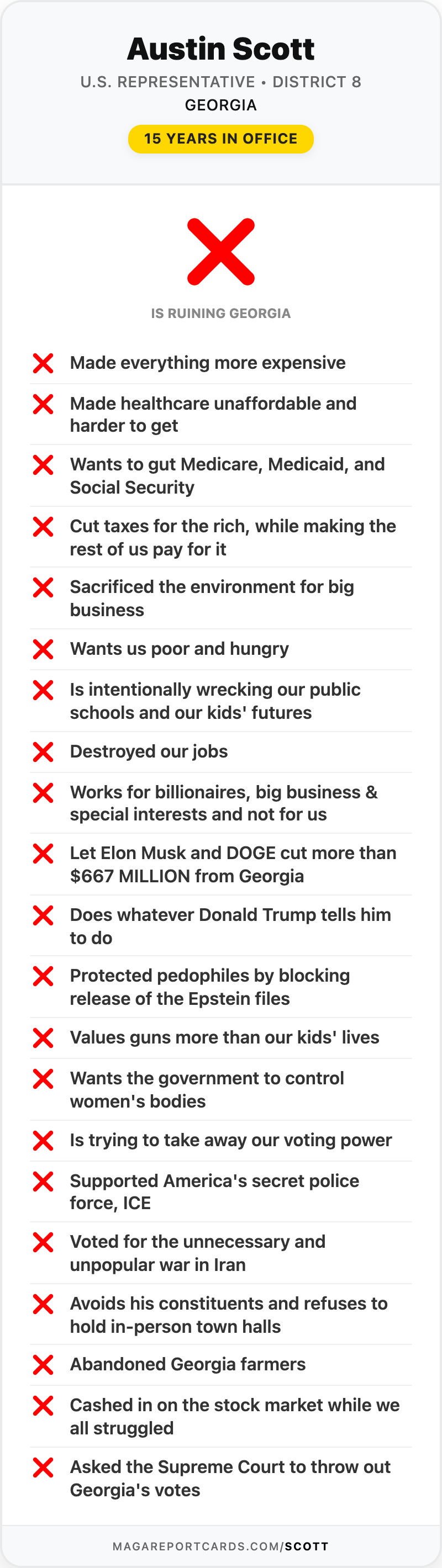
There is a document with Austin Scott's name on it, filed at the Supreme Court of the United States, and you can read it yourself. It has a table of contents. Section III is titled, in full:
"THE USURPATION OF LEGISLATIVE POWER IN GEORGIA PRODUCED UNCONSTITUTIONAL BALLOTS."
Georgia. Not Pennsylvania, not Michigan, not Wisconsin — those got their own sections. Section III is about the state Austin Scott was elected to represent, and about the ballots his own constituents in Georgia's 8th District had filled out five weeks earlier.
Scott has been in Congress since 2011 and is the most senior Republican in Georgia's entire congressional delegation. The brief lists him individually, by name and district: "Amicus U.S. Representative Austin Scott represents the Eighth Congressional District of Georgia in the United States House of Representatives."
What Georgia had already done by the time he signed
This is the part that matters most, because it establishes what Scott knew when he signed.
November 19–20, 2020. Georgia completed a full hand tally of roughly five million ballots — an audit required under a new state law, not a response to any suspected problem. It affirmed Biden's lead, and the state certified the result.
December 2–3, 2020. A second recount — a full statewide machine recount, this one requested by the Trump campaign — ran to its midnight deadline.
December 6, 2020. Georgia's Republican secretary of state, Brad Raffensperger, went on ABC's This Week and told George Stephanopoulos: "We've never found systemic fraud — not enough to overturn the election."
The same day, Georgia's Republican governor, Brian Kemp, and Republican lieutenant governor, Geoff Duncan, refused Trump's demand that they call a special legislative session to appoint a different slate of electors. Their joint statement: "The judicial system remains the only viable — and quickest — option in disputing the results of the November 3rd election in Georgia."
December 7, 2020. Raffensperger recertified. Biden won Georgia by 11,779 votes. As the Atlanta Journal-Constitution reported that day, Raffensperger said: "We have now counted legally cast ballots three times, and the results remain unchanged."
December 10–11, 2020. Austin Scott signed the brief.
Three days after his own state's Republican election chief announced the third count had changed nothing, Scott put his name on a filing asking the Supreme Court to treat Georgia's ballots as unconstitutional.
The brief names Georgia's Republican secretary of state as the violator
This wasn't vague hand-waving about "irregularities." The document Scott signed makes a specific accusation against a specific Georgia Republican:
"Georgia's Secretary of State, Brad Raffensperger, violated Article II of the U.S. Constitution when he usurped legislative power by purporting to issue procedures that were in direct conflict with Georgia's Legislative Acts governing the choosing of electors."
That is the sitting secretary of state of Scott's own state, elected as a Republican, accused in a Supreme Court filing of violating the Constitution — by a Georgia congressman of the same party, four days after that same official said under questioning on national television that there was no systemic fraud.
The lawsuit Scott was supporting was brought by the state of Texas against Georgia, Pennsylvania, Michigan and Wisconsin. Read that again: a Georgia member of Congress signed a brief supporting another state's lawsuit against Georgia.
The Supreme Court threw it out on December 11, 2020, the day after it landed, holding that Texas lacked standing — it had no legally recognizable interest in how other states run their elections.
The letter he signed a month later says the quiet part
Scott's usual defense is that he didn't join the January 6 objections to the electoral count, and that's true. On January 5, 2021, he signed a letter to House leadership — hosted on his own congressional website — laying out why Congress had no role:
"Congress has only a narrow role in the presidential election process. Its job is to count the electors submitted by the states, not to determine which electors the states should have sent."
Credit where it's due: that is the correct constitutional reading, and it took some nerve to write it down on January 5, 2021.
But read the rest of the letter, because it does not say the election was fine. It opens by declaring the signers "outraged at the significant abuses in our election system resulting from the reckless adoption of mail-in ballots," says the elections in six battleground states "raise profound questions," and complains that Congress had held only one hearing on election integrity.
And then it points at a different door:
"Of the six states as to which questions have been raised, five have legislatures that are controlled by Republicans, and they all have the power to send a new slate of electoral votes to Congress if they deem such action appropriate under state law."
Georgia is one of those states, and Georgia's legislature is Republican-controlled. So the letter isn't a defense of Georgia's result. It's an argument that Congress shouldn't overturn it — combined with a note that Republican state legislatures still could.
Scott signed that on January 5. Georgia's Republican governor and lieutenant governor had publicly said one month earlier that a legislature retroactively naming its own electors would be unconstitutional and immediately blocked by the courts. Scott's letter treats it as an open option anyway.
He isn't the only one, but those were Georgia's ballots
126 House Republicans signed that brief, and this site has written about several of them. Mississippi's Michael Guest signed it, voted to reject two states' electors, and then told a Jackson TV station in February 2021 that "we were never presented evidence to show that the voter irregularity, the voter fraud was substantial enough that the elections should be overturned" — after he'd already voted to throw those states' ballots out.
What separates Scott from most of the 126 is whose votes he was asking the Court to void. A congressman from Alabama or Tennessee signing that brief was asking the Court to throw out someone else's ballots. Austin Scott was asking it to throw out Georgia's — the same ballots his own constituents had cast in the same election that returned him to Congress. He asked a court to declare his own voters' ballots unconstitutional, and he did it after his own party's state officials had counted them three times and told him they were fine.
There is nowhere to ask him about it
If a voter in Warner Robins wanted to ask Austin Scott why he signed a brief attacking Georgia's ballots, there is no room to do it in.
Scott hasn't held a public town hall in his district since 2015 — and that one was only for veterans. In March 2025, close to 200 constituents came to his district office anyway, put a blue blazer on an empty folding chair, and asked their questions to it. Nobody from his office came outside.
He is now running for a ninth term.
Every piece of this is on the public record, in his own filings, on his own website. The brief is on the Supreme Court's docket. The letter is on austinscott.house.gov. The counts are certified by a Republican secretary of state who said out loud, three days before Scott signed, that nothing had changed.
Georgia voters counted their ballots three times. Their most senior Republican congressman signed a document calling them unconstitutional anyway. He has never had to answer a single question about it from the people who cast them.
Source
The primary documents: Texas v. Pennsylvania — amicus brief of 126 House Republicans, including Austin Scott (U.S. Supreme Court, December 2020), and the January 5, 2021 letter to House leadership posted on Scott's own House website. Photo: official House portrait via Wikimedia Commons.