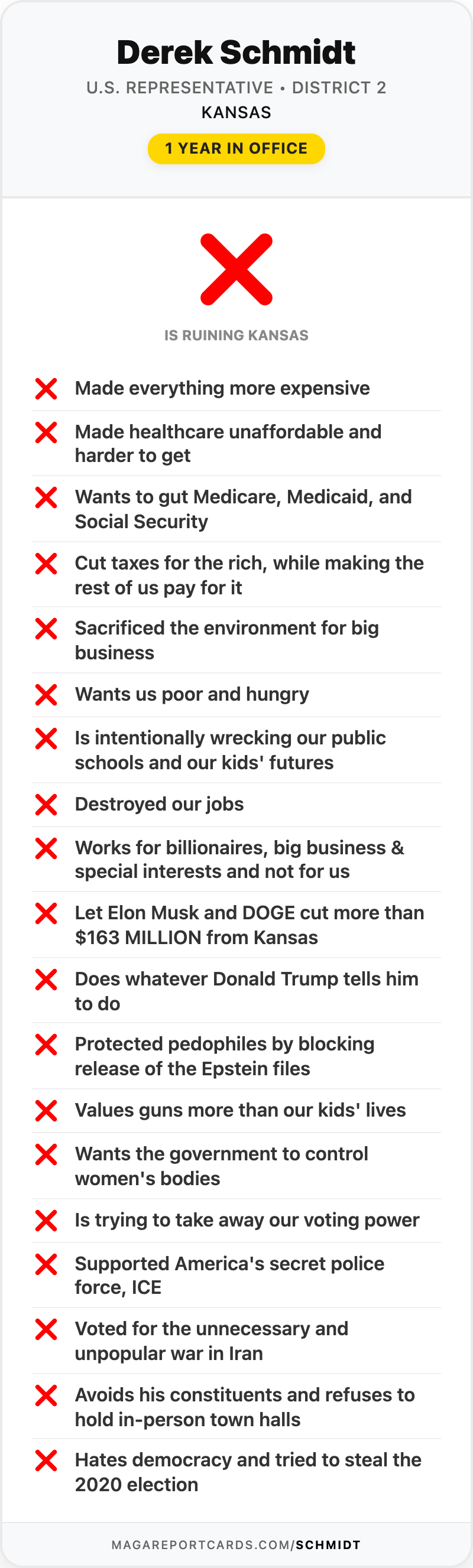
Before he was a congressman, Derek Schmidt spent 12 years as the Attorney General of Kansas. That job comes with real power. You decide which cases the state brings. You tell every prosecutor and police officer in Kansas what the law means. And when a conspiracy theory shows up at your door, you get to decide whether to shut it down or give it a hearing.
Twice, Schmidt gave it a hearing.
2012: The Kansas board that wanted to see Obama's birth certificate
In September 2012, a Manhattan, Kansas man named Joe Montgomery filed an objection with the state. His claim: Barack Obama — the sitting President of the United States, running for reelection — should not be allowed on the Kansas ballot, because his father had been a British subject from Kenya.
This was the "birther" theory. By 2012 it had been debunked for years. Obama had released his long-form Hawaii birth certificate more than a year earlier, in April 2011.
The objection went to the Kansas State Objections Board. That board had three members, all Republicans: Secretary of State Kris Kobach, Lieutenant Governor Jeff Colyer, and Attorney General Derek Schmidt.
They could have thrown it out in five minutes. Instead, on September 13, the board voted unanimously to delay a decision and go looking for more evidence. They asked for certified documents from Hawaii verifying the President's birth records, and directed staff to contact officials in Arizona and Mississippi about similar challenges there.
Kobach, who ran the meeting, put it this way: "I do think the factual record could be supplemented." He also said he didn't think the objection was "frivolous."
Here is the part that should stick with you. According to the Associated Press account of that hearing, Schmidt disagreed with the legal theory. He didn't buy Montgomery's argument that both of a president's parents have to be U.S. citizens. He knew the claim was junk.
He voted to keep it alive anyway.
Think about what that meant in practice. The chief legal officer of the state of Kansas put his name on a decision that treated "show us the President's birth certificate" as a reasonable request the government should follow up on. Not a fringe blog. Not a talk radio host. A state board with the power to decide who appears on a ballot.
The story ended two days later, and not because the board found its spine. Montgomery withdrew the objection himself on September 14, saying he and people around him had been intimidated. The board then closed the matter without ever ruling on whether the President of the United States was a citizen.
Kansas came within one man's change of heart of having a sitting president's eligibility formally adjudicated by three Republican officials. Schmidt was one of the three.
Why that matters now
It would be easier to write off 2012 as a strange moment that got out of hand — if Schmidt hadn't done something very similar eight years later.
As Attorney General in 2020, Schmidt sat on the board of the Rule of Law Defense Fund, the group whose robocall gave out the time and place of the January 6 march on the Capitol. He left the board in August 2020. The next month his office sent two top aides to an RLDF "war games" summit in Atlanta, where the group's own executive director described the agenda as "conversations planning for what could come if we lose the White House."
Then in December 2020, Schmidt signed Kansas onto the amicus brief supporting Texas v. Pennsylvania — the lawsuit asking the Supreme Court to throw out certified election results in four other states. The Supreme Court tossed it. The Wichita Eagle's editorial board wrote that Schmidt had "signed our state's name to an embarrassing and baseless lawsuit aimed at overturning the presidential election."
Same instinct, eight years apart. When a conspiracy theory about an election shows up, Derek Schmidt does not slam the door. He holds it open and lets the state's authority walk through with it.
2020: Telling police not to enforce a public health order
The second story is about a pandemic.
On April 7, 2020 — three weeks into COVID, before vaccines, before treatments — Kansas health officials reported that three coronavirus clusters had been traced to church gatherings. Governor Laura Kelly responded with Executive Order 20-18, limiting religious services and funerals to 10 people. It took effect the next day, five days before Easter.
Most Kansas churches had already moved to livestreams or drive-up services. This was not a controversial ask.
Schmidt made it one. On April 8, he issued a memo to prosecutors and law enforcement across Kansas saying the order likely violated state law and the Kansas Constitution. He allowed that the 10-person limit was sound public health advice that Kansans should follow. And then he told the people who enforce the law to stand down anyway:
"We also strongly discourage law enforcement from attempting to enforce the requirements of EO 20-18 as violations of the criminal law."
That is the Attorney General of Kansas telling every police officer in the state to ignore a public health order during a pandemic — days before Easter, after his own state's health department had already traced outbreaks to church gatherings.
Hours later, the Republican-led Legislative Coordinating Council voted 5-2 to revoke Kelly's order outright, citing the constitutional concerns Schmidt had just handed them.
Kelly called the memo "unusual" and "unwarranted," and said it had "injected confusion into the current situation." On the legislature's vote, she was blunter: "There are real life consequences to the partisan games Republican leaders played today."
The courts put the order back
Kelly sued. On the evening of Saturday, April 11 — the night before Easter — the Kansas Supreme Court ruled that the legislative panel had no authority to revoke her order. The 10-person limit stood through Easter Sunday. The Associated Press reported the court's decision the same weekend: a seven-member legislative committee does not get to overrule the governor.
Notably, the justices made clear they were not deciding whether the order violated religious freedom. That question wasn't before them. The ruling was about who has the power to do what.
Schmidt filed a brief in the case anyway, arguing the governor's emergency powers were "unprecedented" in their reach. "In short," he wrote, "we all are in uncharted waters that may test the limits of emergency powers."
He was right that the waters were uncharted. That is exactly why the state's top law enforcement officer telling police to stop enforcing a health order — before any court had ruled a single thing — was such a reckless way to swim in them. A lawyer can argue an order is unconstitutional. An Attorney General can go to court and say so. Schmidt did both. But he also did a third thing that wasn't necessary and wasn't his call: he told the cops to skip it, and he did it in the exact week the answer mattered most.
What this tells us about the congressman
Derek Schmidt now represents Kansas's 2nd District in Congress. He'd like voters to see 12 years as Attorney General as a résumé line.
It's more than that. It's a record. And the record shows a pattern: when the moment called for someone to say no, that's not real or no, this isn't the week for that, Schmidt used the power of his office to say the opposite. He lent state authority to a birther complaint he personally thought was wrong. He lent state authority to a lawsuit trying to void other states' election results. He lent state authority to undercutting a health order the week his own state had traced outbreaks to churches.
That's not a series of unlucky calls. It's a habit.
We deserve better.
Sources
- Kansas Republicans: We need to see Obama's birth certificate — CBS News, September 2012
- Kansas board delays decision on Obama, ballot — Associated Press / Deseret News, September 2012
- Kansas OKs Obama ballot spot for November — Fox News/AP, September 2012
- Ahead of Easter Sunday, Kansas lawmakers revoke governor's restrictions on church gatherings — Route Fifty, April 2020
- As Easter looms, Kansas GOP lawmakers overturn governor's order limiting church gatherings — Talking Points Memo, April 2020
- Kansas Supreme Court sides with governor, preserving ban on large church services — KMUW, April 11, 2020