In July 2025, the Senate took up a bill to cancel $1.1 billion Congress had already approved for the Corporation for Public Broadcasting. For four tribal radio stations in South Dakota, that money was most of what kept them on the air.
Mike Rounds said he wouldn't vote for it.
Then he did — after getting a promise. Not a law. A promise.
The deal
Rounds had been holding out on Trump's rescissions package. On July 15, 2025, he said he'd vote yes after all, posting on X:
"We wanted to make sure tribal broadcast services in South Dakota continued to operate which provide potentially lifesaving emergency alerts. We worked with the Trump administration to find Green New Deal money that could be reallocated to continue grants to tribal radio stations without interruption."
What he'd negotiated was this: the Trump administration would move $9.4 million out of an Interior Department account to at least two dozen Native American radio stations. It was never written into the bill. Nothing in the law required anyone to send that money. It was, in the word reporters kept using, a handshake.
Two days later, at 2:18 in the morning on July 17, 2025, H.R. 4 passed the Senate 51 to 48. Rounds voted yes. Gone with it: $535 million a year in public broadcasting money Congress had already locked in for fiscal 2026 and 2027.
Four days after that, Trump endorsed him for reelection.
The endorsement
On July 21, 2025, Trump posted that Rounds is an "incredibly strong advocate for the wonderful people of South Dakota" and gave him his "Complete and Total Endorsement." Rounds shared it and thanked him: "I look forward to working with you to make America even better!"
The timing is not in dispute. South Dakota Searchlight's account of it, republished by Sioux Falls Live, ran under a headline that says it plainly — Rounds won the endorsement "after playing deal-making role in rescinding public media funds" — and its opening sentence notes the endorsement came "days after Rounds helped pass Trump's cancellation of previously approved funds for public broadcasting and foreign aid."
It was a shift. Rounds had endorsed Tim Scott, not Trump, in the 2024 primary, and skipped Trump's 2023 Rapid City rally. Trump had once said of him: "I will never endorse this jerk again." Now he had the complete and total endorsement.
The vote and the endorsement are two separate facts sitting four days apart. Readers can decide what to make of that. What isn't a matter of interpretation is what happened to the radio stations.
Somebody told him exactly what would happen
Rounds did not have to guess how this would turn out. The day after he announced his yes vote, the head of America's Public Television Stations put out a statement about the side deal he'd just made. Kate Riley, the group's CEO, said it was
"at best a short-term, half-measure that will still result in cuts and reduced service at the stations it purports to save, while leaving behind all other stations, including many that serve Native populations."
She spelled out why. CPB didn't just write checks — it paid for the infrastructure that lets small stations exist at all: the interconnection and distribution system, emergency relief grants, staff training, and programs built specifically for Native and rural service areas. Take that away and hand a station a one-year grant, Riley said, and you get "station collapse and service disruption, particularly in rural, Tribal and underserved communities."
That was July 16, 2025. Rounds voted yes anyway, at 2:18 the next morning.
The money showed up. Once.
The $9.4 million did get disbursed, through the Bureau of Indian Affairs. By November 2025, the Bureau of Indian Affairs had sent award notices to KILI on the Pine Ridge Reservation, KOYA at Rosebud and KDKO at Yankton, and said an award was expected for KLND, which serves Standing Rock and Cheyenne River. The amounts nearly matched what CPB would have given out, according to station sources.
But it was one-time money for one fiscal year. There is no mechanism behind it. CPB used to distribute funding on a standing basis; CPB dissolved itself in January 2026. Everything now has to be requested again, by hand, every single year, through the appropriations process — and if it isn't, it simply doesn't come.
Rounds said as much himself. Asked in April 2026 what happens next, he said:
"I continue to work with my colleagues on both committees to secure continued funding for tribal radio stations in FY 27. These radio stations are critical for communications in some of the most rural parts of South Dakota and we must make certain they have the funding needed to continue operating."
Read that again. He is describing, as ongoing work, the problem he created by voting yes. He is on the Senate Appropriations subcommittee on the Interior and on the Committee on Indian Affairs. He voted to end the standing funding, then took a seat at the table where somebody now has to beg for a replacement every year.
What the stations say happens if he doesn't get it
Native Public Media surveyed the tribal stations hit by the clawback. About 36 stations in its network have been "heavily impacted." The survey's answers:
- A majority said they will close within six months to a year without continued federal funding.
- Some said they would shutter immediately.
- About a third had relied on CPB for 80% to 100% of their operations.
- The vast majority said they were considering layoffs.
"We will begin to see a cascade of closures as the years go by, starting out with immediate closures, followed by the next wave," said Loris Taylor, CEO of Native Public Media. "It's going to be a ripple effect happening across Indian Country."
John Miller manages KOYA in rural South Dakota. He's been getting ready for the money to dry up.
"I'm not really looking forward to it, to be honest with you, but just, you know, knowing that it's coming, and that we've got to be really proactive in our efforts to try to keep afloat. It's going to be hard."
"If those folks in Washington can come up with a plan that would better help us, you know, I'm for it. I just hope that when everything is said and done that we're not left to just go away."
These are not entertainment stations. On reservations that are news deserts, they carry emergency alerts, weather warnings, school closings, health advisories and election information — and they broadcast in tribal languages. Rounds knows this. It's the argument he made when he asked for the $9.4 million. He called the alerts "potentially lifesaving."
He then cast the vote that removed the funding that pays for them.
This is a pattern with Rounds, not an accident
Rounds joined the Senate DOGE Caucus in January 2025, saying he was "ready to work with my colleagues in the Senate to do our part in assisting President Trump in cutting spending, eliminating unnecessary programs and streamlining the federal government."
Within weeks, calls to his own office for help tripled as the cuts hit South Dakotans. By mid-March his staff were working 139 separate cases trying to undo the damage. By April his offices had fielded nearly 2,300 calls about DOGE. He admitted the people doing the cutting didn't understand what they were cutting: "They went in, and they basically just started unplugging stuff."
He kept defending the cuts anyway.
It's the same move he made on tariffs. He told an Americans for Prosperity luncheon crowd in Rapid City that Trump's tariffs were "of concern" and that "consumers will pay a part of that" — then voted against every Senate resolution that would have ended the tariff emergencies. State the worry out loud. Vote with Trump. Take credit for the worry.
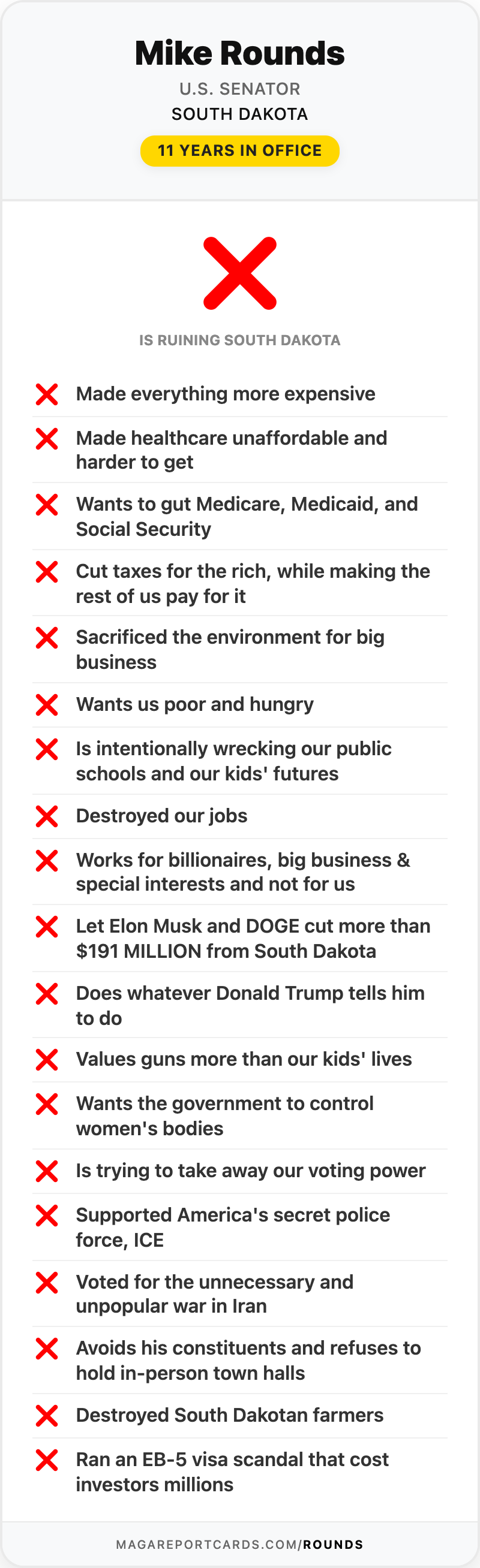
Rounds has been in the Senate since 2015. He also doesn't hold open, in-person town halls where any South Dakotan can show up and ask him about it — in April 2025, state Democrats had to hold their own in four cities "in the absence of South Dakota's Republican senators and congressman."
What a real fix would have looked like
There was an obvious alternative available to Rounds in July 2025, and it cost nothing: vote no.
The bill passed 51 to 48. And immediately after Rounds announced his support, the Senate advanced it on a procedural vote of 51 to 50. Rounds wasn't one vote among many. He was the vote the thing hinged on, which is exactly why he had the leverage to negotiate in the first place.
He could have used that leverage to demand the tribal radio money be written into the bill. He took a promise instead.
Instead he accepted a promise that expires, on behalf of stations that don't have another source of money, and got an endorsement out of it. Now the stations are counting down and he's issuing statements about how he "continues to work" on it.
South Dakota has nine reservations. Four stations serve five of them. If the FY27 request doesn't land, the emergency alerts Rounds called lifesaving go off the air — and the vote that started it will still be on the record with his name next to it.
We deserve better.
Source
Em Luetkemeyer, "Some Republicans want to reverse GOP cuts to rural and tribal radio stations," Current / NOTUS (April 17, 2026). Photo: Kathryn Squyres / Current.