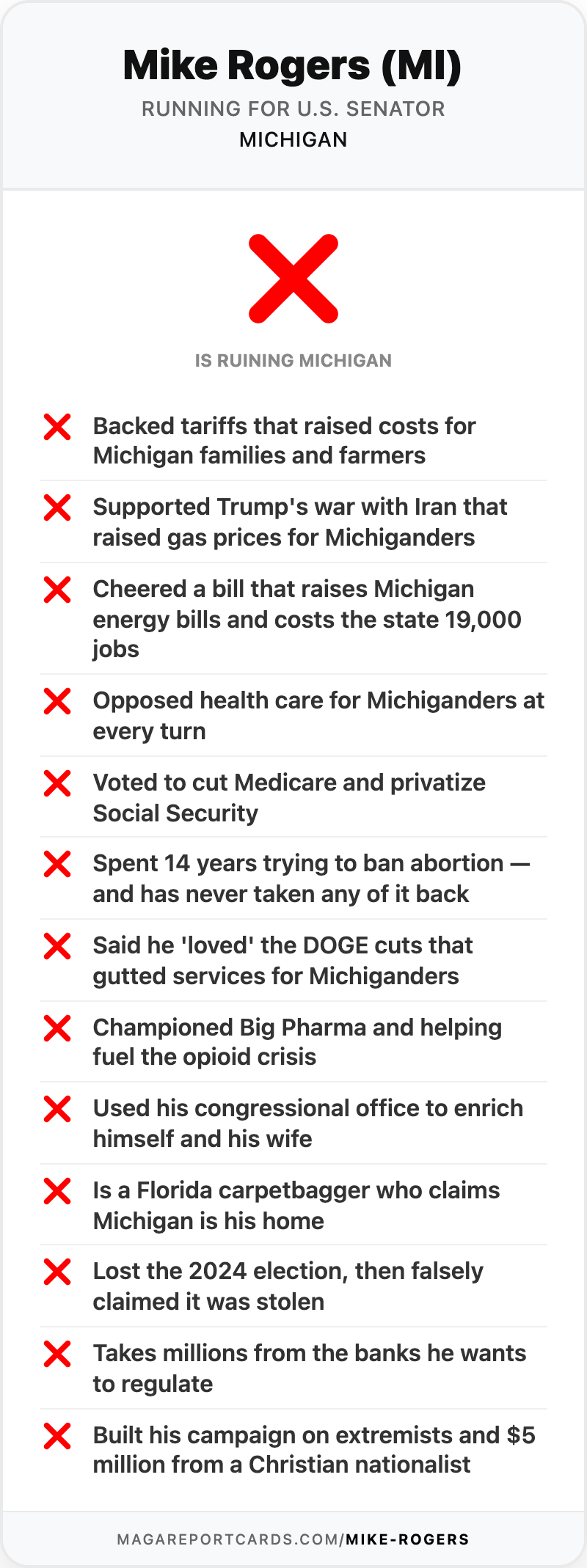
Mike Rogers (MI) is asking Michigan to send him to the Senate. A new investigation shows what he did when he was on the inside of a company that was failing: he made sure he got paid.
The American Prospect and the Center for Media and Democracy went through Rogers's financial filings and the court records from the bankruptcy of IronNet, a cybersecurity company where Rogers sat on the board for eight years. Here is what they found.
The board seat
Rogers chaired the House Intelligence Committee for four years. He retired from Congress in January 2015 and joined IronNet's board right away, according to his filings.
IronNet was started by Keith Alexander, the former head of the National Security Agency. Its pitch was its connections inside the national security world. It never landed the big government contracts it was chasing.
Rogers wasn't a passive name on the letterhead. He sat on the board's audit committee — the group responsible for watching the company's books.
What happened to everyone else
IronNet went public in August 2021 at about $14 a share. By the time Rogers left the board in July 2023, it was trading at 14 cents. That is a 99% loss.
Investors sued, saying the company had inflated its revenue to push up its stock price. The bankrupt firm settled that lawsuit for $6.6 million in September 2024. IronNet filed for bankruptcy in 2023, and ordinary shareholders were wiped out.
What happened to Rogers
Rogers did fine.
- Board pay: IronNet paid him $724,887 from January 2022 on, according to his financial disclosures, as reviewed by the Center for Media and Democracy.
- A place at the front of the line: In December 2022, as the company was running out of money, IronNet borrowed $6.9 million from eight lenders, nearly all of them its own directors and their affiliates, through "secured promissory notes" paying 13.8% interest. The company's own filing with the Securities and Exchange Commission names "Hon. Michael J. Rogers" among the directors who made the loans. "Secured" means the loans were backed by "substantially all of the assets" of the company other than its intellectual property — so if it went under, those insiders would be repaid before shareholders saw a dime.
- Still owed money: Rogers's December 2023 disclosure lists a note from IronNet worth $250,000 to $500,000. IronNet's bankruptcy claims register, kept by the case's claims agent Stretto, still lists him as a secured creditor owed $557,883, and he was on the service list of a September 2026 court filing in the case — even though, the Prospect reports, his Senate campaign disclosures for the past three years don't list it.
- Stock gains: The same 2023 disclosure shows $100,000 to $1 million in capital gains from IronNet stock.
"Obviously they had taken care of themselves first and totally ignored all other shareholders in the entity," Craig Holman of Public Citizen said in the report. "No doubt most investors in IronNet just lost a lot of money from the bankruptcy proceedings," Holman said. "But Rogers made a lot of money."
If Rogers sold stock while he was still on the board, the Prospect notes, he would have had to report it to the SEC — and he filed no such report. His campaign did not answer questions.
The investor with ties to a Russian oligarch
IronNet's board also included Andre Pienaar, a South African private intelligence operative whose firm put tens of millions into the company. As the Prospect recounts, the Associated Press obtained documents indicating Pienaar sat on the board of a South African mine as a representative of Viktor Vekselberg, a Russian oligarch who has been sanctioned twice by the U.S. Pienaar denies any connection.
According to the AP, IronNet collapsed in part because of "associations that could have left the firm vulnerable to meddling by the Kremlin." Rogers — the former chairman of the House Intelligence Committee — sat on that board alongside him. Pienaar's firms later bought up much of what was left of IronNet.
A career built on the revolving door
IronNet isn't a one-off. Rogers has made his money since Congress by selling his national security résumé. He disclosed almost $2 million in income from board positions at tech companies and cybersecurity firms in 2022 and 2023 alone, Business Insider found.
We've documented the rest of the picture. In one three-month stretch, his campaign spent more than $100,000 on luxury travel, most of it on private jets. And even though he's worth millions, he's still collecting a taxpayer-funded pension from his years in the Michigan Legislature.
What the filings show
Mike Rogers (MI) sat on the audit committee of IronNet, a cybersecurity firm that lost 99% of its stock value and went bankrupt, wiping out ordinary investors. In 2022 and 2023 alone it paid him $724,887, and as it ran out of money he was one of the insiders who lent it cash through secured notes at 13.8% interest that put them ahead of shareholders. The bankruptcy's claims register still lists him as a secured creditor owed $557,883.