When a candidate for governor is asked a simple yes-or-no question about your paycheck, you'd like a straight answer. Ohio workers didn't get one.
In a recent Wall Street Journal interview, Vivek Ramaswamy was asked directly whether he would push so-called "right-to-work" laws in Ohio. He wouldn't say no. Instead, according to the interview, he changed the subject to Michigan and said business success is "a composite of factors," adding that "as a business leader, I believe prioritization matters."
That's a fancy way of dodging. And when someone running to lead your state won't rule out a policy that cuts wages, the dodge is the story.
What "Right-to-Work" Actually Does
"Right-to-work" is one of those names designed to sound good while doing the opposite. It doesn't give anyone a job or a right to one. What it does is weaken unions — by letting people benefit from a union contract without paying anything to support it. Starved of resources, unions lose the power to bargain for better pay and benefits. That's the whole point of the law.
And the result shows up in workers' paychecks — union and non-union alike. The nonpartisan Economic Policy Institute found that wages in right-to-work states are about 3.1% lower than in states without these laws, even after adjusting for the cost of living. As Axios summed up the research, right-to-work laws lower wages and depress union membership across the board.
When unions are strong, even workers who aren't in a union earn more, because employers have to compete to keep good workers. Weaken the unions, and everybody's pay takes the hit. That's what Ramaswamy won't rule out doing to Ohio.
Ohio Already Answered This Question
Here's what makes the dodge worse: Ohioans have already weighed in, loud and clear.
Back in 2011, Ohio Republicans passed Senate Bill 5, a law gutting collective bargaining rights for public workers like teachers, firefighters, and police. Voters fought back and put it on the ballot. In November 2011, they repealed it by a landslide, about 62% to 38%.
Ohio is not a right-to-work state, and that's not an accident. It's because Ohioans went to the polls and defended the right of workers to organize and bargain together. Ramaswamy, who wants to be their governor, won't promise to respect that decision.
This Is the Pattern, Not the Exception
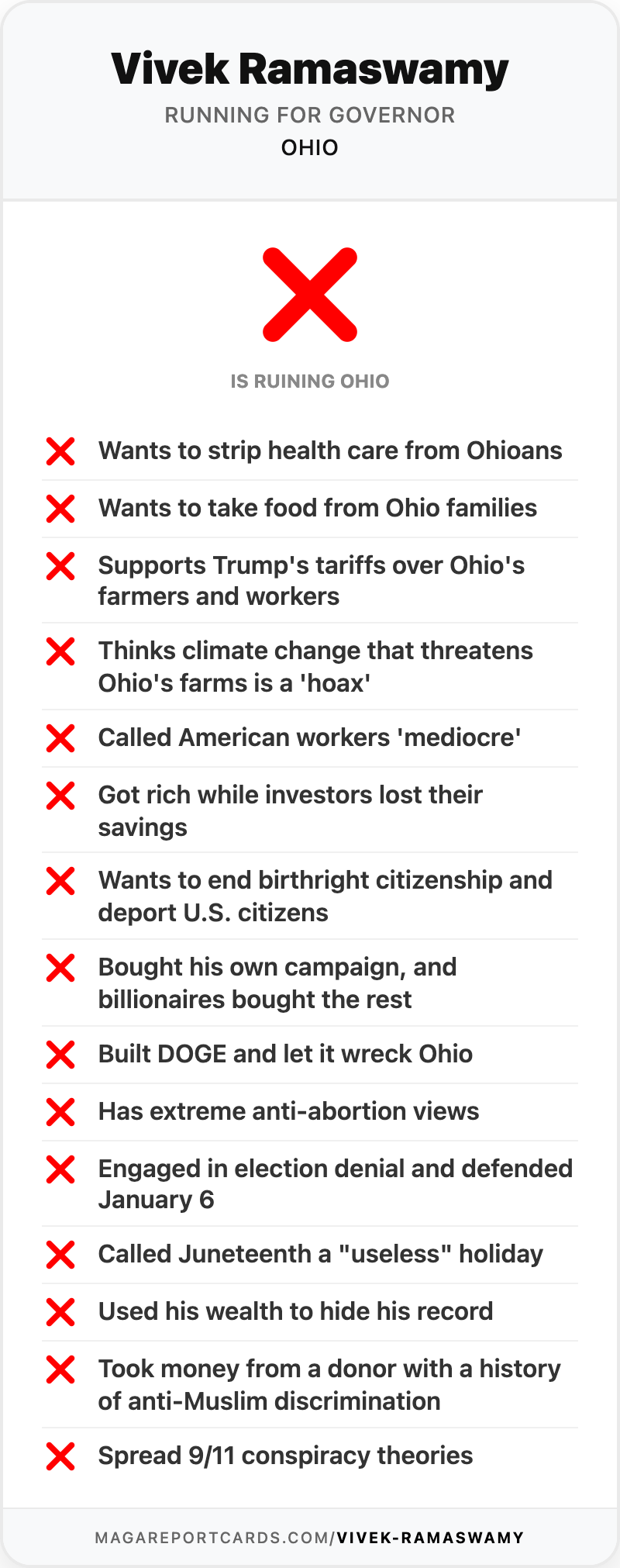
Refusing to rule out an anti-worker law isn't a stray comment. It lines up perfectly with how Vivek Ramaswamy has treated working people his whole political career.
- He won't say whether he backs Trump's tariffs, even as they hammered Ohio soybean farmers and cost an Ohio manufacturer millions of dollars.
- He co-built DOGE, the cost-cutting effort that put an Ohio Social Security office on its list to close in a state with 83,000 federal workers. In 2023 he called for a 75% reduction of the federal workforce.
- He wants work requirements on Medicaid and food assistance: "We will reattach work requirements to Medicaid & welfare," he wrote in March 2025.
A billionaire who built a fortune in business, then helped build the operation that went on to fire federal workers, now won't promise to protect Ohio workers' bargaining power. The "composite of factors" answer wasn't confusion. It was a tell.
Ohio Workers Deserve a Straight Answer
There's nothing complicated about the question. Will you, or won't you, push a law that lowers wages and weakens unions in Ohio? A candidate who actually opposed right-to-work would just say no. Vivek Ramaswamy wouldn't.
Ohioans already settled the union question at the ballot box in 2011. They shouldn't have to fight it all over again because a governor candidate won't take "no" off the table.
Source
This post is based on the Wall Street Journal interview flagged by the Ohio Democratic Party, in which Ramaswamy declined to rule out pushing right-to-work in Ohio.