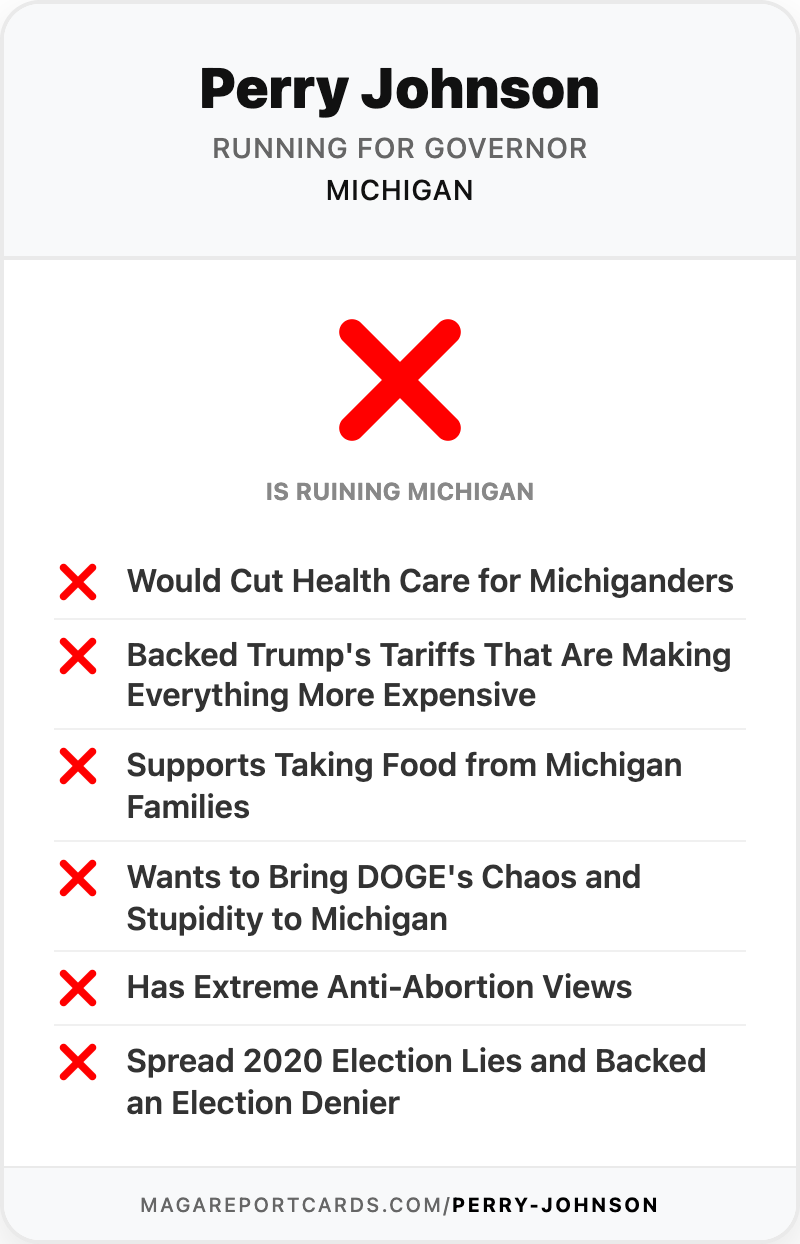
Michigan Republicans pick a nominee for governor tomorrow, August 4. Perry Johnson will be on that ballot.
Four years ago he wasn't. In 2022 Johnson ran for governor, paid a company to collect the signatures that get a candidate's name printed on the ballot, and turned them in. Thousands of them were forged. The state threw him off the ballot, he sued, and he lost at every level — all the way to the Michigan Supreme Court.
Here is the part that matters most, and it's the part that gets left out: Johnson didn't forge those signatures, and nobody says he did. A man is in prison right now for defrauding him. Johnson is a victim in that case, by name, in the Attorney General's own press release.
So this isn't a story about Perry Johnson committing fraud. It's a story about a man whose entire brand — his whole pitch for why he should run Michigan — is that he catches problems other people miss. And he didn't catch this one.
What actually happened in 2022
On May 23, 2022, the Michigan Bureau of Elections told the Board of State Canvassers that five of the ten Republicans running for governor hadn't filed enough valid signatures to qualify. Johnson was one of them.
The scale was staggering. State elections staff identified 36 petition circulators who submitted fraudulent sheets across at least 10 petition drives — at least 68,000 invalid signatures in all, covering races for governor and for circuit and district judge.
The bureau had never seen anything like it, and said so in writing:
"The Bureau is unaware of another election cycle in which this many circulators submitted such a substantial volume of fraudulent petition sheets consisting of invalid signatures, nor an instance in which it affected as many candidate petitions as at present."
A candidate for governor needs 15,000 valid signatures. Of what Johnson turned in, 6,983 signatures came from circulators the bureau identified as fraudulent. Take those away and he didn't have enough. The Detroit News headline that week was blunt: Craig, Johnson, 3 others ineligible for ballot, Bureau of Elections says.
Johnson went to court. A three-judge Court of Appeals panel ruled against him unanimously. Then the Michigan Supreme Court upheld his disqualification on June 3, 2022. He watched the August 2022 primary from the sidelines.
He was defrauded — and the state proved it
Give Johnson this much: he was right that he'd been ripped off, and he stuck with it until a jury agreed.
In February 2026, a Macomb County jury convicted Shawn Wilmoth and Willie Reed of multiple felonies. On March 18, 2026, the Attorney General announced Wilmoth's sentence: four to 20 years in prison, and $376,601 in restitution. The counts included conducting a criminal enterprise and seven counts of election law forgery.
The press release names the people he defrauded — "gubernatorial candidates Donna Brandenburg, Mike Brown, Perry Johnson, and Michael Markey" plus three judicial candidates. It describes the scheme plainly: the campaigns paid Wilmoth's businesses nearly $400,000 for real signature collection, and he "knowingly delivered tens of thousands of forged signatures."
Attorney General Dana Nessel put it this way:
"This defendant ran a calculated scheme that sabotaged candidates and stripped Michigan voters of choices in the 2022 election."
The 2022 bureau report had said the same thing at the time — that there was no reason to believe any of the candidates or campaigns knew about the fraud.
Johnson submitted a victim impact statement. He wrote that the verdict was "a clear and undisputable determination of fraud being committed against five Republican candidates," and added: "Simply put, every voter in this state was a victim of their fraud."
That's fair. It's also true.
But the courts still said it was his job
Here's the thing about being defrauded by your own vendor: it doesn't put your name on the ballot.
Michigan law makes the candidate responsible for what the candidate files. That's why Johnson lost in court even though he hadn't done anything wrong himself — the question was never whether he was a nice guy who got cheated. It was whether the state had to certify petitions stuffed with obvious forgeries. The courts said no.
And in the same 2022 report that cleared the campaigns of knowing about the fraud, the bureau added a recommendation for what candidates should do about it in the future. It recommended that campaigns implement a quality control process before filing their petitions.
Read that again with the candidate in mind.
The quality guru
Perry Johnson does not have a quality control hobby. Quality control is his business, his fortune, and his identity.
He made his fortune providing training in quality standards to the auto industry, building an empire on "quality" — companies that certify whether other organizations meet quality management standards. He calls himself the Quality Guru. It's his X handle. It's the pitch.
In 2022, the state of Michigan had to tell a field of candidates that included the Quality Guru that they ought to consider checking their work before submitting it.
He paid a contractor roughly $400,000 for signatures, and tens of thousands of them were fake — and the process that caught it was the state's, not his. That's not a moral failing. It's a competence failing, in the one area where he claims the deepest expertise.
2026: he tried again, and it still wasn't clean
To his credit, Johnson clearly learned something. For 2026 he built what he called a "first-of-its-kind petition verification system designed to ensure complete accuracy and eliminate fraud" — texting people who signed to confirm they'd actually signed.
When he filed in April, he told reporters his campaign had collected about 38,000 signatures and spent two and a half weeks checking them against census data, the voter file, and cell numbers.
"I am the quality guru, so I better get quality petitions," he said. "We did go overboard, but we know we'll be on the ballot."
Then in May, a PAC supporting his rival John James filed a challenge anyway. The complaint claimed at least two of Johnson's circulators — Robert Harris and Brigette Hawkins — were on the Bureau of Elections' Fraud Watch List. It alleged "at least 11 instances of signatures by people who have since confirmed they did not sign the petitions," and sheets showing "identical handwriting across the entire sheet." Strip the disputed sheets, the challengers argued, and Johnson would land at 14,550 — just under the 15,000 he needed.
Johnson called it "nonsense" from a "desperate" campaign, and he had a point about the motive: he'd filed his own fraud challenge against James the same day. This was two campaigns throwing the same accusation at each other.
And Johnson won. On May 28, 2026, the Board of State Canvassers cleared both men for the ballot. Both had turned in enough cushion that the disputed signatures didn't sink either one. Pastor Ralph Rebandt wasn't so lucky and fell short.
But look at how he won. The most serious allegation against Johnson — that his campaign printed the required "paid for by" disclaimer onto petition sheets after voters had already signed them — never got decided. Mission Michigan's attorney called it forgery under election law and "not even a close call." The board didn't rule on whether it happened. It set the claim aside because it arrived after the challenge deadline with no supporting affidavit. Board Vice Chair Mary Ellen Gurewitz: "We don't have the affidavit. So, what are we supposed to do? Act on a rumor?"
Johnson's lawyer called the whole thing "an obvious, bad faith smear attempt." Maybe it was. The point is nobody ever found out, because it was late — not because it was false.
Two cycles running, the Quality Guru's petitions have been the ones under a microscope.
Why this matters on August 4
Johnson's central promise for Michigan is an audit. He wants to eliminate the state income tax — nearly 30% of state revenue, more than $13 billion a year — and says he'll find the money by rooting out waste. "I'm the perfect DOGE guy," he told MLive. Asked how he'd actually close a $13 billion hole, he told Michigan Public: "I propose we audit everything."
That pitch rests entirely on one assumption: that Perry Johnson is unusually good at inspecting things.
The best available test of that assumption is the one job where the stakes were highest and personal — getting his own name on a ballot. He hired a vendor, paid roughly $400,000, and didn't detect that tens of thousands of the signatures were fake. State employees caught it instead. It cost him the race.
He was wronged. A jury said so and a judge sent a man to prison for it. But "I was defrauded and didn't notice" is a strange closing argument from the guy whose plan is to find $13 billion nobody else can see.
Michigan deserves better.
Source
This post draws on reporting from Michigan Advance, Bridge Michigan, and Michigan Public, plus the Michigan Attorney General's March 18, 2026 sentencing announcement. Top photo of John James and Perry Johnson delivering their petition signatures in Lansing by Katherine Dailey / Michigan Advance.