For two years, Ken Paxton told Texans that a Catholic migrant shelter in El Paso was a smuggling operation and that a Houston immigrant rights group was breaking the law. This year he went to court to have the country's largest Muslim civil rights group declared a terrorist organization. He used the full power of the Texas attorney general's office to try to shut all three down.
Then he lost his U.S. Senate race. And within two weeks, his office walked away from every one of those cases.
What he dropped, and when
On November 9 — six days after the election — Paxton's office dropped its suit to shut down Annunciation House, the El Paso shelter network. It filed what's called a nonsuit with prejudice, which means the office can never bring the same claims against the shelter again. The Texas Tribune reported the case had been set for a hearing in March, and that the shelter's founder, Ruben Garcia, was scheduled to be questioned under oath later the week the suit was dropped.
The same day, according to The Advocate, Paxton also dropped his case against FIEL Houston, an immigrant rights group his office had accused of breaking nonprofit rules through its political advocacy. Then he withdrew his lawsuit against the NCAA over transgender athletes.
On November 16, he dropped the lawsuit seeking to ban CAIR, the Council on American-Islamic Relations, from operating in Texas. That suit, filed in February, had asked a Collin County judge to declare the Muslim civil rights group a foreign terrorist and criminal organization working to "establish dominion through Sharia law."
None of these cases ended because a court ruled for Paxton. They ended because voters ruled against him. Paxton lost to Democrat James Talarico by double digits, and Democrat Nathan Johnson won the race to replace him as attorney general. Johnson has said he will review Paxton's politically motivated cases.
If the cases were real, why drop them?
That's the question Paxton hasn't answered. His office didn't immediately respond when the Tribune asked.
Think about what he claimed. He said Annunciation House was involved in harboring, human smuggling and running a "stash house." If an attorney general believed that, he would not give up the case — permanently — two months before he leaves office. You don't promise never to sue again over smuggling you actually think is happening.
What changed between October and November wasn't the evidence. It was the politics. These cases were useful to a man running for the Senate on immigration and anti-Muslim fear. Once the campaign was over, so was the point.
A judge already called it what it was
Paxton was told in 2024 that his demand in the Annunciation House case was harassment. When El Paso District Judge Francisco Dominguez threw out the suit that July, he wrote that it violated Texas's religious freedom law. He also wrote that Paxton's demand for the shelter's records was harassment and overreach — an attempt to bend the law "to advance his own personal beliefs or political agenda."
Paxton didn't back down. He appealed to the Texas Supreme Court, which reversed that decision in May 2025, and kept the case alive for another year and a half — right up until the election.
Annunciation House was founded in 1978. It has served more than half a million people, and its founder says it serves migrants who have already been processed and released by federal immigration authorities. Its founder described what two years of Paxton's lawsuit did to groups like his:
"This whole process of suing organizations like Annunciation House puts a blanket, a wet blanket, over the work of all of these organizations and many others that were not sued but feared they might be."
That was the real effect. Not one conviction. Not one shutdown. Just a chill on every church and charity in Texas that helps people at the border.
The CAIR case came straight out of a campaign
The CAIR lawsuit followed Governor Greg Abbott's order labeling the group a terrorist organization. The Texas Tribune noted that Paxton's suit came amid a surge in Republican candidates running anti-Islam campaigns. We've already shown where Abbott's case came from: twelve of his thirteen reasons match a report from an anti-Muslim think tank.
Paxton's office filed the CAIR dismissal without prejudice, meaning it could technically be refiled — but not by him. He leaves office in January, and Governor-elect Gina Hinojosa has said she will remove the terrorist label. She described the whole effort as "nonsense happening with power that should be used for public safety, money that should use for public safety, that is not being used for safety."
Who paid for this
Every one of these lawsuits was brought by the state's own lawyers, on the public's time — including an appeal all the way to the state's highest court. The targets paid too. FIEL Houston's executive director, Cesar Espinosa, said the case had been "very burdensome for us as an institution", pulling time and energy away from the families it serves.
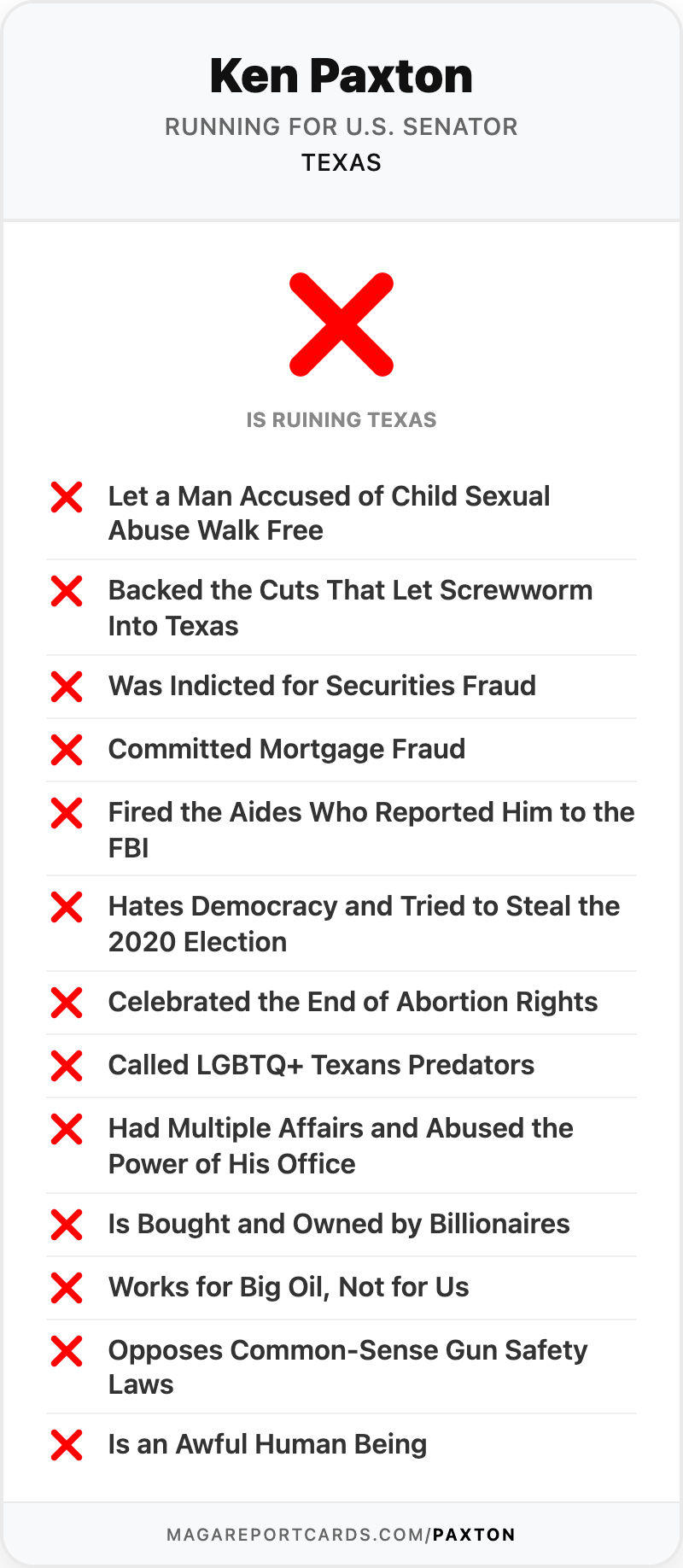
This fits a pattern in Paxton's record. He spent more than a year hunting noncitizen voters and found three. His party made him its Senate nominee anyway. In both cases, the attorney general's office was a campaign tool first and a law office second.
What the record shows
Ken Paxton spent two years using the Texas attorney general's office to try to shut down a Catholic migrant shelter, an immigrant rights group and the state's largest Muslim civil rights organization. A judge called his demand for the shelter's records harassment in 2024, and he appealed anyway. Within two weeks of losing his Senate race, his office dropped all three cases and its NCAA suit — the shelter and FIEL cases permanently — without ever proving the claims he made against them.