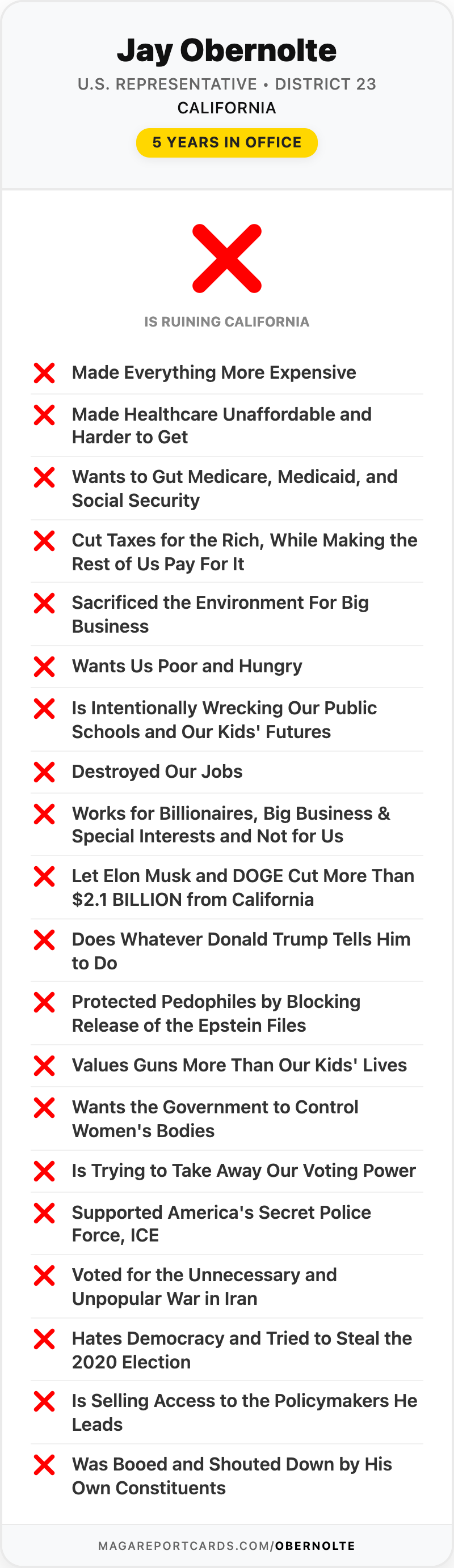
There is a statement sitting on Jay Obernolte's official congressional website right now, under the heading "Statement from Rep. Jay Obernolte on Medicaid Reforms in H.R. 1."
Partway through it, he writes:
"Let me be clear: no one is being forced off Medicaid because of these changes."
That sentence is about to be tested, in his own district, on a specific date.
What Is Actually Coming
California's Medicaid program is called Medi-Cal. The work requirement in H.R. 1 — the law Obernolte voted for on July 3, 2025 — takes effect in California on January 1, 2027.
Here is what the state agency that runs the program projects, as of May 2026:
- 4.8 million Medi-Cal enrollees fall into the category subject to the requirement.
- 2.2 million of them are expected to qualify for an exemption.
- 1.1 million Medi-Cal enrollees are projected to lose coverage by 2029–30 because of the work requirement.
Those are the Department of Health Care Services' own numbers, not an advocacy group's. And the California Health Care Foundation flags that they were calculated before federal guidance came out on June 1 — guidance that will likely decrease how many people qualify for an exemption and increase how many lose coverage.
So one million-plus Californians, on the state's own math, from the one provision Obernolte's statement devotes a single paragraph to and describes as "very modest and flexible."
Forty-Eight Percent of His District
This is not an abstract statewide number for Obernolte. It's a local one.
48% of the people in California's 23rd District are covered by Medicaid, according to CalMatters, which names his district and Doug LaMalfa's when it writes that "some of the state's most conservative areas benefit disproportionately from Medicaid." Nearly half the people he represents are in the program he voted to cut.
The bill he voted for reduces federal Medicaid spending by $911 billion over ten years, according to CBO estimates compiled by KFF — and more than three-quarters of that reduction lands in the second five years, which is exactly why the pain shows up on a delay.
The "Spending Will Still Increase" Trick
Obernolte's statement has a second claim worth pausing on:
"In fact, spending in the Medicaid program will continue to increase even after these changes."
This is technically true and functionally meaningless. Medicaid spending rises over time because medical prices rise and the population ages. Saying spending will still go up doesn't tell you whether people keep their coverage — it tells you that health care gets more expensive.
The $911 billion is the gap between what the program was set to spend and what it will now spend. You can shrink a program by nearly a trillion dollars against where it was headed and still describe the remaining line as "increasing." That is what happened here, and describing it the other way is the point of describing it that way.
Why People Lose Coverage Under Work Rules
Obernolte's defense of the work requirement rests on how reasonable it sounds. His statement lists the ways to comply — "working part-time, going to school, volunteering, or caring for a family member" — and notes the "broad exemptions."
The exemptions are real. That is exactly why the record from the first state to try it is so damning.
Arkansas imposed a Medicaid work requirement in 2018. It disenrolled more than 18,000 adults in four months before a federal court halted it — and researchers found no evidence of a positive effect on employment. Urban Institute researchers reexamined it with national Census data in 2025 and reached the same conclusion as an earlier Harvard study: uninsurance went up in the targeted age group, and work didn't.
People didn't lose coverage because they refused to work. They lost it because of the reporting — the portal, the deadline, the notice that went to an old address, the exemption they qualified for but didn't know how to document.
That's the mechanism Obernolte's sentence steps around. Nobody is "forced off Medicaid" by a rule. They're dropped by a form.
He Has Been Told, Repeatedly
None of this is information Obernolte lacked.
Constituents in California's Republican districts told CalMatters they felt "betrayed" by the coming cuts — one, whose 7-year-old grandson needs Medicaid to manage his cerebral palsy, said: "Some people will die without it." In February 2025, some 200 people packed a town hall in Yucca Valley and shouted him down over federal cuts; his office's response was to tell the San Bernardino Sun that many attendees "were from outside the district and attended with the intent to disrupt rather than engage in a productive conversation" and to call the night an "anomaly."
And Medicaid isn't the only place he's landed on the side of higher costs. He voted against the $35 monthly cap on insulin, voted against the law that finally let Medicare negotiate drug prices, and in December 2025 dismissed extending the ACA premium tax credits — the ones keeping marketplace premiums down — as "temporary taxpayer subsidies to health insurance companies" in an op-ed.
What Happens Next
January 1, 2027 is about five months away. After that, California starts checking, and the state's own projection says the number of people who fall out of Medi-Cal will start climbing.
When it does, there is a statement on Obernolte's website that his constituents can hold up. It's still there. He wrote it himself.
"Let me be clear: no one is being forced off Medicaid because of these changes."
Roughly half his district is on this program. They deserve to know whether their congressman believed that when he wrote it — and what he plans to do when the number comes in.
Sources
Statement from Rep. Jay Obernolte on Medicaid Reforms in H.R. 1 (his own office), and the California Health Care Foundation, "What is the H.R. 1 Work Requirement and How will it Affect Californians with Medi-Cal?". Photo: Larry Valenzuela, CalMatters/CatchLight Local.