The easiest way to win an election is to give voters a real choice and earn their vote. Another way is to make sure your opponents never make it onto the ballot at all.
In Iowa this month, a sitting congressman's campaign went with the second option. Zach Nunn, the Republican representing Iowa's competitive 3rd Congressional District, had his campaign help push a third-party challenger off the November ballot — and, by that candidate's account, asked him to quit the race.
What happened
On June 15, Iowa's State Objection Panel voted to remove two Libertarian candidates from the 2026 general election ballot. One of them was Marco Battaglia, the Libertarian running in Nunn's own 3rd District.
Here's the part that matters for Nunn. According to the Iowa Capital Dispatch, Annie Kuhle — a campaign adviser for Nunn — was the person who "submitted one of the challenges to Battaglia's 3rd District nomination." That's not a random Iowa Republican. That's Nunn's own campaign filing the paperwork to get a competitor thrown off the ballot.
And the objection wasn't the only contact. The same reporting says Battaglia was contacted directly about ending his campaign: Battaglia said Nunn contacted him about dropping out — as did U.S. Health Secretary Robert F. Kennedy Jr., who was making the same pitch to other Iowa Libertarians at the same time.
Nunn's campaign says it had a reason: it contacted him over concerns that he had collected signatures to qualify for the ballot using a third-party organization without proper reporting. Maybe so. But the bottom line doesn't change — Nunn's team worked to shrink the number of names voters get to choose from in his district.
A coordinated push, not a one-off
This wasn't happening in a vacuum. It was part of a wider effort that has Iowa's Libertarians — and the national Libertarian Party — accusing Republican officials of clearing the ballot for partisan advantage.
Consider the company Nunn's campaign was keeping:
- The same week, The Washington Post reported that RFK Jr. personally called an Iowa Libertarian House candidate and urged him to quit — saying a Democratic-controlled House would hurt Trump's agenda, and suggesting the candidate could "make an agreement." The candidate called it a quid pro quo: "the whole implication is: You help us, we'll help you."
- The State Objection Panel that did the removing was supposed to include Iowa Auditor Rob Sand, a Democrat. For the challenge to the Libertarian governor's ticket, Sand recused himself (he's running for governor) and was replaced by Republican Agriculture Secretary Mike Naig, making the panel all-Republican before it voted to throw that ticket off. On Battaglia, the panel split 2–1 along party lines, with Sand the lone vote to keep him on the ballot.
- Local coverage flatly described the result as Libertarian candidates "kicked off the ballot in Iowa after alleged pressure campaign involving RFK Jr."
Why all the effort over a few minor-party candidates? Because the math is tight. Iowa's 2026 races — for U.S. Senate and several House seats, including Nunn's — are rated as toss-ups. In a close race, a Libertarian on the ballot can pull a few thousand votes that might otherwise go Republican. Removing that name isn't about principle. It's about the margin.
This fits a pattern for Nunn
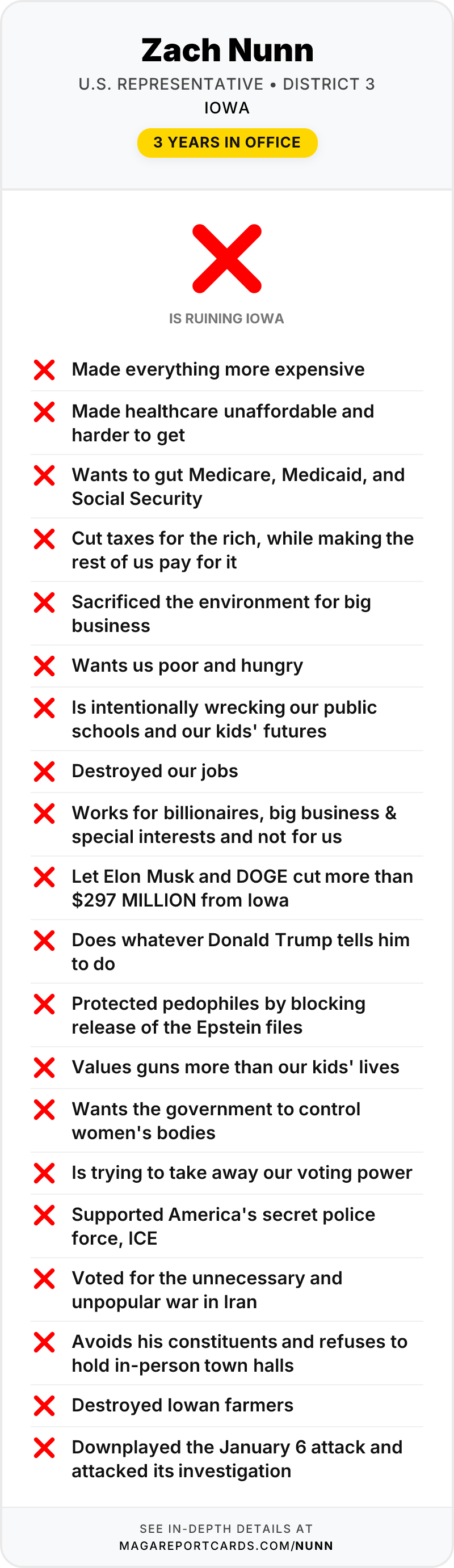
Nunn likes to talk about accountability and the rule of law. His record tells a different story when democracy itself is on the line.
Back in 2022, while campaigning for Congress, Nunn joined other Iowa Republicans in expressing frustration at the prosecution of people who stormed the U.S. Capitol on January 6, 2021. He downplayed the attack as "a bunch of middle Americans" and attacked the congressional investigation as "a Nancy Pelosi committee determined to find someone that they can hang a noose around."
So this is a congressman who waved away an attempt to overturn an election — and whose campaign now files objections to keep challengers off his own ballot. The thread connecting both is the same: when the rules of democracy get in the way, Nunn treats them as obstacles to manage rather than rights to protect.
It's worth remembering who Nunn answers to. He won't hold in-person town halls, telling the Des Moines Register he wants to avoid hosting "a taxpayer-funded protest event" — one constituent had to travel to Washington just to speak with him. A representative who won't face voters in a town hall, and whose campaign works to limit their choices on the ballot, is telling you something about how much he values your voice.
Why it matters
You don't have to like the Libertarian Party to see the problem here. Ballot access is one of the most basic parts of a fair election. Voters — not incumbents and not their campaign advisers — are supposed to decide who wins. When a sitting congressman's team is busy filing objections and making calls to thin out the field, the contest stops being about who Iowans want and starts being about who the incumbent is willing to let run.
Nunn could have spent June making his case to voters about jobs, costs, and health care. Instead, his campaign spent part of it working to make sure one of his opponents wouldn't be on the ballot at all.
We deserve representatives who win by earning votes — not by erasing the competition.
Source
This post is based on reporting by the Iowa Capital Dispatch, "Libertarian candidates ask court to put them back on 2026 ballot," with additional reporting from The Washington Post, The Gazette, and Little Village.