On the morning of October 27, 2014, a sitting Alabama state representative walked into a Lee County courtroom to face four felony charges. The Alabama Political Reporter covered the opening day: two counts of perjury before a grand jury, two counts of making false statements to state investigators.
The representative was Barry Moore. Twelve years later, he is the Republican nominee for the United States Senate seat Tommy Tuberville is giving up — the winner of a June 16, 2026 runoff — and in Alabama that usually means he is on his way to Washington.
Most Alabamians voting this November have never heard this story. They should.
What was on the tape
In June 2013, Moore had a problem. A fellow Republican named Josh Pipkin was thinking about running against him for his state House seat.
So Moore got on the phone with Pipkin. What Moore did not know is that Pipkin was recording.
On the recording, Moore relays a message he says is coming from Mike Hubbard, the Speaker of the Alabama House and the most powerful Republican in the state. The Alabama Political Reporter, which published the audio in April 2014, reported the message this way: Hubbard would kill a job incentive program for Enterprise, and would rain "Holy Hell" down on Pipkin, unless Pipkin got out of the race.
Read that again. The jobs were the hostage. A deal to bring work to Enterprise, Alabama — Moore's own hometown, his own constituents — was the thing being dangled to make a primary challenger go away.
Pipkin ran anyway.
What Moore told the grand jury
By January 2014, a special grand jury in Lee County was investigating Hubbard. Moore was called to testify about those phone calls.
Prosecutors said his answers didn't match the recordings they already had. In April 2014 he was indicted on four felonies and arrested. He was indicted before the primary — and beat Pipkin at the ballot box anyway.
He was defiant the whole way. "I told our people we're going to win the race and we're going to win the case," he told a reporter that June. "We're going to win that too. We have a lot of evidence I haven't been able to present."
His lawyers spent months trying to keep the jury from ever hearing the tapes. Led by former Lt. Governor Bill Baxley, the defense argued the recordings should be suppressed because Moore was in Florida when the calls happened and never consented under Florida law. Prosecutors pointed out that Pipkin was in Alabama, where recording your own call is legal. Judge Jacob A. Walker III refused to throw out the evidence. Moore's team then challenged the legality of the grand jury itself and the appointment of the acting attorney general prosecuting him. The Alabama Supreme Court said the grand jury law was followed and is constitutional.
Every attempt to keep the jury from hearing those tapes failed.
The jury said not guilty — and that matters
On October 30, 2014, the jury came back: not guilty on all four counts.
That verdict is real and it counts. Moore was acquitted, and nothing here says otherwise.
But look at what the verdict was actually about. A perjury conviction required the state to prove Moore made a false statement knowingly and willfully — and Yellowhammer News, reporting on what happened inside the jury room, described that phrase as the sticking point. One holdout juror asked for legal clarification on what "knowingly and willfully" meant, and changed his vote after getting it. Moore's position was that Pipkin and Tullos were trying to trick him, and that he had never actually said Hubbard would stop the project.
The Alabama Political Reporter summed the outcome up as the prosecution failing to meet its burden of proof. That is not the same finding as "the threat never happened." The tape is still the tape.
The man he was carrying the message for went to prison
Here is the part of the story that Moore's campaign biography leaves out.
One week before Moore's trial started, Mike Hubbard was indicted on 23 ethics charges. On June 11, 2016, a jury convicted him on 12 of them. The prosecutor's closing description of Hubbard: "This man right here loved power… It was all about power and it was all about greed."
Half of those convictions were overturned on appeal. Six stood. He went to prison and walked out on January 8, 2023 after serving two years, three months and 28 days.
And this was not some Democratic vendetta. The prosecution came out of the office of Luther Strange — Alabama's Republican attorney general. When the verdict came in, Strange called it "a good day for the rule of law in our state." Republicans investigated Republicans, and a jury in deep-red Lee County convicted the most powerful Republican in Alabama.
Moore was the man delivering that person's messages.
He turned it into a campaign ad
You would think a person acquitted in a public corruption probe would want to move on quietly.
Instead, in May 2020, while running for Congress, Moore released a video comparing his own prosecution to Michael Flynn's. "My heart goes out to General Flynn and his family," he said. "Having gone through this same kind of fire, I know just how hard it is on you and your family." He called what happened to him a "perjury trap" and a "politically-motivated witch hunt," and said that "in both our cases, the truth was finally revealed and justice prevailed."
The witch hunt was run by his own party's attorney general. The judge who ruled against him on the tapes was a Republican. The grand jury that indicted him was seated in Lee County, Alabama.
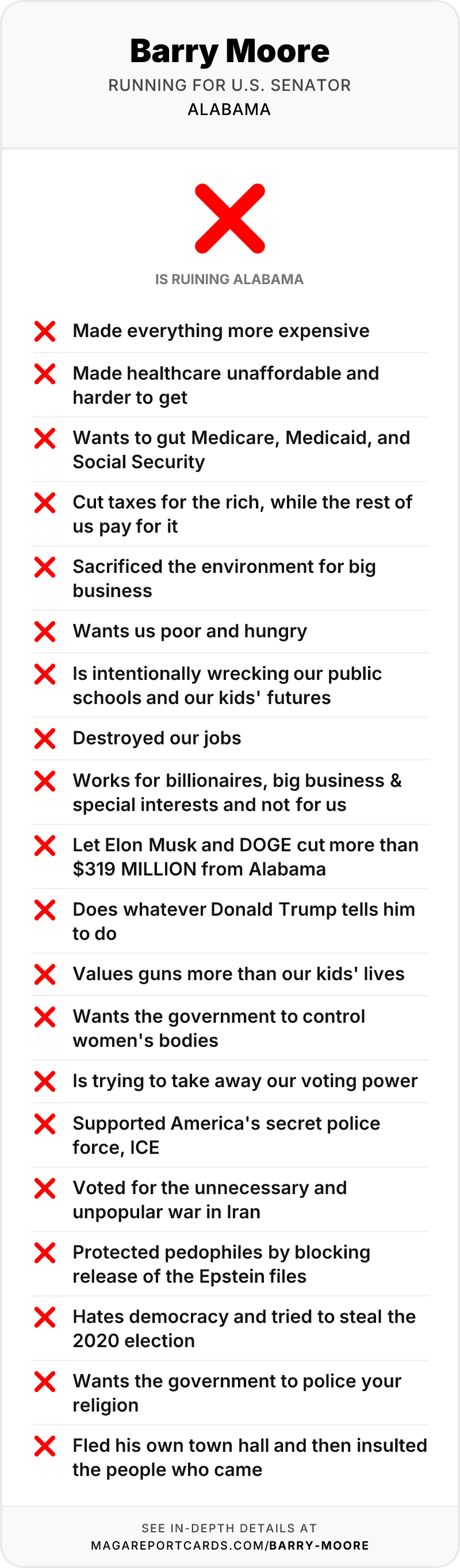
That is the move, and he has never stopped making it: when the facts are inconvenient, the people asking about them are the problem. He did the same thing in Daphne in August 2025, when constituents packed a town hall to ask about Medicaid cuts and tariffs, and he left through the back door of City Hall — then went on the radio the next morning to call the event "somewhat hijacked" by people trying "to get a check from Soros."
One more thing on the recording
There's a detail from Pipkin's secret recordings that reads very differently in 2026 than it did in 2014.
In a 2013 call Pipkin taped, Moore laid out what he wanted to accomplish if he was re-elected. Near the top of the list: banning or curbing sharia law. AL.com's April 2014 headline was blunt — "State Rep. Barry Moore: I need to get re-elected to ban Sharia law."
He kept his word, eventually. On May 12, 2026 — twelve years later, now a member of Congress — Moore introduced the CRUSADE Act, which would require religious-worker visa applicants to disavow sharia law before serving a congregation in the United States. He also joined the Sharia Free America Caucus, which in February 2026 became the first congressional caucus in CAIR's 32-year history to be designated an anti-Muslim hate group.
It's worth asking what any of this is actually protecting anyone from. When Arkansas had its own sharia scare this year, we traced it back to the source: an anti-Muslim hate group's blog post about a subdivision in Little Rock. Five houses. Two of them lived in by Christians. Sitting there quietly for nearly two decades. Arkansas Republicans turned it into a bill anyway — and their own party's committee killed it.
That's the scale of the emergency Moore has been running on since 2013 — and Alabamians only know he was running on it because a primary opponent hit record.
The threat to Enterprise's jobs and the promise to police Alabamians' religion both came off Pipkin's recordings. Moore has now delivered on one of them from a seat in Congress, and he's asking for a bigger one.
Alabama deserves to know
Barry Moore is going to be on the ballot in November against Democrat Everett Wess. Voters will decide.
He would not be the first. Texas Republicans just made Ken Paxton their Senate nominee after three felony counts including securities fraud, eight of his own senior deputies reporting him to the FBI, and an impeachment by his own party's state House. A criminal case in the rearview has stopped being a disqualification in this party. It has started to work like a credential.
They should decide knowing the whole record: that Alabama's Republican Senate nominee once sat in a courtroom answering felony charges over what he told a grand jury about a threat he delivered on behalf of a Speaker who is now a convicted felon — and that a dozen years on, his account of that episode is that he was the victim.
Source
Moore Trial to Begin Today — Brandon Moseley and Bill Britt, Alabama Political Reporter, October 27, 2014. Photo: official congressional portrait, via Wikimedia Commons.