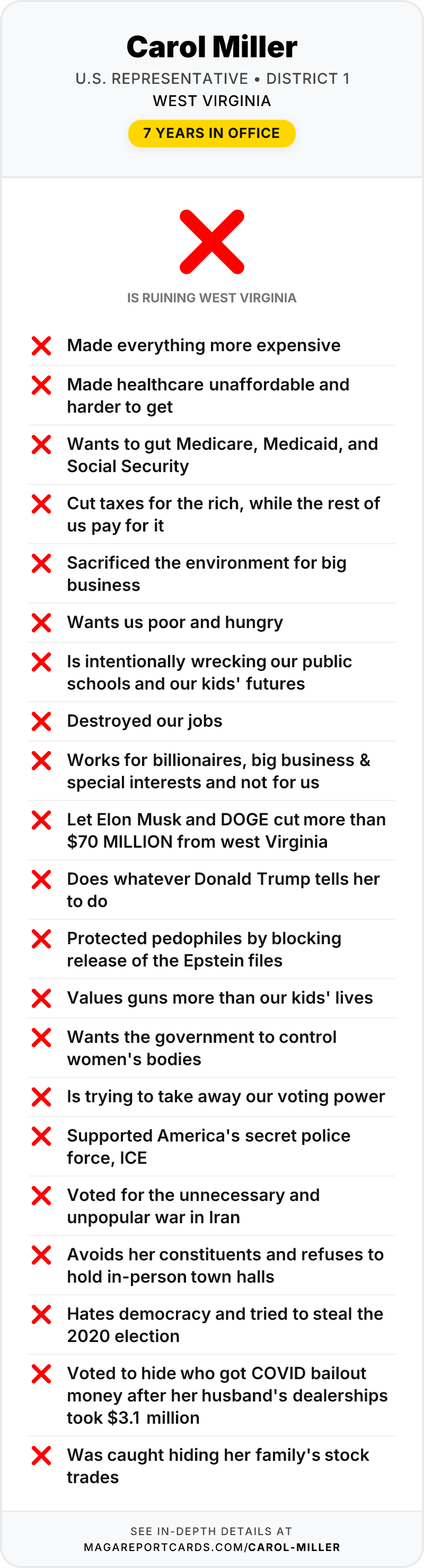
In the spring of 2020, Congress shoveled money out the door as fast as it could. The Paycheck Protection Program put more than $700 billion of federally backed loans into American businesses, and most of it was forgiven — meaning the taxpayer, not the borrower, paid the bill.
Two things happened to Carol Miller in that period, and they are worth putting next to each other.
Thing one: $3.1 million
Five car dealerships owned by Miller's husband — DM Motor, Dutch Miller Chevrolet, Dutch Miller Subaru, Dutch Miller of Charleston and Dutch Miller of Charlotte — received a combined $3.1 million in PPP loans. Every one of those loans was later forgiven.
That's not a claim from a partisan mailer. PolitiFact ran it down in August 2022 and rated it True.
There is nothing illegal about it. Car dealerships were eligible, the loans were applied for through banks like everyone else's, and forgiveness was the design of the program. Plenty of businesses in West Virginia took the same deal and were right to.
Thing two: the vote
On May 8, 2020 — five weeks into the program, while the money was still going out — Rep. Dean Phillips of Minnesota introduced H.R. 6782, the TRUTH Act.
The heart of the bill was one requirement. It ordered the Small Business Administration, within 30 days, to publish online — "sortable and searchable for key words and downloadable" — the identity of every recipient of PPP and disaster-loan money, the number of employees each one had, the date the money went out, the lender that issued it, and an explanation of how the agency decided who got it.
No clawbacks, no penalties, no new restrictions. A list.
As introduced, that list had no dollar floor on it at all. It named every borrower — which in West Virginia would have meant five car dealerships in Huntington and Charleston, among everybody else.
Twenty days later, when the bill came up for a vote, the cutoff was $2 million. Steve Chabot of Ohio, the ranking Republican on the Small Business Committee, described the trade in his own speech against it: "the bill we have before us attempts to name — and some would say, shame — businesses that are recent PPP loan recipients above $2 million. And I do appreciate Chairwoman Velázquez going from $250,000 to $2 million."
Four of the five Dutch Miller loans are individually on the public record, running from $448,900 to $904,500 and totalling a little over $2.6 million. Since all five together came to $3.1 million, the fifth was not large either. The cutoff had moved up past every one of them.
It came to the floor on May 28, 2020 under suspension of the rules, which requires a two-thirds majority. It got 269 votes to 147 — a solid majority of the House, and not enough. It failed. Republicans voted against it 146 to 38.
Carol Miller voted no.
Why the list mattered
The SBA did not want to publish the names, and it fought to avoid it.
For months the agency released only summarized, anonymized data for loans under $150,000 — about 4.5 million of the 5.2 million loans made — arguing that naming borrowers would expose private payroll information. Eleven news organizations sued under the Freedom of Information Act.
In November 2020, federal judge James Boasberg ordered the data released, writing that "the significant public interest in shedding light on SBA's administration of the PPP and EIDL program dramatically outweighs any limited private interest in nondisclosure." He called the agency's payroll-privacy argument "fundamentally flawed," and noted that the loan application form itself told borrowers their names and loan amounts would be "automatically released" upon a FOIA request.
The agency, he wrote, had offered "a series of arguments that essentially all reduce to the unavailing contention that the agency did not mean what the loan-application forms actually said."
The full data came out on December 1, 2020, five months after the TRUTH Act would have required it — and only because a judge made it happen, not because Congress did.
That's the vote in context. Had Miller and the other 146 no votes gone the other way, the public would have had the biggest borrowers' names in June 2020, from the agency, in a searchable file. Instead it took a lawsuit, a court order, and half a year. The judge ordered every borrower disclosed, not only the ones above $2 million — which is why that release, and not the bill, is where the public learned about the Dutch Miller dealerships.
The standard she applies to everyone else
Miller's public posture is that federal money must be watched closely and that people who receive help should have to prove they deserve it.
She sits on the Ways and Means Committee and spoke on the House floor for the One Big Beautiful Bill Act in May 2025, the law the West Virginia Center on Budget and Policy describes as containing the largest cuts to Medicaid and SNAP food assistance in program history. A large share of the savings comes from new documentation requirements — people proving they worked enough hours, re-verifying eligibility more often, and losing coverage when the paperwork doesn't arrive on time. The WVCBP's assessment of who that hits in West Virginia: "parents of older children, rural residents, and coal miners who lose their jobs through no fault of their own."
Asked in April 2026 whether Washington should restore the money her state lost, she pointed at the debt: "with the $37 trillion in debt, we're trying to figure out how to be fiscally responsible."
So a laid-off coal miner in her district now has to document his hours to keep his health coverage. When the question was whether the public should get a searchable list of who received millions in forgiven federal loans — by then a list narrowed until it would not have named her — Miller voted no.
The one she was caught on later
This is also not the only disclosure Miller has been on the wrong side of. In 2022, Business Insider reported that she had failed to properly disclose her husband's 2021 trades in 21 separate stocks, worth between $217,021 and $805,000 — a violation of the STOCK Act, the law requiring members of Congress to report their household's trades within 45 days. Her office called it a technical error.
Twice now, the thing that didn't get disclosed on time was money moving through her husband's businesses and accounts. Both times the public found out anyway — from a court order in one case and a reporter in the other.
The bottom line
Taking a PPP loan is not a scandal. Voting to keep the recipients secret while you are one of them is a choice about who the government works for, and she did it after the list had already been narrowed past her own household's loans.
The TRUTH Act asked for a spreadsheet. A majority of the House said yes. Carol Miller said no, and the public had to sue.
We deserve better.
Sources
- Andy Nguyen, "Businesses associated with these GOP politicians had pandemic loan program borrowings forgiven" — PolitiFact, August 30, 2022 (rated True)
- H.R. 6782, the TRUTH Act, introduced May 8, 2020; the amended text as read on the floor and the debate on it, Congressional Record, May 28, 2020, H2330-2332; House Roll Call 113, May 28, 2020 (Miller: Nay)
- Dutch Miller of Charleston, Inc. — Tracking PPP, ProPublica, from SBA loan data
- Ben Popken and Andrew W. Lehren, "Judge orders Trump administration to reveal PPP loan data it sought to obscure" — NBC News, November 6, 2020
- Photo: official congressional portrait, 118th Congress