Right now, if you have health insurance, your blood pressure check is free. So is your diabetes screening. So is your mammogram, your colonoscopy, your cervical cancer screening. If you are a woman, so is the yearly well-woman visit itself. You do not pay a copay. You do not pay a deductible. That is not a favor your insurance company does for you — it is the law, and it has been since the Affordable Care Act took effect: nearly all private plans have to cover a defined list of preventive services at no cost to the patient.
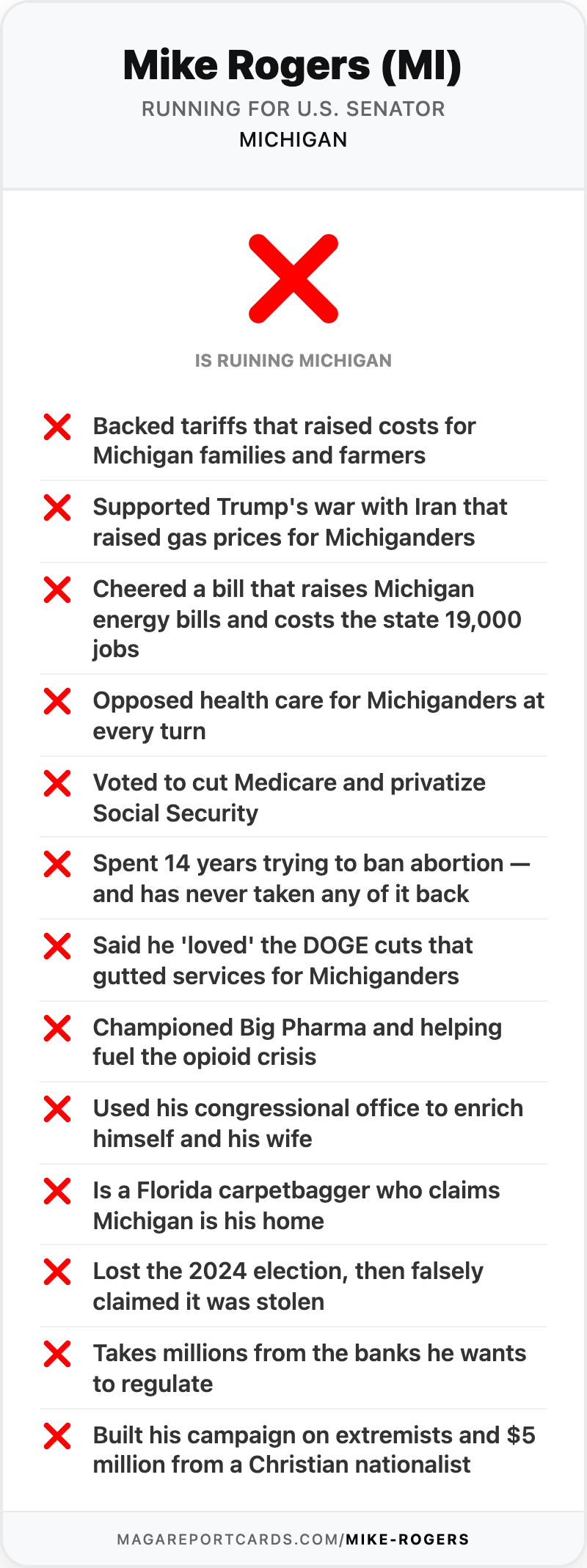
Mike Rogers (MI) would like to change that.
At a private event in Macomb County on March 21, 2026, Michigan's Republican Senate nominee took a question from someone in the audience about how to bring down the cost of health care. He said he would release a full plan in the coming weeks that would "embrace the freedom of the free market." Then he explained one of the ways he would do it.
"You know," Rogers said, "if you go up and have to pay the doctor $50 for your annual physical, that's probably okay, right?"
Bridge Michigan reviewed a recording of the event and reported the quote in April. On Sunday, in a piece for The Bulwark, Jonathan Cohn asked the Rogers campaign to confirm whether charging people for preventive care is still what Rogers wants to do.
The campaign did not answer.
He compared your cancer screening to a burned-out blinker
In the same recorded remarks, Rogers explained why he thinks free preventive care is a bad deal. He said covering it was like having "an auto insurance plan that would pay for your blinker's light going out." A nice thing to have, he argued — but something that drives everyone's costs up.
"We need to start changing the way we look at health care," he said.
The comparison gives away the whole argument. A blinker bulb is a small annoyance you can put off. A colonoscopy is how you find a tumor while it is still small enough to remove. Congress made preventive care free precisely so that people with high-deductible plans would have no reason to skip the visit that catches the thing early.
We know what happens when you put a price on it, because researchers have measured it. Dr. Mark Fendrick directs the Center for Value-Based Insurance Design at the University of Michigan. He told Bridge Michigan that "our work shows very clearly that even increasing cost sharing by a few dollars leads to decreased utilization of services." Not fifty dollars. A few.
Fendrick gave Rogers the narrow point: free preventive services do add to what a health plan spends, and Rogers "is exactly right" about that. The disagreement is about what happens next. Charge copays for preventive care and "in the short term, costs go down," Fendrick said — but overall, "the health of individuals and populations get worse."
Anand Parekh, chief health policy officer at the University of Michigan School of Public Health, who helped formulate the ACA's prevention initiatives, put the money side of it plainly: when people skip screenings, undiagnosed disease gets worse and more expensive. "We end up paying for more costly care for things that could have been prevented, or at least treated at less expense," he said.
So the savings are real for a while, and then the bill comes back bigger, with sicker people attached to it.
There is also an obvious place to look for waste that is not the cancer screening. Fendrick's advice to politicians is to go after care that does nothing — piles of lab tests, or, in his example to Bridge, "CT scans for uncomplicated back pain." Rogers went after the annual physical instead.
He also wants to put sick people in a separate pool
The copay was not the only idea Rogers floated that day. He also proposed what he called "catastrophic funds" for the sickest Americans — separate insurance arrangements for people who need the most care.
"So we're going to pay our premium based on what a normal life would be, not including these people who are really, really sick," Rogers said. And: "We take the really sick people and put them in this fund that we all pay a little bit. The government pays, the hospital pays, Medicare would pay a little bit."
That idea has a name and a history. Before the Affordable Care Act, 35 states ran high-risk pools for people who could not get insurance any other way. The ACA made them unnecessary by simply requiring insurers to cover people with pre-existing conditions. KFF's look back at how those pools actually worked is not a close call: premiums were often double what healthy people paid, nearly all of them refused to cover the pre-existing condition you joined for — usually for six to twelve months — most capped what they would pay over your lifetime, and some states limited how many people could get in at all. Republicans put the idea back on the table in the 2017 repeal bills, and it has been proposed steadily since.
Parekh told Bridge that pulling sick patients out does lower premiums for healthier people — but the sick patients still need care, and covering it takes large subsidies. "This turns out to be expensive for consumers and government," he said.
Fendrick was shorter about it. Going back to high-risk pools would be, he said, "just so crazy."
Four months later, he released a plan. It does not mention any of this.
Rogers said in March that the full plan was weeks away. It arrived on July 30, announced through a press release that quotes a friendly column at Townhall describing it. Its three pillars are affordability, accessibility and transparency. What is actually in it: make hospitals and insurers publish their prices and fine the ones that don't, expand a federal bulk-buying program for prescription drugs, speed up approval of generics, and require insurers to publish how often they deny claims.
There is no $50 copay in it. There are no catastrophic funds, no high-risk pools, nothing about preventive care at all. The two ideas Rogers described to a private room in March simply are not in the document he released to the public in July — and his campaign will not say whether he dropped them or just stopped mentioning them.
That is the whole problem. Cohn asked. Bridge asked in April. Neither got an answer.
This fits a twenty-five-year record
None of this is a departure for Rogers. He represented Michigan in the House from 2001 to 2015. He voted against the Affordable Care Act when it came to the floor in March 2010, then voted to repeal it in 2011, again in 2012, and again in 2013. In 2012 the Michigan Republican Party sent out a mailer with his name on it in capital letters: "MIKE ROGERS IS COMMITTED TO REPEALING OBAMACARE."
He has not softened since. In January, Michigan Advance asked him about the ACA tax credits that had expired at the start of the year. He answered, in an emailed statement, that he would start by "phasing out insurance company taxpayer subsidies and giving that money back to patients so they are in charge of their own healthcare." Those credits are what kept marketplace premiums affordable for people who buy their own insurance. They are gone now, which is what 197 Republicans voted for, and in Michigan the individual-market plans they applied to went up about 20 percent this year.
He also praised the Republicans' "One Big Beautiful Bill," the law that cut Medicaid — his campaign built an entire video series around it, under the friendlier name "Working Families Tax Cuts." In the same January statement he called the law a "historic, $50 billion investment in rural healthcare, including $173 million for Michigan alone." Michigan Advance noted that the claim rural communities come out ahead is disputed by health care providers themselves, including the state hospital association.
Cohn asked Rogers's campaign to confirm that he still stands behind letting the subsidies expire, behind the Medicaid cuts, and whether he still supports repealing the law outright. He got no response to any of it.
Michigan is already living with the answer
The numbers moved while the campaign was declining to comment.
About 357,000 Michiganders had active ACA marketplace coverage in February — 130,000 fewer than a year earlier, a 27 percent drop, down from a record 501,806 in June 2025. That is roughly one in four people covered by the program, gone in a year. Michigan had the sixth-largest loss of any state.
The Medicaid cuts have not fully arrived yet. When Republicans were drafting them in May 2025, the state health department warned that more than 700,000 Michiganders could lose Medicaid — nearly a third of everyone enrolled — if the full $880 billion in cuts then on the table landed on the program. KFF's estimate of the law that actually passed is that it leaves about 300,000 more Michiganders uninsured by 2034, or 390,000 once the expired premium credits are counted alongside it.
This is the state where Rogers wants to charge people $50 to see a doctor who is well.
What his campaign will say
Asked about the recording, Rogers's communications director Alyssa Brouillet told Bridge Michigan that Rogers "is exploring ideas with voters to increase affordability of health care, whether that's investing in rural hospitals, ensuring the wealthiest Americans cover their own copays, or improving transparency and access."
Read that again. "Ensuring the wealthiest Americans cover their own copays" is not what Rogers said. He did not say the wealthy should pay $50 for a physical. He said you should — "if you go up and have to pay the doctor $50 for your annual physical" — to a room of supporters, as an illustration of ordinary people having more skin in the game.
To be fair to him, one idea from that March meeting was a good one: forgive medical school debt for doctors who spend five years at a federally qualified health center, the clinics that treat low-income patients and struggle to recruit. Rogers called them "one of those government programs that actually functions." It is a real proposal and it would help. It also, like the price transparency in his July plan, would not change what anybody pays for a mammogram.
There is one more thing worth putting next to a $50 copay. Rogers is a wealthy man who has been collecting a taxpayer-funded state pension while worth millions. And at a town hall last year, he mocked the complaint about prices before it even arrived — "Oh my gosh, coffee went up," he said, imitating what he expected to hear from Democrats.
Fifty dollars is a rounding error to him. It is a reason to skip the appointment for a lot of people in Michigan.
He is not the only one with this record
Cohn offers three other Republicans running statewide this year as case studies, and the record is the same in each.
In Texas, where marketplace enrollment fell by nearly 150,000 people after the credits expired, Senate nominee Ken Paxton spent years trying to erase the law entirely — including the 20-state lawsuit he co-led in 2018 that the Supreme Court rejected 7–2. In Iowa, Ashley Hinson voted for the Medicaid cuts and has publicly defended the new work requirements — while a MercyOne clinic on the south side of Des Moines closed in June, citing staffing shortages, rising costs and pending cuts to Medicaid reimbursement. In Ohio, Jon Husted voted for a law projected to pull roughly $33 billion in Medicaid money out of his state over a decade.
None of this is settled history. If Democrats take either chamber in November, restoring the premium credits and undoing the Medicaid cuts is at the top of the list, and in a Senate this close it can come down to a single seat. Michigan is one of the seats.
The bottom line
Mike Rogers (MI) told a private audience in March that charging people $50 for an annual physical is "probably okay," and floated moving the sickest patients into a separate insurance pool — two ideas that, as Bridge Michigan put it, would undo two promises of the Affordable Care Act. University of Michigan researchers say even a few dollars of cost-sharing makes people skip preventive care, and that the short-term savings evaporate when the undiagnosed illness shows up later. The health care plan Rogers finally released in July does not mention either idea, and his campaign has refused, twice, to say whether he still holds them. Meanwhile he spent his House career voting four times against or to repeal the law that made those screenings free, told a reporter he wants the premium credits phased out, and campaigned on the bill that cut Medicaid — while 130,000 Michiganders lost marketplace coverage in a single year.
Sources
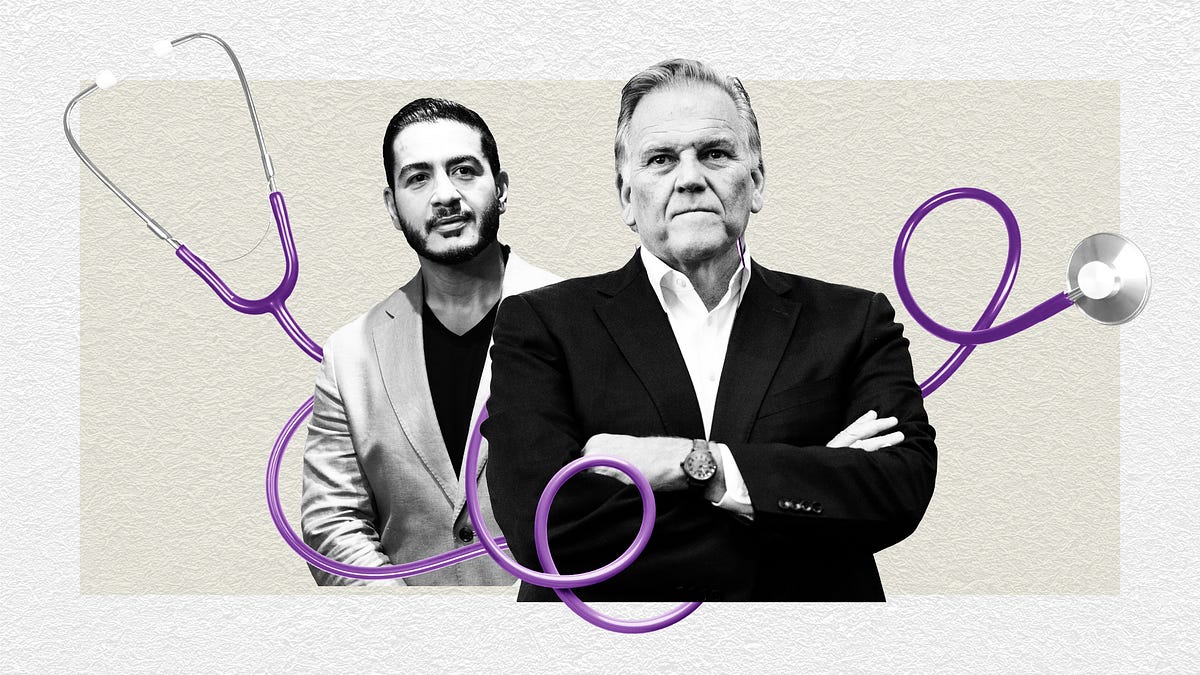
Mike Rogers Wants $50 Copays for Routine Screenings — Jonathan Cohn, The Bulwark, August 30, 2026. Original reporting on the March recording by Simon D. Schuster, Bridge Michigan, April 2, 2026. Michigan enrollment figures from Eli Newman, Bridge Michigan, July 13, 2026, citing federal effectuated-enrollment data. Rogers's July plan as announced by his campaign. Photo illustration by Bill Kuchman/The Bulwark.