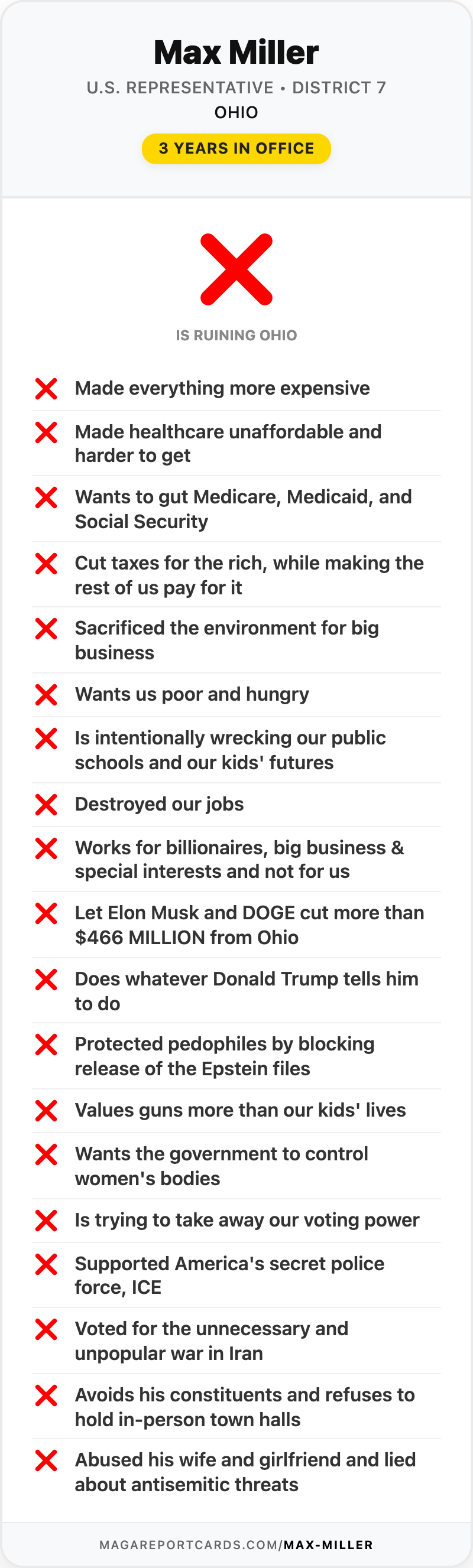
For weeks, the allegations against Ohio Congressman Max Miller sat in a strange kind of silence. The documents piled up. The lawsuits multiplied. And almost nobody in his own party would say his name out loud.
That silence broke this week.
On Thursday, July 30, the Democratic Women's Caucus formally called on the House Ethics Committee to investigate Miller. The same day, his ex-wife's lawyers went to court and filed a restraining order against him — not over the old allegations, but over how they say he is behaving right now.
And in between, something new happened: Republicans started talking.
This post is about that shift. The underlying allegations — the 2,000 pages of police reports and court filings, the child abuse investigation, the two lawsuits — we covered in detail in an earlier post. What's new is that the institutions and the people who spent months looking away have finally been forced to respond.
The formal referral
Three House Democrats put their names on the request: Rep. Teresa Leger Fernández of New Mexico, who chairs the Democratic Women's Caucus, and Reps. Emilia Sykes of Ohio and Hillary Scholten of Michigan, both vice chairs.
Their statement was blunt:
"The recent reports of domestic violence and child abuse against Representative Max Miller are deeply disturbing and Congress can't ignore them. Allegations of violence against women and children have to be met with the utmost seriousness."
"We therefore call on the House Committee on Ethics to swiftly and thoroughly investigate these allegations. Every woman and child deserves to live free from fear of violence, especially within the sanctity of their own home, and we will not stop fighting until that's the reality."
The referral followed a New York Times report in which Miller's ex-wife, Emily Moreno, alleged that he "scalded her chest and stomach by throwing hot water from a skillet at her body; held a gun to her head; pushed her against a wall and hit her head; and fractured their daughter's collarbone and bruised her shoulder."
Miller denies all of it. He has not been criminally charged in connection with any of these allegations, and the county investigation into his daughter's injury was closed as unsubstantiated.
A day earlier, on Wednesday, the gun violence prevention group Giffords — founded by former Rep. Gabby Giffords — called on Miller to resign outright. Their statement was one sentence long and hard to argue with:
"Congress is no place for violent abusers who attack their family and hold a gun to their wife's head."
Republicans finally said something
Here is what makes this week different.
Rep. Nancy Mace, a sitting Republican, told Newsweek on Wednesday:
"The allegations against Max Miller are horrific. They must be investigated, and if true, he should resign immediately."
Ohio Gov. Mike DeWine, a Republican, gave his first public comments on the scandal the same day, telling reporter Morgan Trau that "the accusations are certainly very serious and certainly troubling." But DeWine stopped short of asking Miller to do anything. He handed it to voters instead:
"They are the ultimate people who decide; They're the ones who decide who they want to represent."
And George Santos — the former congressman the House expelled in 2023 — told the Washington Examiner:
"For me, if you're asking my objective opinion, yes, I think it's reprehensible, abhorrent behavior and conduct for Max Miller, and I think he should step aside and go deal with this in private, not on the taxpayer dime."
When George Santos is the one telling you to go handle it in private, the ground has moved.
Speaker Johnson's convenient process
House Speaker Mike Johnson has been asked repeatedly why Miller and Rep. Cory Mills — who is facing his own domestic violence allegations — are still in the House Republican conference. His answer has settled into a shape worth noticing.
"We have a process here in the House, the Ethics Committee works on those things. If allegations are made, they work through a process. So, I'm not in the business of commenting on investigations as they're in process, and we'll see how that shakes out."
"That's how this always works. And by the way, it's done for Rs and Ds — both sides of the aisle."
Look carefully at what that does. Johnson points to the Ethics Committee as the reason he doesn't have to say anything. But the Ethics Committee only acts when someone asks it to — and until this week, the people asking were not Republicans. Johnson gets to sound like he respects the process while doing nothing to start it.
Earlier this month, asked about the same allegations, Johnson's answer was even shorter: "The key word there is 'allegation.'"
That standard has not been applied evenly, and Johnson knows it.
The restraining order is about today, not 2019
The most important new fact this week is the one that has nothing to do with the old allegations.
On Thursday, Emily Moreno's lawyers filed for a restraining order against Miller. The reason wasn't something he allegedly did years ago in a marriage. It was what they say he is doing to them — her attorneys — in the middle of active litigation.
Moreno said in court papers that Miller made physical contact with her attorney and "harassed [and] threatened" them. Her filing asks the court to stop it:
"Unless restrained, [Miller] will continue to harass, threaten and communicate with my counsel directly."
The New York Times' Annie Karni posted the legal papers publicly.
There is one more line in that filing worth sitting with. According to Moreno's own account of a Tuesday court hearing, Miller's attorney, Larry Zuckerman, said in court that his client "just can't control himself." That characterization comes from Moreno's filing, not from a transcript we've seen — but it is now part of the court record, offered as her explanation for why a sitting member of Congress needed a judge to tell him to stop contacting opposing counsel.
This matters for a reason that goes past the divorce. Miller's entire public defense has been that this is a bitter custody fight and his ex-wife is not credible. A restraining order sought over his conduct toward lawyers, in 2026, is a different category of problem. It's about whether he can be trusted to behave in the present tense.
What this costs Ohio's 7th District
While all of this unfolds, Miller still holds a seat. He still votes. Ohio's 7th District still has exactly one representative in the House, and his attention is currently divided between a custody battle, a defamation suit he filed against his ex-wife, a second defamation suit filed against him by an ex-girlfriend, a restraining order, and now a possible ethics investigation.
His constituents didn't ask for any of this. They asked for someone to show up and do the job.
The job is real, and Miller's record on it is its own story. He sits on the House Ways and Means Committee, the panel that writes the nation's tax law, while taking money from KKR, Jane Street Group, and Stanley Black & Decker, among other corporate donors. He holds a 0% score from the League of Conservation Voters for 2025 and a 1% lifetime score, without a single pro-environment vote on any of the 31 House votes LCV scored in 2025.
That's the work his district is getting while his congressman's calendar fills up with lawyers. And he's doing it, as The Hill notes, from "a competitive House seat" — this is not a safe incumbent coasting through a rough news cycle.
The bar is not "convicted"
Miller has not been convicted of anything, and nothing here says he has been. He's entitled to deny the allegations and to defend himself in court.
But the standard for holding federal office was never supposed to be "hasn't been convicted yet." The House Ethics Committee exists precisely because Congress is meant to police the conduct of its own members — not to wait for a jury.
For months, the answer from Miller's party was silence, and the answer from the Speaker was that the process would handle it. This week, someone finally asked the process to start.
Ohio deserves a representative whose biggest fight isn't with his own family. We deserve better.
Sources
Reporting by Sudiksha Kochi for The Hill (July 30, 2026), Kathianne Boniello for Mediaite (July 30, 2026), Newsweek, and the Washington Examiner. Photo: Tom Williams/CQ Roll Call via AP Images.