On January 29, 2025, American Airlines Flight 5342 took off from Wichita, Kansas, headed for Washington, D.C. It never landed. An Army Black Hawk helicopter hit it in the air over the Potomac River. All 67 people aboard the two aircraft were killed. Several of them were Kansans.
Congress wrote a bill about it. The bill is called the ROTOR Act.
On February 24, 2026, it came to the floor of the House of Representatives. It got 264 votes. It needed 265.
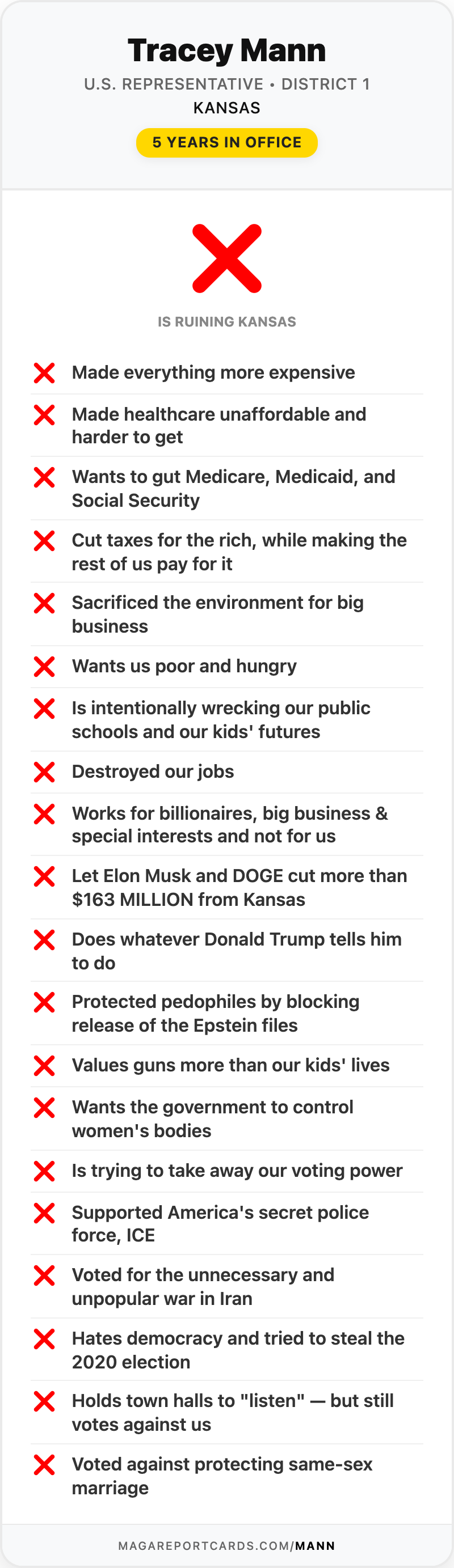
Tracey Mann voted no. He was the only member of the Kansas delegation who did.
What the bill would have done
Most aircraft already have to broadcast where they are. That system is called ADS-B Out. It's been required for years.
The ROTOR Act would have required aircraft flying around busy airports to also receive those broadcasts — a system called ADS-B In — so a pilot can see the other planes and helicopters around them on a screen in the cockpit. It would also have made the FAA review crowded airspace at airports across the country.
The National Transportation Safety Board has been recommending exactly this since 2008.
The NTSB found the Army helicopter that hit Flight 5342 was flying above the maximum altitude for its route and was not broadcasting its position over ADS-B. The board's simulation of the crash showed that the crew of Flight 5342 would have received two alerts about the helicopter if their plane had carried an ADS-B-based system.
The vote
The bill came up under a fast-track process called suspension of the rules, which requires a two-thirds majority instead of a simple one. The roll call reads:
- 264 yes, 133 no. 265 were needed.
- Democrats: 187 yes, 1 no.
- Republicans: 77 yes, 132 no.
Kansas voted 3–1 for it. Ron Estes, Derek Schmidt, and Sharice Davids all voted yes. Mann voted no.
Consider how alone that is. The bill's lead author in the Senate was Ted Cruz. Its cosponsors included Sen. Jerry Moran of Kansas, the chairman of the Senate's aviation subcommittee, and Sen. Roger Marshall of Kansas — who held Mann's own House seat before him. The Senate passed it unanimously in December 2025.
Both of Kansas's Republican senators put their names on the bill the day it was introduced, and Moran negotiated it. Both of Kansas's other Republican House members voted for it. Mann, who got his start in politics as a college intern for Jerry Moran, voted against it.
What Mann said
KWCH asked his office why. Here is the heart of his statement:
"Aviation safety is a top priority for me as a member of the Transportation and Infrastructure Committee, and I care deeply about getting this policy right. The tragic American Eagle collision near Reagan National Airport, which departed from Wichita, demands a serious and thoughtful response from Congress. While I appreciate the intent behind the ROTOR Act, it was drafted prior to the release of the National Transportation Safety Board's investigation and recommendations, which were made public last week. Additionally, the legislation did not have an opportunity to move through the normal Transportation and Infrastructure Committee process, where complex aviation policy is typically vetted and refined in a bipartisan manner."
Two arguments there. The bill was written before the NTSB's final report. And it skipped his committee.
Neither one survives contact with the record
Start with the NTSB. Mann's objection is that the bill predates the board's findings. But the board wasn't neutral on the bill — its chair endorsed it. And the central thing the ROTOR Act does, requiring ADS-B In, is a recommendation the NTSB has been making since 2008, seventeen years before the crash. The final report didn't discover the idea. It confirmed it.
Moran, who negotiated the bill, said so directly:
"The ROTOR Act was the result of months of bipartisan negotiations. The final product was supported by Secretary Duffy and the National Transportation Safety Board and was even supported by the Department of Defense until its last-minute reversal the day before the House was scheduled to vote. The NTSB's yearlong investigation found that lives could have been saved on January 29, 2025, if the policies in the ROTOR Act had been in place. The failure to pass this legislation is disappointing..."
Now the committee argument. It's true the bill didn't go through House Transportation and Infrastructure — it went through Senate Commerce, where it was negotiated between Cruz and ranking member Maria Cantwell and reported out unanimously. That is how a Senate bill gets to the House floor.
Mann's own colleague from Wichita didn't find the process disqualifying. Ron Estes voted yes and said this:
"There are 50 recommendations from the NTSB in their final report and many more findings that warrant legislative consideration, which should be similarly prioritized and considered as quickly as possible. This collision involved an Army Black Hawk helicopter and an American Airlines flight that originated from my hometown of Wichita. This tragedy has left our community shocked, and I am heartbroken that several Kansans were among the victims."
Estes had the same information Mann had. He reached the opposite conclusion: pass this one, then keep going.
The families watched it happen
The relatives of the people killed on Flight 5342 spent months lobbying for this bill, which Cruz introduced six months to the day after the crash. They put out a statement the day it failed:
"Today, a majority of the House voted to pass the ROTOR Act. It was not enough. Under suspension of the rules, the bill fell one vote short of the two-thirds threshold — despite a unanimous Senate, the endorsement of the NTSB Chair, and the support of the pilots who fly these planes every day. This bill was not defeated on its merits... The same risk that killed 67 people thirteen months ago is still in the sky tonight."
One of the Kansans killed was PJ Diaz. His father Pete and stepmother Ruth spoke to KWCH after the vote. Ruth Diaz said: "The longer we wait and the more delay there is, the more chance for fatalities." She added: "It's going to take longer, will be a setback, but we are not going away."
What Mann voted for instead
Mann's objection was that the bill had not been through his committee. The House's own bill had been — Transportation and Infrastructure marked it up in March and reported it in April.
On April 14, 2026, the House passed the ALERT Act, H.R. 7613, 396 to 10. Mann voted yes.
It's worth knowing what rode along inside that bill. As we reported, Missouri Republican Bob Onder — a licensed pilot — wrote Section 105 of the ALERT Act, a provision that would bar state and local governments from using aircraft-location data to figure out who owes taxes on a private plane. Alabama's revenue commissioner estimated it could cost his state and its local governments more than $18 million a year. An amendment to preserve state and local governments' ability to keep using the data for tax collection was not adopted.
So the process Mann held out for produced a bill with a private-plane tax shield tucked into a public safety law. The bill he voted against was the one the victims' families were asking for.
The bottom line
There is a version of Mann's argument that's honest. Complex aviation rules should get careful work. Regular order matters.
But the vote wasn't happening in a vacuum. It was a suspension vote, which means it needed two-thirds — and everybody in that chamber knew a no vote was worth more than a no vote usually is. It failed by one.
Sixty-seven people died on a plane that took off from his state. Both of his state's senators put their names on the fix. Both of his Republican colleagues from Kansas voted for it. The families asked him to vote for it.
He voted no, and it's still not law.
Source
"ROTOR Act, requiring aircraft locator systems that NTSB recommends to prevent midair collisions fails in House," The Associated Press, KWCH Staff and Thomas Lynch, KWCH 12, February 24, 2026. Photo: KWCH. Vote totals from the Office of the Clerk of the U.S. House of Representatives.