On Wednesday, July 29, Idaho Gov. Brad Little put out a press release about the state's latest crime numbers. It opened like this:
"Idaho continues to be one of the safest places to live, work, and raise a family."
On Saturday, August 1, at 2:29 in the afternoon, a 24-year-old man named Chad Williams opened fire at an In-N-Out Burger in Twin Falls. Three people were killed and seven were injured. An off-duty Idaho State Police trooper and an armed civilian confronted him and drove him from the scene. He died of a self-inflicted gunshot wound.
Little's response was a post asking Idahoans to "join me in keeping the Twin Falls community in your prayers."
The timing is ugly. But timing is not the real problem here, and treating it as a gotcha lets Little off easy. The real problem is that his safety claim was built on a measurement that was never going to catch this — and that his own record on guns runs directly against it.
What that crime report actually counts
The Idaho State Police report Little was celebrating showed declines in property crime, violent crime, and nearly every major category. That's real, and it's good news.
But a police crime report counts crimes reported to police. That is not the same thing as counting how Idahoans die.
Here is what gets missed. In 2024, an estimated 331 people in Idaho died from gun-related injuries — about 15.9 per 100,000 people, a rate 24% higher than the country as a whole.
And 86.4% of those deaths were suicides.
Suicide isn't a crime. It doesn't show up in a crime report. So a governor can hold up a falling crime chart and say Idaho is one of the safest places in America while the single largest cause of gun death in his state sits entirely outside the data he's citing.
That's not a technicality. It's the difference between "fewer people are being robbed" and "your family is safe."
The law he signed after a sixth-grader shot up a middle school
In May 2021, a sixth-grade girl pulled a handgun out of her backpack at Rigby Middle School in eastern Idaho and fired multiple rounds. Two students and a custodian were injured. A teacher disarmed her.
Less than a week later, Brad Little signed Senate Bill 1205.
That law bars every government entity in Idaho — every city, every county, every agency — from enforcing federal orders, laws, or rules on firearms and ammunition that the state considers in conflict with the Idaho Constitution. The Associated Press described it at the time as aimed at thwarting a half-dozen executive actions intended to reduce gun violence.
Among the things it was designed to keep out of Idaho:
- Cracking down on untraceable "ghost guns"
- Regulating pistol-stabilizing braces
- Red flag laws — the kind that let a family go to a judge and temporarily take firearms away from a relative in crisis
Read that last one again next to the number above. 86.4% of Idaho gun deaths are suicides. Red flag laws exist almost entirely for that situation: someone in crisis, a family that sees it coming, and a legal way to put distance between that person and a gun for a few weeks.
Little signed a law making sure Idaho would not enforce them. He did it days after children were shot at school.
The NRA noticed. Its Political Victory Fund endorsed him for reelection in 2022 and gave him an A+ rating.
"Thoughts and prayers" is not a policy
After Twin Falls, Little asked for prayers and told people to avoid the area and follow law enforcement. Both are reasonable things for a governor to say in the first hours of a mass shooting.
The question is what comes after the first hours.
Idaho has had no serious movement on red flag laws, on secure storage requirements, on waiting periods, on anything that addresses the 86% of gun deaths that are suicides. What Idaho has instead is a statute forbidding its own government from helping enforce federal firearms rules, signed by this governor.
You cannot claim credit for public safety and simultaneously insist that the leading way people in your state die by gun is nobody's business.
The rest of the record
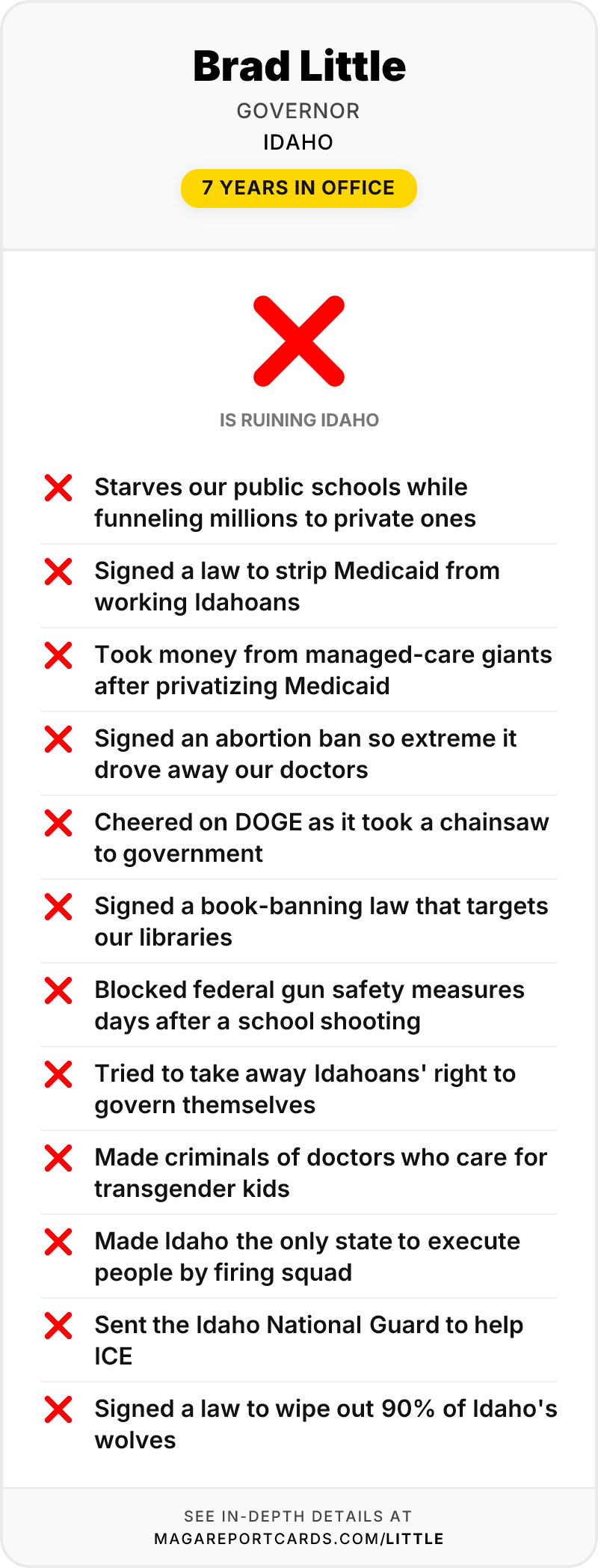
The gun law isn't an outlier. Little's report card documents a pattern of the same instinct applied elsewhere: signing one of the country's most extreme abortion bans, which drove doctors out of Idaho; signing a book-banning law aimed at libraries; making Idaho the only state to execute people by firing squad; cheering on DOGE while federal jobs and services in Idaho were cut.
The common thread is a governor who is very comfortable telling Idahoans they're safe and very uncomfortable doing anything that might upset the people who fund his campaigns.
Three families in Twin Falls buried someone this week. Seven more people are recovering. They live in what their governor called, three days earlier, one of the safest places in America to raise a family.
We deserve better.
If you or someone you know is struggling, the 988 Suicide & Crisis Lifeline is available 24/7 by calling or texting 988.
Sources
Gov. Little's July 29, 2026 press release, "Gov. Little comments on another year of decreased crime in Idaho"; ABC News on the August 1 Twin Falls shooting; USAFacts on Idaho gun deaths; Associated Press on Senate Bill 1205.