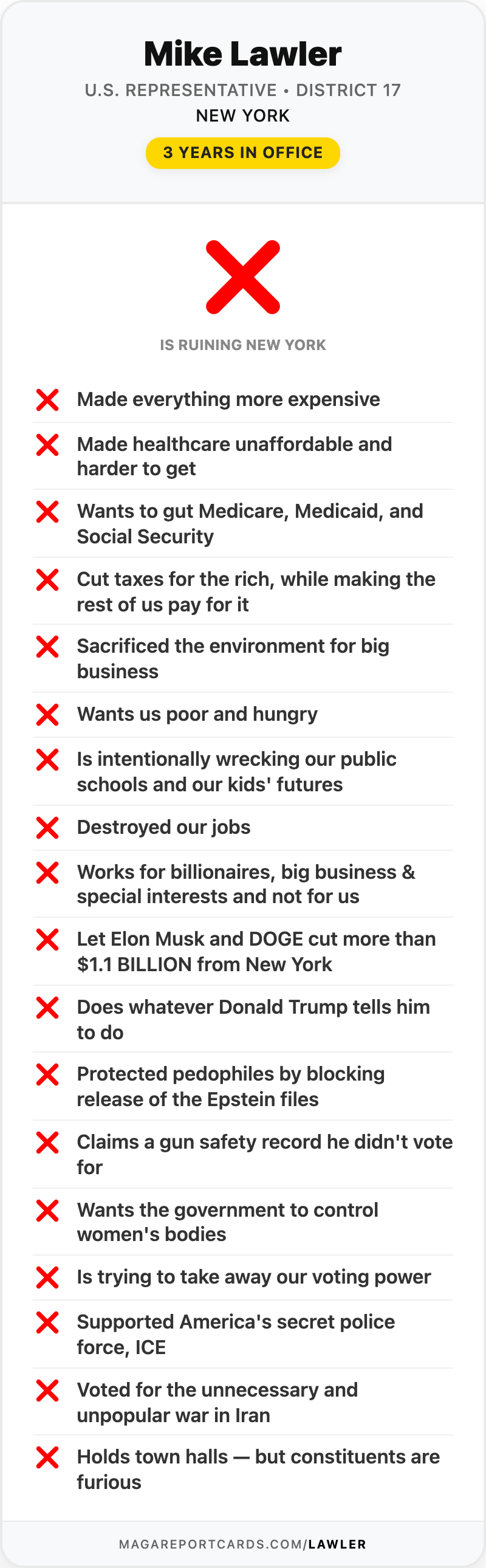
On October 24, the first day of early voting, Mike Lawler stood on a stage in Peekskill next to his Democratic challenger, Cait Conley, and made his closing argument to the voters of New York's 17th District.
"I delivered the largest tax cut in American history," Lawler said, according to the Peekskill Herald's account of the forum, reprinted by The Current. He went on: "The fact is, no tax on tips, no tax on overtime, no tax on Social Security. That's not for billionaires. That's for working people."
Two of those claims have already been checked — when other Republicans made them — and both failed.
"The largest tax cut in American history"
Lawler is talking about Trump's 2025 budget bill, the one Republicans call the "One Big Beautiful Bill."
It isn't the largest tax cut in American history. The usual way to compare tax cuts across decades is to measure them against the size of the economy. By that measure, the nonpartisan Tax Foundation ranks the 2025 law sixth since 1940. Five were bigger:
- Ronald Reagan's 1981 tax cut — about twice as large
- The Revenue Act of 1945
- The Revenue Act of 1948
- The 2012 tax deal signed by Barack Obama
- The Revenue Act of 1964
Count Trump's tariffs, which the Tax Foundation treats as a tax increase, and the Tax Foundation says the law drops to eighth.
When Iowa Republican Zach Nunn made the same "largest tax cut in U.S. history" claim this fall, PolitiFact rated it Mostly False. Counting only the new tax cuts the law created, PolitiFact found it tied for sixth-largest since 1980. Even counting the 2017 tax cuts it extended, it ranks third.
"No tax on Social Security"
The 2025 law did not end taxes on Social Security. When Trump made that claim about the bill, PolitiFact rated it Mostly False.
What the law did was give people 65 and older an extra $6,000 tax deduction. It doesn't cover anyone under 65, and it isn't permanent — PolitiFact noted it lasts through 2028. PolitiFact cited an estimate the chief of staff of Congress's own tax scorekeepers, the Joint Committee on Taxation, gave in May 2025, while the bill was still being written: about 27 million tax returns would owe tax on Social Security benefits in 2026 under the old rules, and the new deductions would cut that only to about 24 million.
Twenty-four million tax returns still paying tax on Social Security is not "no tax on Social Security."
$50 billion in, $137 billion out
Earlier in the forum, asked how he would make health care more affordable and protect women's and reproductive health care, particularly in communities with persistent health disparities, Lawler pointed to the same law. He said he supported putting $50 billion into it to expand access to rural health care, according to the Herald.
That $50 billion is a five-year rural health fund. But the same law cuts Medicaid — and health policy researchers at KFF estimated that its Medicaid changes could reduce federal Medicaid spending in rural areas by $137 billion over 10 years. FactCheck.org found the fund falls about $87 billion short of what rural areas stand to lose.
On the reproductive health part of the question, Lawler talked about community health centers and small-business health plans. Conley said his vote on the budget bill stripped federal funding from Planned Parenthood — something we documented in detail: he voted twice to cut Planned Parenthood off from Medicaid, and New York had to spend $35 million to cover it.
Why the details matter
Lawler's race is, in the Herald's words, a closely contested one that could help decide which party controls the House, and this forum was one of the last chances its voters had to hear him and Conley side by side before they mail or cast a ballot. He used his closing minutes to tell them he'd delivered a record tax cut and ended taxes on Social Security. Neither is true. And when he was asked about health care, he cited a $50 billion fund created by a law that KFF estimates could take far more than that out of federal Medicaid spending in rural areas.
What the fact-checks show
In his closing remarks at an October 24 forum in Peekskill, Mike Lawler said he "delivered the largest tax cut in American history" and "no tax on Social Security." The Tax Foundation ranks the 2025 budget bill as the sixth-largest tax cut since 1940, and PolitiFact rated the same "largest" claim Mostly False when Zach Nunn made it. PolitiFact also rated the "no tax on Social Security" claim Mostly False: the law added a temporary $6,000 deduction for people 65 and older, and Congress's tax scorekeepers estimated before final passage that about 24 million tax returns would still owe tax on their benefits. The $50 billion rural health fund Lawler pointed to is about $87 billion smaller than the rural Medicaid cuts KFF projects from the same law.
Source
This post is based on the Peekskill Herald's report on the Lawler–Conley forum by Eric Harvey, reprinted by The Current.