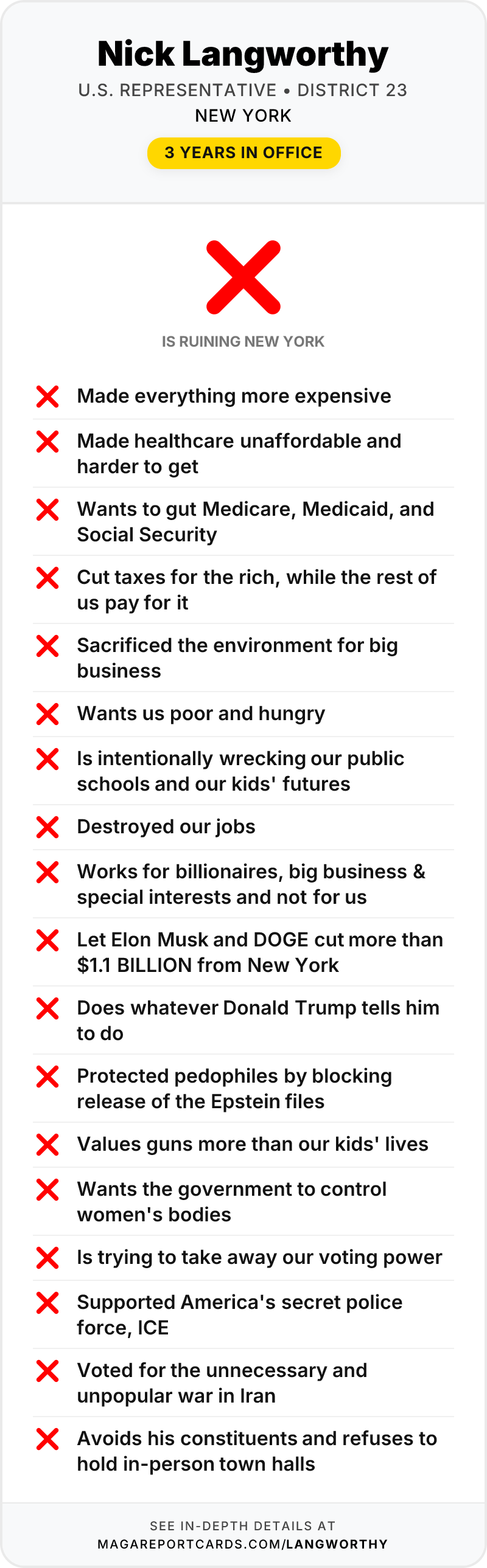
Most members of Congress never get to decide what the House votes on. A dozen or so do. They sit on the House Rules Committee — the panel that, as one report put it, "decides which bills and amendments the full House can vote on."
Nick Langworthy sits on it. He is the only New Yorker who does.
Three times in 2025, that committee was asked to let the House vote on releasing the Jeffrey Epstein files. Three times, Langworthy voted no.
July 2025: "a pointless political gimmick"
On July 14, 2025, Rep. Ro Khanna offered an amendment that would have required Attorney General Pam Bondi to gather and publish the government's records on Epstein. The Rules Committee rejected it, five votes to seven.
Only one Republican on the panel — Ralph Norman of South Carolina — voted yes. Langworthy voted no, along with Virginia Foxx, Michelle Fischbach, Erin Houchin, Austin Scott, Morgan Griffith and Brian Jack.
When a local station asked him why, his office sent this:
"Congressman Langworthy supports full transparency on the Epstein files and believes anyone who committed crimes—especially against minors—must be fully prosecuted. This issue shouldn't be politicized, but that's exactly what the Democrats did with their amendment stunt that was completely unrelated to the bill and wouldn't have released a single file. He voted no because it was a pointless political gimmick, not a path to justice."
Note the structure of that answer. He supports full transparency. He just voted against the thing that would produce it, because someone he doesn't like proposed it.
Minutes later the committee voted again, this time on whether to let the House consider a resolution demanding that the administration release the files. Langworthy voted no on that one too, and the committee defeated it 4 to 8.
The next day, the full House killed Khanna's effort on the floor through a procedural vote — a "motion on ordering the previous question" — that passed 211 to 210. One vote.
September 2025: not a gimmick, and he blocked it anyway
The "unrelated amendment" objection had an obvious answer: bring a standalone bill. Democrats did.
On September 9, 2025, the Rules Committee voted on whether to send the Epstein Files Transparency Act — the bipartisan bill from Khanna and Republican Thomas Massie — to the House floor. This was not an amendment bolted onto a crypto bill. It was the whole point of the legislation, and it carried protections for victims, letting the Attorney General withhold or redact anything that would expose a victim's personal or medical information.
The committee killed it 8 to 4, on a party-line vote. Langworthy was one of the eight, alongside Foxx, Fischbach, Norman, Chip Roy, Austin Scott, Morgan Griffith and Brian Jack.
There was no gimmick left to object to. He voted no anyway.
November 2025: 427 to 1
What finally moved the bill wasn't the Rules Committee. It was a discharge petition — the procedure that lets a majority of the House go over the committee's head and force a floor vote directly.
Once the signatures were there and passage was guaranteed, the vote happened. On November 18, 2025, the Epstein Files Transparency Act passed the House 427 to 1.
Langworthy voted aye.
Then he put out a statement: "I stand for full justice for all of Jeffrey Epstein's victims and today's vote marks another step toward accountability."
That is a fine sentence. It would have meant something in July, when he was one of the seven votes that kept the question off the floor, or in September, when he was one of eight people standing between the bill and the floor. In November it cost him nothing. Four hundred and twenty-seven members voted the same way.
Why the committee votes are the ones that count
There's a reason to care more about a 5–7 committee vote than a 427–1 floor vote.
On the floor, one member out of 435 rarely changes an outcome. In the Rules Committee, thirteen people decide whether the other 422 get a say at all. When Langworthy voted no in July, the margin was two votes. When he voted no in September, he was one of eight blocking a bill that — the moment it escaped the committee — turned out to have the support of virtually every member of the House.
Put those two facts side by side. In September, Langworthy helped keep a bill off the floor. In November, that same bill passed with one dissenting vote in the entire chamber. The committee wasn't reflecting the House's view. It was overriding it.
And the public's view wasn't ambiguous either. The western New York group Lake Effect Change, tracking his votes, pointed to a PBS/NPR/Marist poll finding 77% of Americans supported releasing the files — including 67% of Republicans.
The pattern in his district
This is a member who has built a record on not being in the room.
Langworthy has not held a single in-person town hall since taking office in 2023. When constituents invited him to one in April 2025, he didn't respond, and they held it with an empty chair where he should have been. In February 2026, the community radio station in Jamestown published a piece saying his office repeatedly failed to tell them about press conferences he was holding in their own county.
We've written about what that looks like from the Southern Tier.
The Epstein votes are the same instinct applied to the House itself: keep the question from being asked, and when it finally gets asked anyway, answer it the popular way.
We deserve better.
Source
"Langworthy defends voting no on Epstein files," News10/Nexstar. September Rules Committee vote list via Yahoo News.