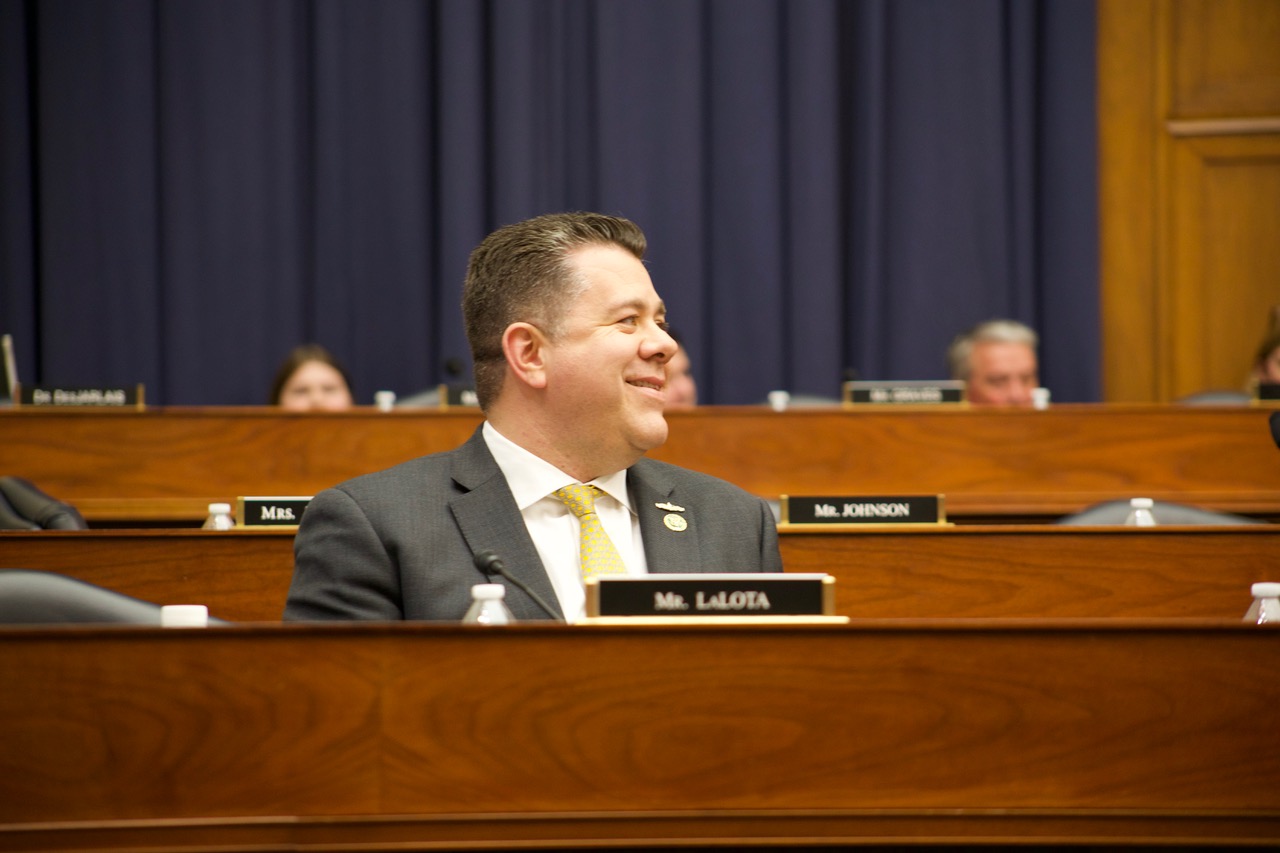
In June 2026, Nick LaLota sent a letter to town supervisors, mayors, and other local government officials across New York's 1st District. It said this:
"I will not support community project funding requests from municipalities that have adopted policies, enacted local laws, or taken official actions that deliberately obstruct, impede, or refuse lawful cooperation with federal authorities carrying out their responsibilities under federal law."
Community project funding is the money members of Congress steer to their own districts for local projects — road repairs, water mains, sewer hookups. Individual members have wide latitude over who gets it. It is one of the few things a House member can hand a hometown directly.
Only two places in the district fit LaLota's description: East Hampton Town and East Hampton Village. He named them himself.
So he cut them off.
What the laws he's punishing actually say
Here is the East Hampton Village law, passed unanimously by the village board in April 2026.
It creates a new section of the village code barring the village from entering a 287(g) agreement — the arrangement that lets ICE deputize local police officers to do federal immigration work. It states plainly that the federal government has the authority to enforce immigration law, and that federal law overrides conflicting local law.
Then it adds the operative part: village personnel
"shall not use village resources, equipment, property, databases, or funds to investigate, detain, question, arrest, or transport any individual solely for purposes of federal civil immigration enforcement, except pursuant to a judicial warrant or as otherwise required by law."
It also says the village's Flock license plate reader cameras can't be queried for federal civil immigration enforcement.
The town passed a similar law in May 2026.
Read that sentence again, because everything in this fight turns on it. Civil immigration enforcement. Except pursuant to a judicial warrant. Or as otherwise required by law. The law does not stop ICE from operating in East Hampton. It says the village won't spend its own money and staff doing ICE's civil paperwork, and that a judge's warrant still opens every door.
New York State has since banned 287(g) agreements statewide anyway, in its most recent budget. Which means the single loudest provision of East Hampton's law is now simply state law everywhere in New York.
What LaLota says the laws do
On July 13, he wrote on social media that the town and village had
"just adopted Suffolk County's first Mamdani-Hochul-style sanctuary policies, blocking cooperation with federal immigration authorities, even to remove illegal immigrants in custody on rape, assault, or DUI charges. But I won't let Long Island become NYC's sixth borough. No CPF funding until they reverse these dangerous policies."
In a July 16 letter to constituents, he went further: under these laws, he wrote, if either municipality had someone in custody after an arrest for possessing child sexual abuse material, third-degree assault, or second-degree robbery, "local officials could not use local personnel or vehicles to transport that individual into federal custody," and combined with New York's bail laws, "these sanctuary policies require that those violent criminal illegal aliens be expeditiously released from custody."
That is a description of a law that requires releasing violent criminals. It is not a description of the law East Hampton passed.
Jerry Larsen, the village mayor, spent his career in the village Police Department — he was its chief. His response:
"[The congressman] obviously hasn't read our legislation, because if he had taken the time to read the legislation, he would hopefully understand that this has nothing to do with criminal offenses and is in no way impacting our communities in a dangerous manner."
And: "What is dangerous is sending untrained immigration officers into communities, causing chaos."
Town Supervisor Kathee Burke-Gonzalez walked through the actual sequence. The town's law "does not require the release of anyone charged with a crime" and "does not prevent cooperation with federal authorities when required by law." Town police could not drive someone straight to federal immigration authorities on the charges LaLota listed because that is not how an arrest works — the person is processed and arraigned, and a judge decides whether they're released, held on bail, or sent to the Suffolk County jail. If federal authorities show up with a judicial warrant while the person is still in custody, police can hold them.
Her summary of what the town law actually changed: additional police reporting to the town board, a new citizens task force, and the 287(g) ban. "The town's law largely mirrors the rules already followed by local police departments across the East End."
Withholding federal money over a reporting requirement and an advisory committee, she said, "is not a serious public safety policy" but "a bizarre form of political retaliation over two basic measures, and the only practical result is our residents' tax dollars are sent elsewhere."
Minerva Perez, who runs Organización Latino Americana of Eastern Long Island, has been putting one question to LaLota in public: which specific provision of the local law do you oppose? Where, she asked, "does our law stop local law enforcement from cooperating with federal immigration enforcement when required by law?"
He hasn't answered it. He didn't respond to The East Hampton Star's request for comment either.
"Choose the money instead of going broke"
The part that should bother every voter in NY-01, whatever they think about immigration, is what LaLota did with the threat next.
Last month he stood at a ceremony announcing a $3.5 million appropriation for Huntington Town's Highway Department — a nice, ordinary piece of congressional work — and used it as a stage. As quoted in Newsday, he advised municipalities to "choose the money instead of going broke, when [East Hampton] went woke."
On WABC radio on July 3, he called the town and village "run by some pretty far-left individuals" who "are trying to out-Mamdani each other," and said their laws are the basis "of some of this mayhem we're seeing across the nation in places like Minnesota, Los Angeles, and other places."
And he told the hosts his funding cutoff was "also a warning sign to some of these other drifting municipalities: Don't go there."
That is the whole thing said out loud. The federal money isn't LaLota's — it's tax revenue his constituents already sent to Washington. He is holding it as leverage over local governments to make them repeal ordinances their own voters' elected boards passed unanimously. And he's telling every other town and village on Long Island — of which, by his own count, there are 13 and 96 — to watch what happens to the ones who don't fall in line.
By August it was working. On August 4, just before Southold's work session on immigration policy, LaLota's re-election campaign emailed supporters to claim credit: the town attorney had cited his position when recommending against the policy, warning it put "real dollars at stake." "I stood up, and Southold is poised to say no," he wrote.
He is not describing a policy victory. He is describing a town lawyer telling elected officials they can't afford to cross their congressman.
The "mayhem" he's pointing at
LaLota told the radio audience these local laws are the source of the mayhem in Minnesota and Los Angeles.
Here's what has actually happened in the places he named and elsewhere. In January, ICE agents shot and killed two American citizens in Minneapolis during protests against masked agents operating in their neighborhood. In July, ICE agents shot and killed a man during a traffic stop in Houston and a Colombian immigrant with a work permit in Biddeford, Maine — both on their way to work, neither the target of the operation, and in both cases the government's account was disputed by the families and witnesses who were there. Since January 2025, at least 12 people have been killed in shootings and violent incidents involving ICE agents, and more than 60 others have died in ICE custody or immigration detention.
That's the enforcement East Hampton's law declines to fund with village vehicles and village databases. LaLota's position is that declining to fund it is what makes people unsafe.
The pattern
This isn't a local quirk. It's the national playbook arriving in Suffolk County.
The Justice Department has filed 27 lawsuits against more than 20 cities, counties and states over sanctuary policies — including a suit to stop Philadelphia from barring ICE agents from wearing masks and hiding their badges. Tom McClintock has used his immigration subcommittee chairmanship to demand up to six years of records from Philadelphia's sheriff, including her correspondence with named immigrant-rights groups. In San Diego County, Jim Desmond cast the lone vote to keep handing people to ICE without a judge's warrant, then brought a motion to repeal the new policy three months later.
LaLota's version uses the one lever a House member has that a lawsuit doesn't: the checkbook.
What it actually costs
Here's the sour joke at the center of it. East Hampton Town has received $758,900 in earmarks this century — against an annual town budget of roughly $110 million. LaLota's threat is worth a rounding error to East Hampton's finances.
Which tells you what it's for. It was never really about the money. It's a message to Southold, to Riverhead, to Shelter Island, to every village board on the East End: pass the wrong local ordinance and your congressman will campaign against your town.
He's running for a third term this fall against Chris Gallant, who won the Democratic primary in June.
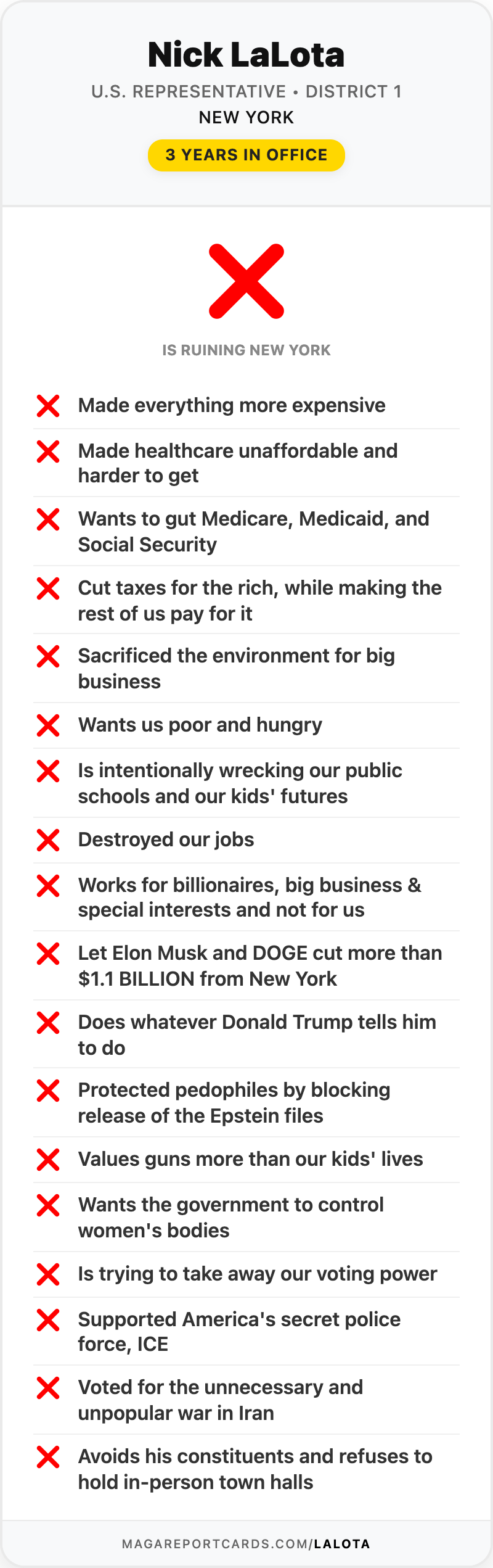
Meanwhile, the congressman who has time to write to local officials across the district about East Hampton's police reporting requirements had not held a single public, in-person town hall in his first two years in office — only telephone call-ins. The two elected officials he's punishing sat for interviews about this. He didn't return a call.
We deserve better.
Source
LaLota Doubles Down on Withholding Federal Money — Christopher Walsh, The East Hampton Star, July 23, 2026, and LaLota: Play Nice With ICE or You're Cut Off, The East Hampton Star, June 18, 2026. LaLota's Southold claim is from his August 4, 2026 campaign email, reported by The East End Beacon. Photo: The East Hampton Star.