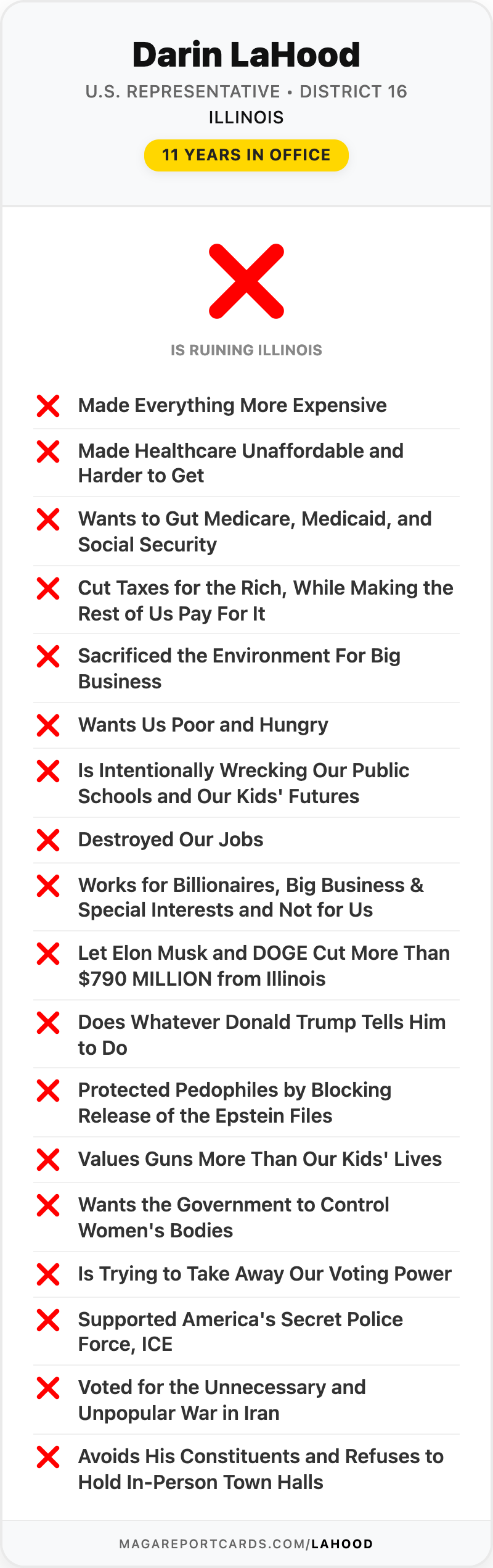
Darin LaHood chairs the Ways and Means Subcommittee on Work and Welfare. That is the panel with jurisdiction over Temporary Assistance for Needy Families — the cash assistance program for the poorest families with children in America — plus child welfare and unemployment insurance.
It is a genuinely powerful job that gets almost no coverage back home, and LaHood has used it. In May 2025 he introduced H.R. 3156, the Jobs and Opportunity with Benefits and Services (JOBS) for Success Act — a full rewrite of TANF, which hasn't been reauthorized since 2005.
It's worth reading, because it is a clear statement of what he thinks the problem is.
What's in the bill
From the bill text, the operative provisions:
A signed personal responsibility agreement. Every "work-eligible individual" gets an assessment and an "individual opportunity plan" that must include "a personal responsibility agreement in which the individual acknowledges receipt of publicly funded benefits and responsibility to comply with program requirements in order to receive the benefits." Universal engagement, in the bill's own words.
An income ceiling. States "shall not use the grant to provide any assistance or services to a family whose monthly income exceeds twice the poverty line."
A tighter administrative budget. The cap on administrative spending drops from 15% to 10%, with a new penalty of up to 5% of a state's grant for missing it. The bill also widens the exception to that cap, adding "case management necessary to assist an individual in developing an individual opportunity plan" alongside the computer systems current law already exempts.
A 25% floor on "core activities" — work supports, education and training, apprenticeships, short-term benefits, work activities and case management — from both federal funds and state matching funds.
A ban on spending TANF directly on child care. Section 7(c): a state "shall not use the grant for direct spending on child care and other early childhood education programs, services, or activities." The bill raises the cap on transferring TANF money into the Child Care and Development Block Grant to 50% instead — so the money can still reach child care, but only by routing through a different program with different eligibility rules, copays and set-asides. It's a redirect, not an elimination, and honest accounting should say so.
And the funding. Section 4 is the shortest section that matters. It extends the block grant by striking "2017 and 2018" and inserting "2026 through 2030."
That's it. Same dollars.
The number that never changes
Here is what those dollars are. From the Center on Budget and Policy Priorities:
"Under TANF, the federal government gives states a fixed block grant totaling $16.5 billion each year."
That figure was set when the program was created in 1996. It has never been adjusted for inflation. LaHood's bill would carry it, unchanged in nominal terms, through 2030 — a 34-year run at one number, through two recessions, a pandemic, and the price increases of the last five years that his own district feels every week at the grocery store.
The bill has a great deal to say about what recipients must sign, what states may spend, how administrative costs must be squeezed, and how improper payments must be measured. It has nothing to say about the size of the grant.
CBPP's accounting of where the money goes, from the 2014 spending data that report examines: states spend "only slightly more than one-quarter" of combined federal and state TANF funds on basic assistance to families, "and just another quarter on child care for low-income families and on activities to connect TANF families" to work. The basic-assistance share has not moved since. CBPP's state fact sheets, updated January 2026 say that "in 2023, states spent only about one-fourth of the funds on basic assistance." Those are the two buckets the bill touches — the second one by barring direct spending.
His stated philosophy
LaHood has been consistent about the theory, and it's fair to quote him at length rather than paraphrase.
Opening the April 2025 hearing on GAO's findings:
"My belief is that we need to reclaim TANF for work, do a better job of targeting funding towards the most vulnerable families, and restore the program to its original roots... By modernizing the program, while ensuring that it continues to serve those who rely on it, we can reduce dependency and empower Americans to uplift themselves."
And on Medicaid work requirements in the 2025 budget bill, to WGLT:
"Whether you call that a cut to Medicaid or a transition to a job, that's clearly included here, but I think that's something we ought to be doing."
"The best social service program in the country is a job."
Where the theory runs into the bill
The proposition is that work is the answer, so the program should be reorganized around work. Fine. Then the design question is what a parent needs in order to work.
The near-universal answer, from every side of this debate, is child care. It's the thing that determines whether a single mother in Peoria can take a shift at all. LaHood's bill responds to that by prohibiting states from spending TANF directly on it and telling them to transfer the money to a different block grant if they want to — a block grant that is also capped, also chronically oversubscribed, and that comes with its own waiting lists.
Meanwhile the money available to do any of this stays at 1996 levels through 2030, and states get a smaller administrative allowance to run a program the bill makes considerably more administratively demanding: assessments, individual opportunity plans, signed agreements, new outcome measures, new improper-payment reporting. Case management for those plans is carved out of the cap. The rest of it is not.
That is a lot of new obligation financed with the same, steadily shrinking, dollar.
To be fair
LaHood is not a bomb-thrower on this committee. He worked with Ranking Member Danny Davis to reauthorize the Title IV-B child welfare program, and he built his TANF case on GAO's own audit findings rather than anecdote. The underlying complaint — that states have drifted TANF money far from cash aid, and that Congress hasn't reauthorized the program in twenty years — is not a partisan invention. CBPP has been making a version of it for years.
The difference is what you conclude from it. If states spend only a quarter of TANF on basic assistance and much of the rest has drifted, one answer is to require the money to reach poor families and give them enough of it. LaHood's answer is to require more of the families, more of the states, and the same amount of money.
Eleven years
LaHood has represented central Illinois since 2015 and is on the ballot again in November. During the 2025 push for him to hold a town hall, he told WGLT "I meet with any constituent that wants to meet with me" but would not commit either way to holding one. In April 2025, constituents filled the UAW Hall in East Peoria for a town hall they held themselves. He wasn't there.
The people most affected by the bill he wrote are the least likely to get a seat at any of the rooms he does show up in.
We deserve better.
Source
H.R. 3156, the JOBS for Success Act of 2025, full text via GovInfo; "ICYMI: LaHood Chairs House Ways and Means Subcommittee on Work and Welfare to Discuss TANF Reform," lahood.house.gov, April 9, 2025; "How States Use Federal and State Funds Under the TANF Block Grant," Center on Budget and Policy Priorities. Photo: official congressional portrait via Wikimedia Commons.