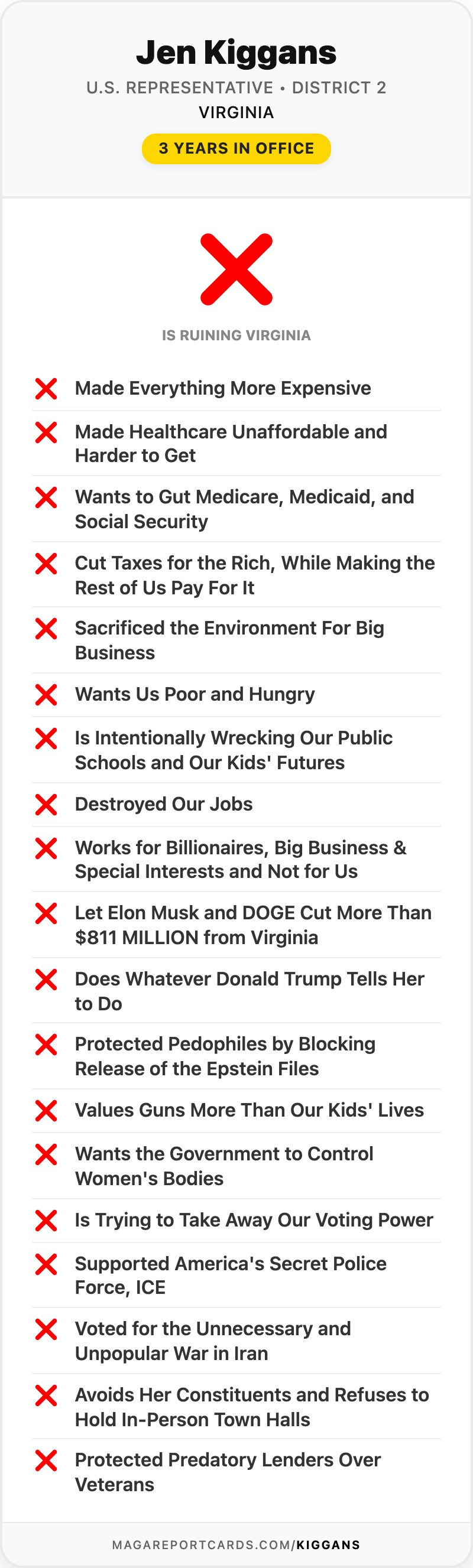
Before she went to Congress, Jen Kiggans was a state senator from Virginia Beach. On February 10, 2020, her chamber took up the Virginia Fairness in Lending Act.
The bill did one main thing: it stopped payday and car title lenders in Virginia from charging whatever they wanted. Before it passed, the Pew Charitable Trusts found, many Virginia lenders were writing "open-end" loans at annual rates of 299% or more, using a patchwork of four different state statutes so that closing one loophole just pushed them into another. The Act closed all of them at once, banned balloon payments, and set a 36% cap.
Pew's estimate of what that saved Virginians: more than $100 million a year.
The bill passed the Senate 23 to 16. Kiggans voted no.
The district makes this worse, not better
Virginia's 2nd is one of the most military-dense congressional districts in the country — Naval Station Norfolk, Oceana, Little Creek, Dam Neck, plus the retirees and veterans who stay in Hampton Roads after they get out.
Federal law already protects the active-duty part of that population. Under the Military Lending Act, an active-duty servicemember or covered dependent cannot be charged more than a 36% Military Annual Percentage Rate. Congress set that cap because triple-digit loans were wrecking troops' finances and their security clearances.
But the MLA covers you based on your status when you sign. Retire, separate, or get out — and the protection goes with the uniform. A veteran in Virginia Beach walking into the same storefront as the sailor ahead of him had no federal rate cap at all.
The Virginia Fairness in Lending Act was the law that would have covered him. Kiggans voted against it.
Dogwood, which reported on the vote in 2024, noted that payday lenders have long clustered around military bases, and cited an estimate that 44% of active-duty military had used a payday loan in 2017.
This wasn't a party-line vote she got swept into
It would be one thing if every Republican voted no. They didn't.
Pew describes the Act as bipartisan legislation, and the roll call shows why: Republicans are in both columns. Republican Sen. Jill Holtzman Vogel was a chief co-patron of the bill and voted for it. So did Republican Sen. John Cosgrove of Chesapeake — a Hampton Roads senator who was himself a co-patron of the bill — and Republican Sen. David Suetterlein of Roanoke.
Kiggans was in the 16 who said no. Republicans in her own caucus gave her cover to vote yes, and she didn't take it.
The money
Dogwood also traced where some of her campaign money came from. Kiggans's state Senate campaign took $2,500 from GOPAC in June 2019 and $15,000 in October 2019 — $17,500 in the months before the vote. GOPAC, the Republican candidate-training group, had taken $50,000 from Advance America, one of the country's largest payday lenders, in May 2019.
That is not a receipt for a bribe, and we're not saying it is. It's a sequence: payday lender money into GOPAC, GOPAC money into her campaign, her vote against the payday lending cap five months later.
The reason a sequence like that matters is that the alternative explanation is easy to give. All she had to do was explain the vote.
She wouldn't explain it
She was asked. Repeatedly.
In October 2022, during her first congressional race, WAVY's Andy Fox pressed her on why she voted against the Virginia Fairness in Lending Act. She was asked eleven times. She refused all eleven times. She had given the station five minutes, and when the timer went off she got up and walked away, "dragging the microphone still strapped to her dress."
The closest thing to an answer came in that same interview, moments before she left — a general reassurance: "I would not do anything to harm our veteran population."
That is a statement about her intentions. The roll call is a statement about her vote. When the two conflict, only one of them is in the record at the Virginia General Assembly.
Why it still matters
Kiggans's whole public identity is military. She flew Navy helicopters. She's married to a retired F-18 pilot. She chairs the House Veterans' Affairs Subcommittee on Oversight and Investigations. Every campaign she has ever run has been built on it.
So it's fair to check the recorded chances she had to protect military families from 299% loans, with money on one side and her own constituents on the other. There were four: the February 10 passage vote, and three more on April 22, 2020, when the Senate took up Governor Ralph Northam's recommendations on the bill. She voted no every time.
Then she wouldn't say why — eleven times.
That pattern shows up again in her time in Congress. When DOGE cancelled at least 70 contracts with veteran-owned businesses in her own district, what her constituents got was a sympathetic statement issued after a reporter did the counting.
Ask her about the 2020 vote. See if the count gets past eleven this time.
Source
The Virginia General Assembly's official roll call on SB 421 (February 10, 2020), the Pew Charitable Trusts' analysis of the Fairness in Lending Act, and Michael O'Connor's May 20, 2024 report for Dogwood.