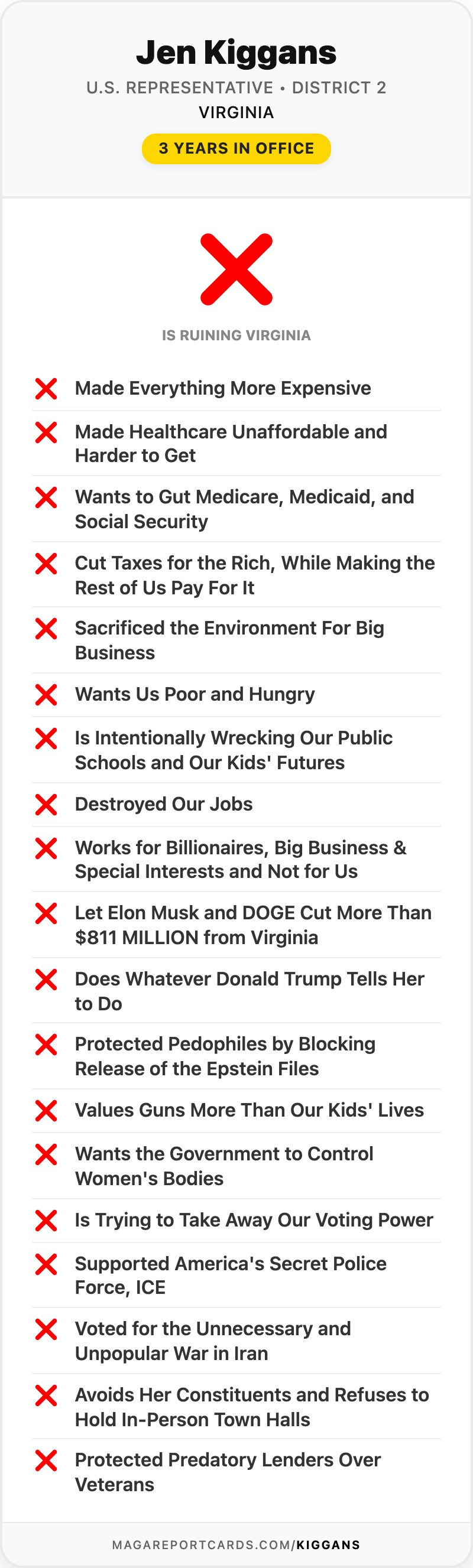
On Monday, May 11, 2026, Jen Kiggans went on "Richmond's Morning News" to talk about the midterms and Democrats' redistricting push in Virginia.
Host Rich Herrera said that if House Minority Leader Hakeem Jeffries wanted to be involved in Virginia politics, he should move from New York and run for office in the commonwealth.
"If not, get your cotton-picking hands off of Virginia," Herrera said.
"That's right," Kiggans replied. "Ditto. Yes, yes to that."
Jeffries is the highest-ranking Black lawmaker in Congress. The phrase Herrera used carries ties to slavery and sharecropping. Kiggans didn't push back and didn't ask him to rephrase. She agreed three times in a row.
What she said afterward — and what she never said
The clip spread Monday night. By Tuesday morning it was a national story. Kiggans posted this on X:
"The radio host should not have used that language and I do not — and did not — condone it. It was obvious to anyone listening that I was agreeing Hakeem Jefferies should stay out of Virginia."
She had told a Richmond station much the same on Monday night: "Of course, he never should have used that language, and of course that's not the sentiment I was agreeing to."
Read those statements for the thing that isn't in them. There is no apology. There is a criticism of the host, and there is an explanation of her own state of mind — that she was agreeing with a sentiment and not with a phrase. Both statements are about what Jen Kiggans meant. Neither is addressed to anyone she offended.
"It was obvious to anyone listening" is doing the heaviest lifting. It wasn't obvious to the people listening. That is the entire reason there was a story.
The people who actually heard it
The Virginia State Conference of the NAACP asked for a real apology. Its president, Rev. Cozy Bailey, put the problem in one sentence:
"We have a congresswoman from Virginia who says ditto to that."
He said the group was "not only disappointed, but we are also enraged."
Elaine Luria — the former congresswoman Kiggans unseated in 2022, and now, after winning the Democratic primary on August 4, her opponent again this November — was blunt about what she'd heard:
"I grew up in the South. I know what these racist dog whistles mean."
Luria said Kiggans "should publicly apologize and denounce these racist remarks." Katherine Clark of Massachusetts, the second-ranking Democrat in the House, called on her to resign. Christie Stephenson, Jeffries's top spokesperson, called it a "stunning failure of judgment and leadership" from a "so-called moderate."
The House Republicans' campaign arm called the whole thing a "total nothing-burger."
Nearly three months later, the apology the NAACP asked for still hasn't come.
Why "moderate" is the point, not the defense
Kiggans's brand is the reasonable one. She's a former Navy helicopter pilot in a Navy town who belongs to the Republican Governance Group and the Republican Main Street Partnership — the caucuses whose entire selling point is not being the loud wing of the party. She runs, every two years, on being less extreme than the rest. Jeffries's own spokesperson used the word in scare quotes for a reason: "so-called moderate."
That reputation is exactly what made this worth reporting. Nobody was surprised when a bomb-thrower said something ugly. The story here is that the "so-called moderate" heard a slur aimed at the highest-ranking Black member of Congress and said "yes, yes to that" — on air, on a friendly morning show, without a word of objection.
Reflexes are more revealing than press releases. A prepared statement tells you what someone wants to be. What comes out unscripted, on a friendly morning radio show, tells you what they actually think is normal.
It keeps happening, and it keeps ending the same way
Tennessee's Diana Harshbarger called 77-year-old Rep. Al Green "boy," and when Green explained why that word is a slur, she tweeted "BOY oh boy." Kentucky's Andy Barr spent a million dollars on an ad telling voters "it's not a sin to be white" while running against a Black opponent.
The pattern isn't the remark. It's the response to the remark: never an apology, always a clarification. The offense gets reframed as a misunderstanding on the listener's part, and everyone moves on.
Green said it better than we can: the danger is "the normalization of these kinds of slurs."
Normalizing doesn't take a slur. It takes someone respectable hearing one and saying "ditto."
Source
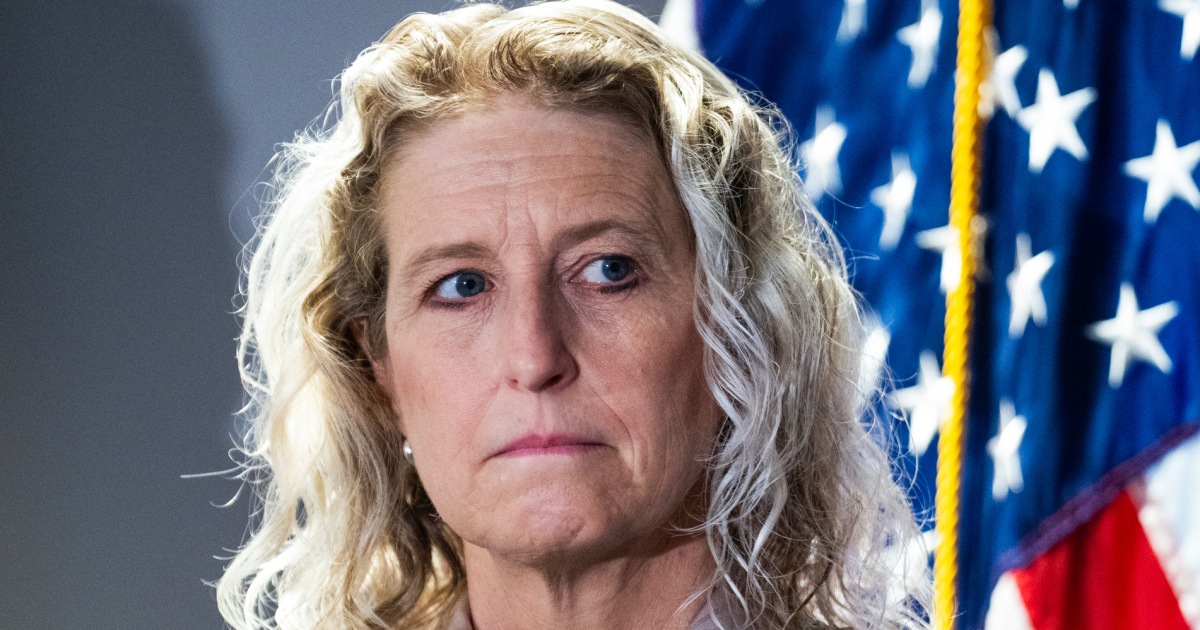
GOP Rep. Jen Kiggans faces backlash for agreeing with 'cotton-picking' comment about Hakeem Jeffries — Kyle Stewart and Scott Wong, NBC News, May 12, 2026. Photo: Tom Williams / CQ-Roll Call via Getty Images, via NBC News.