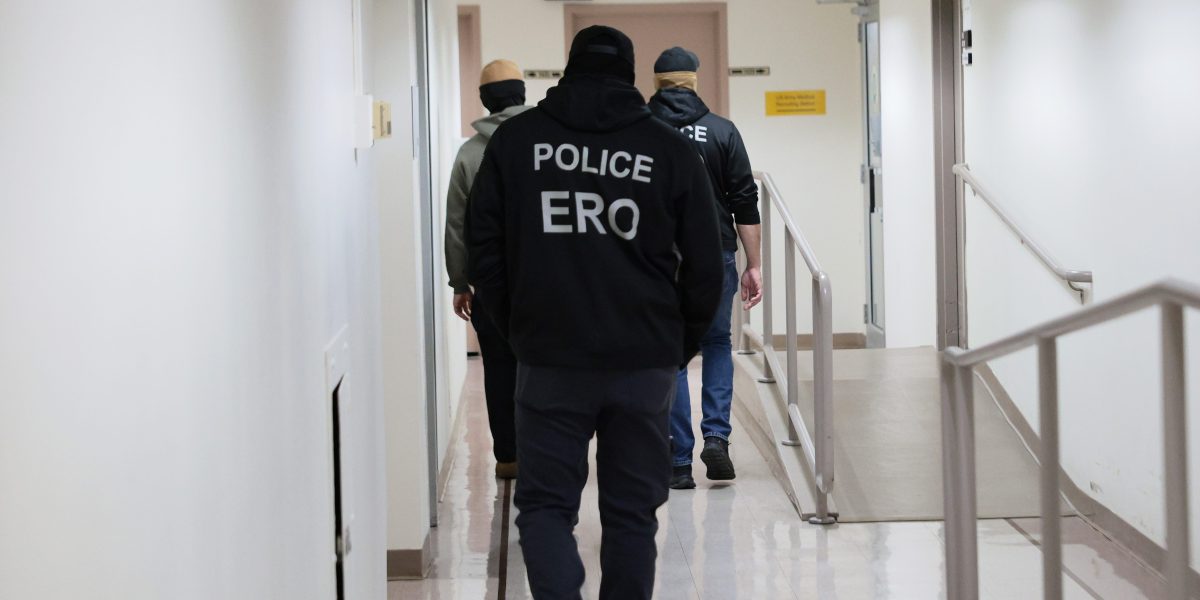
For most of this year, Trump's government would not give a straight answer on whether ICE would show up around the polls in November.
In February, press secretary Karoline Leavitt said she couldn't guarantee that an ICE agent wouldn't be around a polling location. A few weeks later, a Homeland Security official promised election officials ICE wouldn't patrol polling places. In September, States Newsroom reported that Homeland Security Secretary Markwayne Mullin had noted agents could conduct immigration enforcement at polling places, while a department spokesperson said ICE wasn't planning any operations targeting them.
Then came Election Day. And according to a new report in The Intercept, ICE went quiet.
"We were told all operations are canceled"
ICE officials across the country told The Intercept that orders began going around on Monday, November 2. The directive called for a halt to immigration enforcement operations on Election Day. One official called it a "national no enforcement day."
It moved through internal group chats and spoken commands.
"We were told all operations are canceled for Election Day," said one official in the South. "Word of mouth from our first-line supervisors, no official email notice."
Multiple officials said it was handed down quietly to avoid media attention. Officials working in four of ICE's regions, covering parts of the Northeast, Midwest, North and south-central U.S., said they got orders to stand down.
"We were told to do 'admin' shit," an official in the Great Lakes region told the outlet. Officers who normally work the streets were sent to desks. "I'll be drinking coffee at the office for the first time in a year."
The trackers saw it too
People who watch ICE every day noticed right away.
"Yesterday was the least amount of activity observed from ICE ERO throughout the entire year so far," said Sherman Austin, who runs the tracking site StopICE.net. ERO is the part of ICE that does arrests and deportations. Most reports he did get were sightings, not enforcement.
AntiFreeze, another tracking network, logged about 56 sightings nationwide. Its creator called that "one of the quietest Tuesdays we've ever seen," and said about three were near polling stations. They barely got any reports of actual arrests. Volunteers in the Twin Cities and Southern California told The Intercept it was quiet there too.
Activists still heard about arrests at jails, so this wasn't a total stop.
What one quiet day tells us
Nobody knows yet who gave the order. Some officials told The Intercept they think it came from ICE's own enforcement leaders and not the White House. One said senior leaders were acting "with fears of us being at the polls."
Think about what that means. These raids are a choice. If the officials are right, they could be switched off across much of the country for a single day, the day Americans went to the polls.
The officials also said the order was kept quiet to avoid media attention. That tells you how its authors expected it to look.
The backlash is real, and Republicans know it. The Intercept ran a separate story headlined "In California's Central Valley, ICE Swung a Red District Blue." Vice President JD Vance wrote on Wednesday that he's open to changing enforcement, while rejecting any major overhaul.
Families have lived under these raids all year, and immigration agents have held more than 500 U.S. citizens. They got one quiet day, and it was the day Republicans were on the ballot.
The short version
ICE officials in four regions told The Intercept they were ordered, through group chats and word of mouth, to cancel enforcement operations on Election Day, a move one called a "national no enforcement day." Two tracking networks recorded some of the lowest activity of the year. Trump's administration had given conflicting answers for months on whether ICE would stay away from polling places, and it is still unclear who gave the order.


