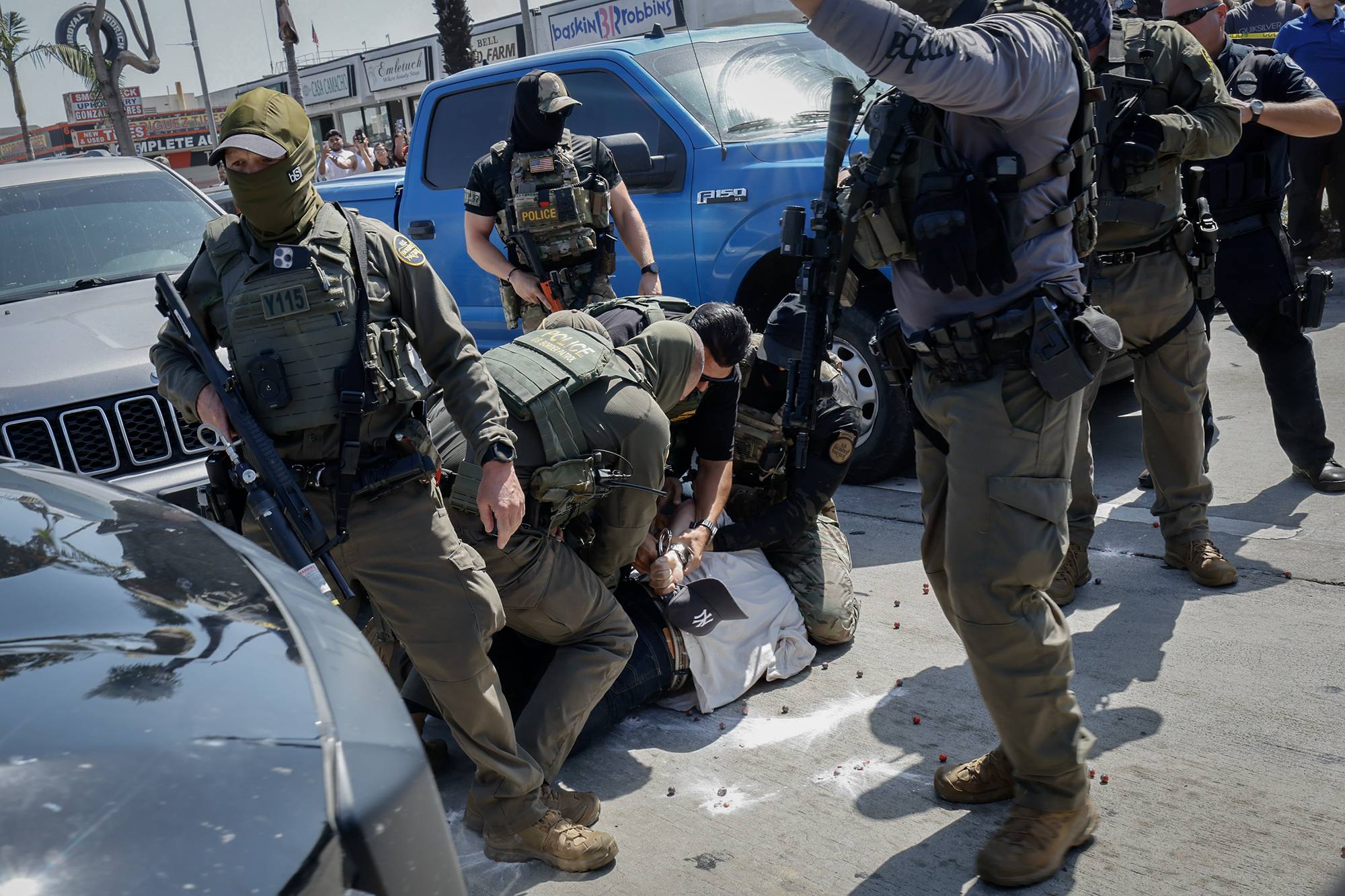
For a year, the federal government has told courts that its immigration agents in Los Angeles weren't stopping people because they looked Latino — that they were acting on specific intelligence about specific individuals.
Then the agents' own text messages came out.
What the agents wrote and said
A new court filing in Vasquez Perdomo v. Noem, reported by CalMatters, draws on months of discovery — text messages, body camera footage, and sworn depositions of agents. Here's some of what it contains:
- A text from one agent: "Yeah, just plug us in wherever you see some tonks and we'll jump out."
- Another describing "tonks everywhere selling food."
- Bodycam audio of a Border Patrol agent at the Hollywood Home Depot: "There was a guy, I'm pretty sure he's wet he was just sitting in that minivan."
- An agent in a deposition, asked what suspicious appearance they look for, answering plainly: "Older Hispanic male."
"Tonks" is a slur Border Patrol agents have used for migrants. It's reportedly derived from the sound a heavy object — like a flashlight — makes when it hits a person's skull. This is not a new discovery inside the agency: in 2019, Customs and Border Protection issued guidance stating outright that "the term 'tonk' is not appropriate."
Agents used it anyway, in writing, while deciding who to grab.
This came from the top, not from a few bad agents
The easiest way to dismiss a story like this is to call it a few rogue officers. The filing argues the opposite, and cites the paperwork.
A May 2025 directive from ICE headquarters told field officers to "turn the creativity knob up to 11" and arrest more "collaterals" — the agency's word for people who weren't the target of an operation but happened to be there.
"This was not a rogue method of operationalizing agency orders," the filing states. "It was precisely what agency leadership desired."
Plaintiffs' attorneys also note that ICE doubled the size of its field teams "thanks in part to recruitment ads employing white nationalist messaging."
The people caught in this weren't all undocumented. Racially profiling everyone who looks Latino and low-income sweeps up U.S. citizens — and the filing says some plaintiffs and organization members, including citizens, have already been stopped more than once.
The raids didn't stop. They got a new name.
There's a common assumption that the aggressive street sweeps of summer 2025 ended. According to a deposition quoted in the filing, an ICE agent put it this way:
"We're [still] doing the same thing [as 'Operation at Large'] just with a different name."
The motion filed Monday asks U.S. District Judge Maame Ewusi-Mensah Frimpong for a preliminary injunction, arguing agents have run an "ongoing campaign of suspicionless and discriminatory detentive stops" across the Central District of California.
It's worth being precise about where this case stands: an earlier temporary restraining order in this case was stayed by the U.S. Supreme Court last September, and the discovery that produced these records was ordered afterward. The new motion asks the court to bar agents from racial profiling.
The government is running out the clock on evidence
The most telling part of the story may be what the government has done about handing over the agents' phones.
- Of 1,400 Border Patrol agents involved in the Los Angeles operations, more than half told the government they used their personal cell phones.
- The government asked agents to voluntarily upload data from those phones — an arrangement worked out with the agents' union to avoid workplace grievances. Only 88 volunteered. None have been imaged yet.
- On government-issued phones, federal lawyers told the court they are imaging 3 phones every 2 weeks, with an estimated "200-300 still to go."
Do that math. At three phones every two weeks, 300 phones takes close to four years. The midterm elections are in three months. The case is about stops happening right now.
Last month, Judge Frimpong weighed whether to hold the federal government in contempt for failing to comply with her order to produce the phones. Plaintiffs argued the government deserved sanctions for "straight-up saying they will not comply with an order because their employees might complain if they do."
Why this matters everywhere, not just Los Angeles
"There's enough to suggest that this is a system-wide practice of identifying people through racial slurs," said ACLU attorney Mayra Joachín.
That's the point. These records came out only because a lawsuit forced discovery in one federal district. The directive to "turn the creativity knob up to 11" came from headquarters — not from a Los Angeles field office. The recruitment pipeline is national.
What a court in California pried loose is a window into how the agency operates in every city it works in.
And the constitutional principle at stake isn't complicated or partisan: the government cannot stop and detain you because of how you look. That protection either applies to everyone or it protects no one.
The bottom line
Federal agents used a slur derived from the sound of a flashlight hitting a skull to decide who to stop. Their headquarters told them to be more "creative" and grab more bystanders. Their agency has imaged 0 of 88 volunteered personal phones and is imaging government phones at a pace that would take years.
Every elected official who has cheered these operations on — and who has voted to expand ICE's budget and its ranks — owns this record now that it's public.
Source
This post is based on reporting by Sergio Olmos and Wendy Fry for CalMatters. Photo by Carlin Stiehl, Los Angeles Times via Getty Images.