The Department of Homeland Security ran out of money on February 14, 2026. TSA officers kept screening passengers without paychecks. Coast Guard crews kept running search-and-rescue not knowing whether the next paycheck would clear, and the service's nearly 10,000 civilian employees went without a full one from February 16 until early April. FEMA staff kept working without paychecks.
Six weeks in, the Senate found a way out.
After 2 a.m. on Friday, March 27, the Senate passed a bill by voice vote — no objections, no roll call — funding almost all of Homeland Security: TSA, the Coast Guard, FEMA, the cybersecurity agency. The one thing it left out was ICE and parts of Customs and Border Protection, which was the actual dispute.
It would have put paychecks in the hands of the people who had gone six weeks without one, that week.
The House killed it that night. Bill Huizenga voted to kill it.
The vote
The mechanism was a procedural rule, which is how the House disposes of things it doesn't want to be seen voting against directly.
Late on March 27, the House adopted H. Res. 1142 by 213 to 203. Huizenga voted Aye. Under that rule, the Senate's bill was automatically "considered as agreed to with an amendment consisting of the text of" a Republican substitute — the official record spells it out. The Senate's language was gone. In its place went a 60-day stopgap funding all of DHS, ICE included, through May 22.
Speaker Mike Johnson called the Senate's move "a joke." The Senate had already left for a two-week recess.
So the shutdown continued. Not because nobody had a bill — the Senate had passed one hours earlier, unanimously enough that nobody demanded a recorded vote. It continued because the House majority, Huizenga among them, would rather leave TSA unpaid and the Coast Guard unfunded than fund Homeland Security without funding ICE.
Four days later
On March 31, 2026, a photograph surfaced of a congressional delegation on a tour group at Edinburgh Castle in Scotland. TMZ published it. Semafor identified the group as the Republican Main Street Caucus. A reporter spotted a familiar face at the far right of the frame.
Huizenga's spokesman Brian Patrick confirmed it to the Michigan Advance: the congressman was in Scotland, on what he called "a long-planned, House Ethics approved mission to strengthen our ties with allies and collaborate with U.S. officials, foreign dignitaries, and U.S. companies in the region."
Also in the photo, per TMZ and Semafor: John McGuire of Virginia, Derrick Van Orden of Wisconsin, and David Rouzer of North Carolina.
Two things about the defense.
"House Ethics approved" is not the standard. Nobody accused Huizenga of breaking an ethics rule. Congressional delegations are routinely cancelled during a shutdown of a major department — that's standard practice, as the Advance noted. Speaker Johnson had cancelled the official House delegation to the Munich Security Conference in February for exactly that reason. The trip wasn't against the rules. It was against the point.
"Long-planned" is not a defense either. The shutdown started February 14. The trip happened at the end of March. There were six weeks to reconsider, and four days between voting to prolong the shutdown and boarding the plane.
What was happening while he was away
The Coast Guard is not an abstraction in Michigan. It patrols the Great Lakes.
By the end of April, CBS News reported, the service had racked up more than $300 million in unpaid obligations and $5.2 million in overdue utility bills. Water outages hit duty stations "in Port Huron, Michigan, and Station Channel Islands, California." Natural gas was locked off at an air station in Hawaii. Nearly 1,000 housing units were at risk. The Coast Guard was going to run out of money to pay its people on May 1, with the first missed paychecks due May 15.
The commandant, Adm. Kevin Lunday, described it plainly: "It seems like a horror movie, but it's actually happening. It's almost unbelievable."
Michigan travelers got off comparatively easy — Detroit Metro stayed relatively unaffected while lines at Atlanta, New York and Louisiana blew out. But the Michigan TSA officers working those checkpoints had been unpaid since February 14 all the same. Trump signed an order to pay TSA staff out of existing funds in late March. It took until early April for an emergency order to cover the Coast Guard's unpaid civilians, and by the end of the month that money was gone.
The ending makes it worse
Here is the part that should decide how you read the whole episode.
On April 30, 2026, the House came back and passed the Senate's version. Not a compromise, not a renegotiated deal — the House voted to "recede from the House amendment to the Senate amendment to H.R. 7147, and concur in the Senate amendment." By voice vote. No roll call. It became Public Law 119-86 the same day.
That is the identical bill Huizenga voted to throw out on March 27, adopted 34 days later.
Thirty-four more days of a Coast Guard that could not pay its bills, ending with $5.2 million in overdue utility bills and families having their electricity shut off. A payroll the service was one day from being unable to meet. And at the end of it, the House took the deal that had been sitting on the table the whole time.
Huizenga's office told the Advance he has now voted four times to fully fund DHS, and that "we cannot allow Senate Democrats to paralyze our national security." He can count his votes however he likes. The record shows the House had a bill on March 27 that would have funded the Coast Guard, he voted to discard it, and his side accepted that same bill five weeks later after gaining nothing.
This is a pattern with him
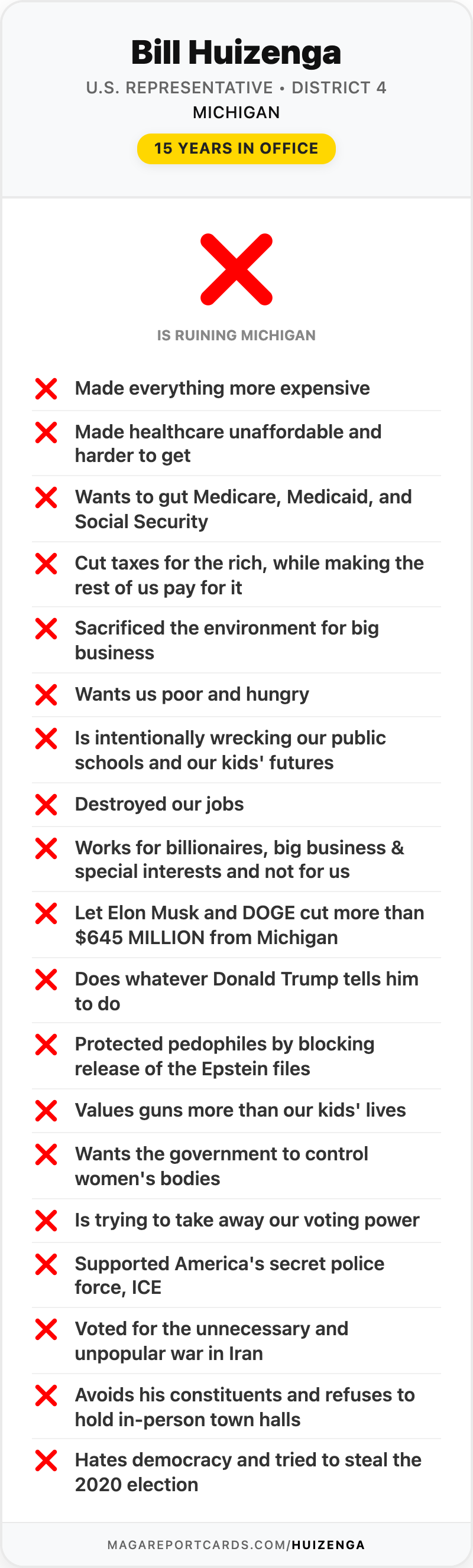
Huizenga has been in the House since 2011 — 15 years — and has represented Michigan's 4th District since 2023. He is the vice chairman of the House Financial Services Committee.
He also refused to take part in an in-person town hall, which is why about 350 constituents in Holland held one without him in March 2025. He deleted his own issue pages from his campaign website the day a poll showed him trailing. His campaign paid a company owned by his half-brother more than $400,000 — the same brother who was selling the condos Huizenga's own company built.
The through-line isn't a single scandal. It's a member of Congress who has stopped expecting to be asked about any of it.
He should be asked about this one. He voted to keep the Coast Guard unfunded, flew to Scotland four days later, and then voted for the bill he'd rejected — after the damage was done.
Source
Huizenga's office confirms Scotland delegation visit during partial shutdown — Ben Solis, Michigan Advance, April 1, 2026.
Photo: Congressional delegation at Edinburgh Castle, March 31, 2026. Screenshot courtesy of TMZ.com, via Michigan Advance.