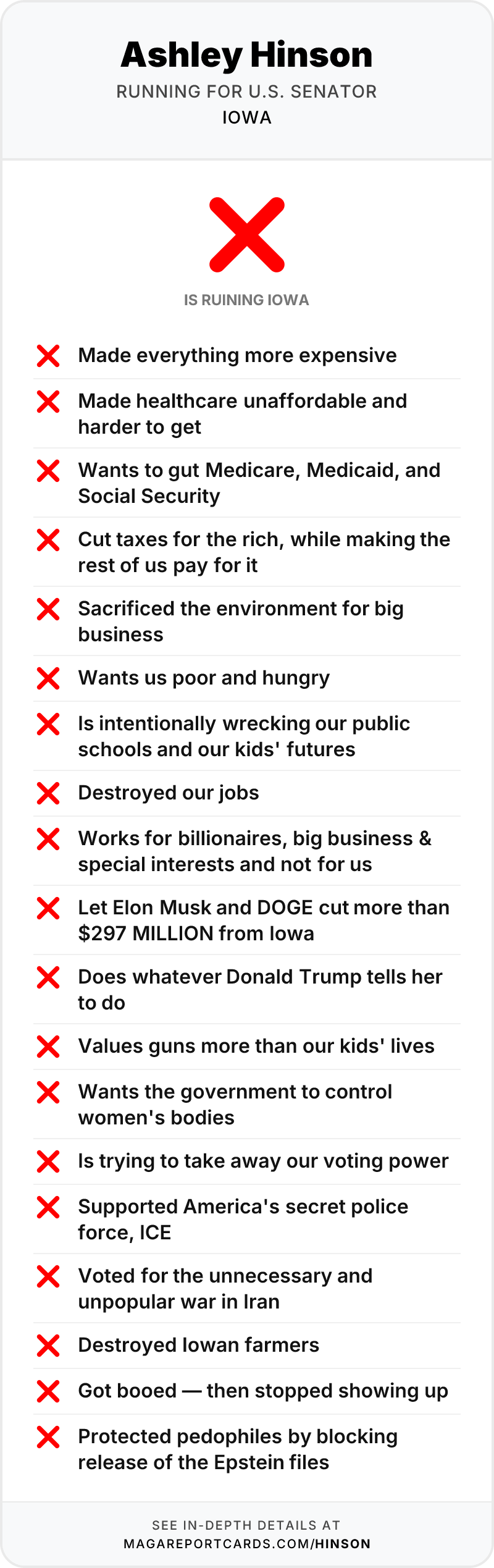
Ashley Hinson is the Republican nominee for Iowa's open U.S. Senate seat. She beat former state senator Jim Carlin in the June 2 primary, and in November she'll ask Iowans to trust her with six years in the Senate.
Trust is the word she uses too. Before politics, Hinson spent eleven years on television in Cedar Rapids — a news anchor and reporter at KCRG from 2005 to 2016. Her party's own campaign arm still leads her bio with it, calling her an "award-winning former TV journalist" and a two-time Midwest Regional Emmy winner. That same page lists "Government Accountability and Ethics Reform" among her priorities and credits her with leading "efforts to root out corruption in Washington."
So it's worth remembering what happened the last time Ashley Hinson's integrity was actually tested.
What the New York Times found
In July 2020, during her first run for Congress, the New York Times went through Hinson's campaign website and the op-eds published under her name. What it found was that her campaign had lifted verbatim sentences "more than a dozen times" since the campaign began.
Not paraphrased. Not "similar to." Word for word.
The stolen passages came from the New York Times, CNBC, the Des Moines Register and The Hill. The Times also found that Hinson's own policy positions on veterans issues used near-identical language to the positions posted by her opponent, sitting Congresswoman Abby Finkenauer. She was copying from the woman she was running against.
The clearest example was an essay Hinson published on her campaign website titled "Creating America's new normal: China must be held accountable." It ran 642 words. Ninety-one of those words — across three separate passages — were identical to a March 11 New York Times story by reporter Ana Swanson.
Her old station, KCRG, later laid the two versions side by side. The Times sentence began, "Chinese pharmaceutical companies have supplied more than 90 percent of U.S. antibiotics…" and ended by crediting a senior fellow at the Council on Foreign Relations for the figures. Hinson's version was the same sentence — with the credit chopped off the end.
That is the whole trick of plagiarism, right there in one edit: keep the work, delete the person who did it.
Then the op-eds disappeared. So did the tweets.
Once the Times contacted her campaign, the op-eds came off her website. And according to ProPublica's Politwoops tool, which archives politicians' deleted tweets, Hinson deleted more than 30 tweets on the day the Times story published — some of them the tweets promoting those very op-eds.
Think about what that means. The reflex wasn't to explain. It was to scrub.
Three different answers in three days
Here's where it stops being a staffing mistake and starts being a character question. Hinson gave Iowans three different versions of herself in seventy-two hours.
Monday, July 20. She posted on Twitter: "I was unaware of the plagiarism when I reviewed drafts presented to me by staff. As a journalist I take this extremely seriously and am deeply sorry for the mistake. The staff responsible will be held accountable."
Read that last sentence again. Her name was on the op-eds. Her signature. Her byline. And within hours of being caught, the person she said would be held accountable was somebody else.
Tuesday, July 21. In an interview with KWWL-TV, she apologized again — and then reframed the whole thing:
"I think people see this for what it is, which was a partisan attack on me."
The New York Times is not the Iowa Democratic Party. The words on her website either matched somebody else's words or they didn't, and they did. But rather than sit with that for even one full day, Hinson turned herself into the victim of the reporting.
In the same interview she said the plagiarism was "absolutely appalling," that it was "unacceptable to me, and… unacceptable to voters," and — this is the line — "Integrity is what matters to me." She said that in the same breath as calling the fact-finding a partisan attack.
Wednesday, July 22. Finally, a written letter to Iowans, and the most honest thing she said all week:
"I spent more than a decade on the air building the trust of viewers… As a former journalist, it is my responsibility to perform the proper due diligence to ensure that what I release is original and is attributed properly."
And then: "What happened was wrong and violated your trust."
She was right. It did.
But notice the order. The full apology came third — after the deflection to staff, and after the "partisan attack" defense. She got there only once it was clear the story wasn't going away.
"The staff responsible" is not a real answer
Hinson's explanation was that an employee at a consulting firm she'd hired to help with background and writing had copied the passages, and that she approved and published the drafts without catching it. She said she cut ties with the firm and that both the firm and the employee were terminated.
Fine. But she is the one who put her name on it. She's the one who tweeted it out. And she is the one who had spent eleven years in a newsroom where lifting another reporter's sentences is the single fastest way to end a career.
Every journalist in Iowa knows that rule. Hinson knew it better than most — she cited it herself: "As a journalist I take this extremely seriously." The rule she'd lived under for a decade suddenly applied to a contractor instead of to her.
Frank Durham, an associate professor of journalism at the University of Iowa, wrote in The Gazette that the deeper problem wasn't the copying but what it revealed about how little serious reading was going on inside the operation. His warning was blunt: "It may be normal for the average American to ignore journalism. Most do. But for a congressperson, that can be deadly."
Why this still matters in 2026
Some people will say this is old news from a 2020 House race. It isn't, for three reasons.
One: she never stopped selling the journalism. The Emmy awards, the eleven years on the air, the "award-winning former TV journalist" line — that credential is still the first thing her campaign puts in front of voters. If the résumé counts as a reason to trust her, then what she did with that résumé counts too. You don't get to keep the credibility and disown the conduct.
Two: the instinct hasn't changed. Caught doing something wrong, Hinson's sequence was blame a subordinate, delete the evidence, call the reporting partisan, and apologize properly only when nothing else worked. That is the same posture she brings to the job now. She announced her Senate campaign by saying she wants to be "President Trump's top ally in the United States Senate" — not Iowa's ally, Trump's. And after a rough run of 2025 town halls — pushback in Mason City over tariffs, DOGE cuts and deportations, then boos and jeers in Decorah when she said she was proud to have voted for Trump's budget bill — she stopped holding them. She hasn't held a single town hall all year.
Three: she's running on ethics. Her party's official bio credits her with leading the fight against corruption in Washington. Accountability is supposed to be her brand. The one documented time she was personally on the hook for it, her first move was to hand the blame to a staffer.
Iowans are entitled to hold a former journalist to a journalist's standard. Hinson set that standard herself when she said integrity is what matters to her, and again when she admitted she had violated Iowans' trust.
She was right the second time. We deserve better.
Sources
Reporting from The Gazette ("Ashley Hinson cites staff after New York Times uncovers plagiarism," July 20, 2020), KCCI ("'I violated your trust': Ashley Hinson apologizes for plagiarism" by Sarah Muller, July 2020), KWWL (July 21, 2020), and KCRG's I9 fact check by Ethan Stein (September 18, 2020), which rated the plagiarism claim an "A."