On March 9, 2023, the House passed the Protecting Speech from Government Interference Act. At its core the bill did one thing: it would have made it illegal for federal executive-branch employees to lean on private companies to take down speech.
In the words of the official summary, it barred federal employees from "using their official authority to censor a private entity," and defined censorship as "influencing or coercing, or directing another to influence or coerce, for the removal of lawful speech … with respect to any interactive computer service (e.g., social media)."
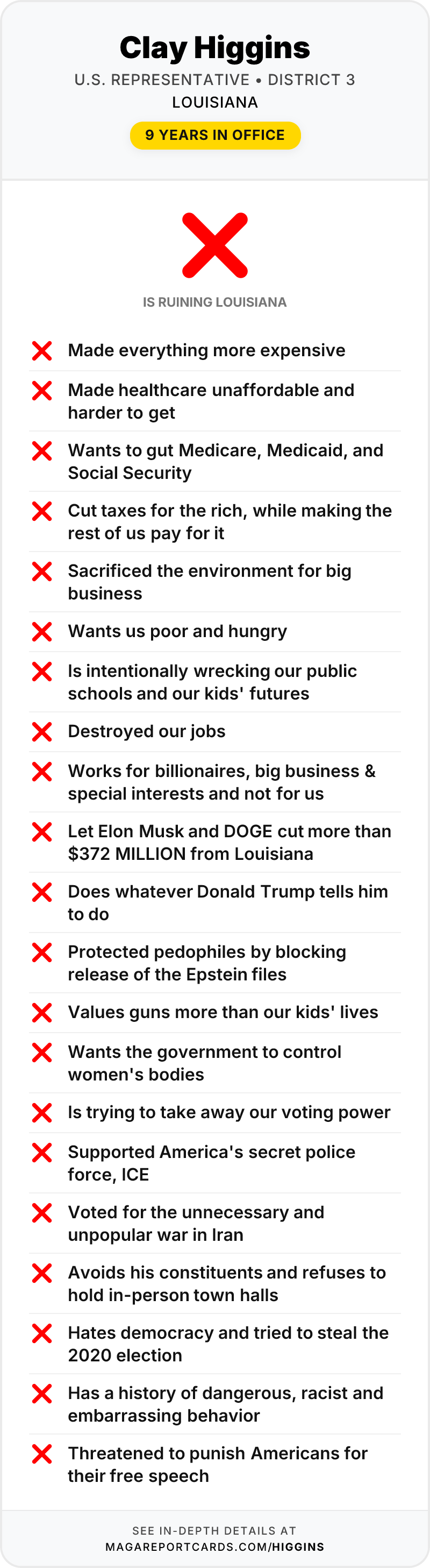
It passed 219 to 206. Clay Higgins voted yes, and his office put out a press release under the headline "Higgins Helps Pass Protecting Speech from Government Interference Act."
Two and a half years later
On September 11, 2025 — the day after conservative activist Charlie Kirk was assassinated at Utah Valley University — Higgins posted this:
"I'm going to use Congressional authority and every influence with big tech platforms to mandate immediate ban for life of every post or commenter that belittled the assassination of Charlie Kirk."
Read that against the bill he voted for. Using official authority to influence or coerce a private entity for the removal of lawful speech. That is the thing H.R. 140 makes a fireable offense with civil penalties attached. It's not a close analogy. It's the definition.
And he didn't stop at social media. In the same statement:
"I'm also going after their business licenses and permitting, their businesses will be blacklisted aggressively, they should be kicked from every school, and their drivers licenses should be revoked."
Roll Call reported the line that follows: "I'm basically going to cancel with extreme prejudice these evil, sick animals who celebrated Charlie Kirk's assassination."
Take that list apart
A U.S. congressman said he would use his office to take away, from private citizens, for things they wrote online:
- Their business license. Issued by states and parishes. Not a federal power.
- Their permits. Same.
- Their place at school. Public universities are bound by the First Amendment; expelling a student for protected speech is the textbook violation.
- Their driver's license. A state document, issued for whether you can operate a car safely. There is no lawful path from an offensive post to a revoked license.
Higgins does not have the authority to do most of this. That's not a defense. A member of Congress announcing he'll aim the machinery of government at people for their opinions does damage whether or not he can pull it off — because the people hearing it can't be sure he can't, and the safest thing to do is shut up. That's the point of a threat.
Roll Call quoted George Washington University law professor Mary Anne Franks on the constitutional problem with the social-media half: pressuring private companies to punish users for their political views is "jawboning," which can violate the First Amendment even when the government never touches the speaker directly. As she put it, among the things the First Amendment protects, "you are allowed to say that some terrible thing that happened is a good thing."
That is uncomfortable and it is also the law. The Constitution does not have an exception for tasteless.
The man he was avenging
WBRZ, reporting Higgins's statement, described Kirk as a commentator "known for his advocacy for free speech, gun rights and opposition to progressive and liberal ideology." He made his name going onto campuses to say things the room didn't want to hear.
Higgins's response to his murder was to propose a federal blacklist.
He's said the quiet part before
This is not the first time Higgins has proposed using force or state power against Americans for expression.
In September 2020, he posted a photo of armed Black demonstrators with the caption: "One way ticket fellas. Have your affairs in order. Me?...I wouldn't even spill my beer. I'd drop any 10 of you where you stand." Facebook removed it for violating its violence and incitement rules. He posted again — "I'll advise when it's time gear up, mount up, and roll out" — and that one appears to have come down too. The ACLU of Louisiana called for his censure.
In June 2017, hours after the London Bridge attack, he wrote of terrorism suspects: "Hunt them, identify them, and kill them. Kill them all."
The through-line isn't a party position. It's a habit of reaching for punishment — state punishment, or worse — as the first response to speech he doesn't like.
Why this one matters more than a bad tweet
Plenty of politicians say ugly things online. What separates this is the word "Congressional."
Higgins wasn't venting as a citizen. He said explicitly that he would use the authority of his office — the same office that put him in charge of the House Oversight Subcommittee on Federal Law Enforcement — to get Americans banned, blacklisted and stripped of licenses over posts.
Two and a half years earlier he voted to make that behavior illegal for federal employees across the executive branch.
We deserve better.
Source
Domenic Purdy, "Rep. Higgins says making light of Charlie Kirk's death should result in social media bans, revoked licenses," WBRZ, September 12, 2025.