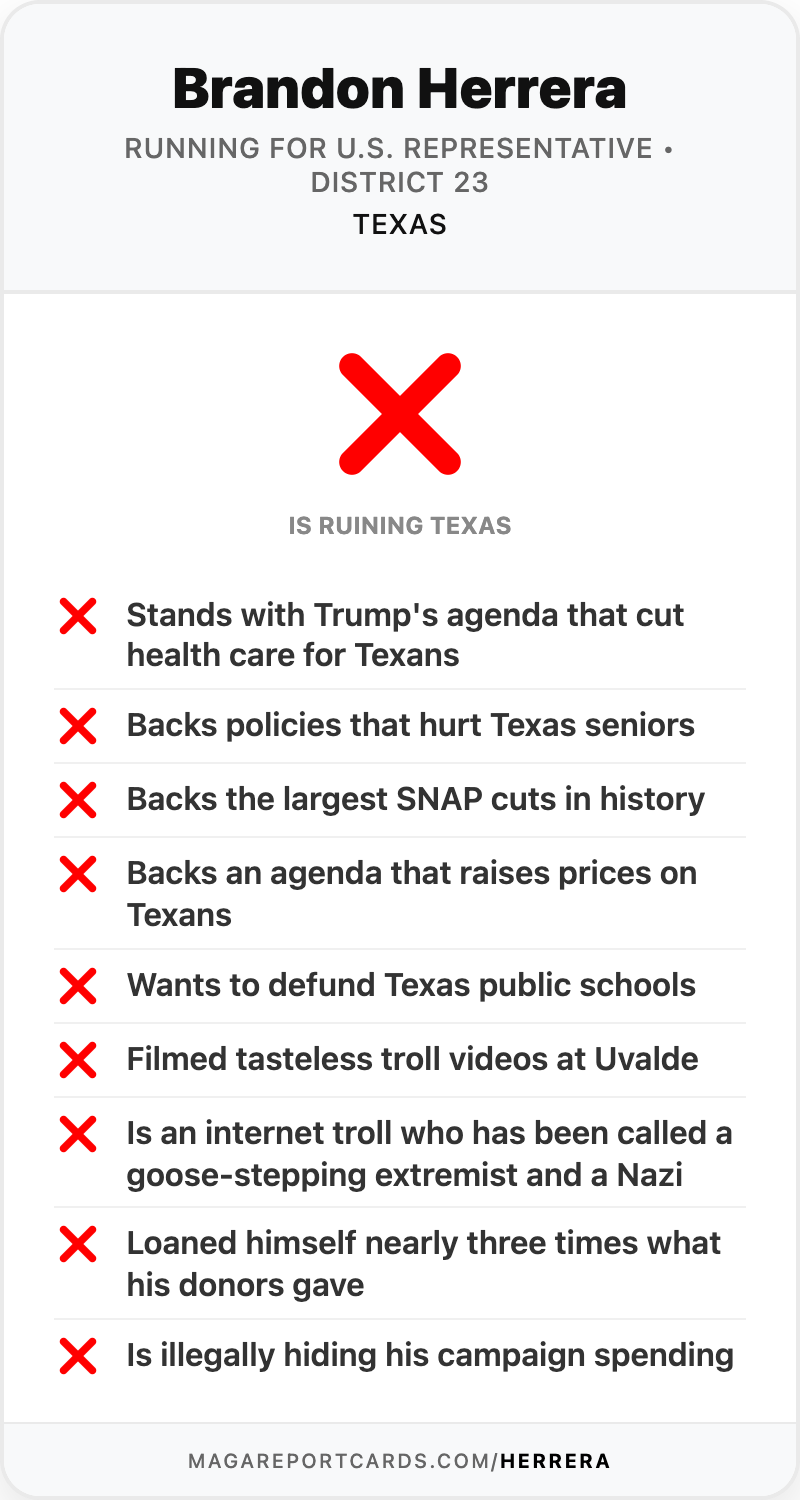
The rule is simple, and it's the whole point of campaign finance law: when a campaign spends money, it has to tell the public who actually got it. Not a middleman. The real recipient.
Brandon Herrera's campaign has reported that essentially all of its money went to one company.
According to a complaint the nonpartisan Campaign Legal Center filed with the Federal Election Commission in May 2026, federal filings show that 99.4% of Herrera's 2026 campaign expenditures went to an entity called Texas Strategy Group. In his failed 2024 run for the same seat, it was about 92% of operating expenses.
Here is what the complaint says about Texas Strategy Group. It is not registered to legally do business anywhere in the United States. It does not have a website.
$2.7 million into a box
The complaint covers three committees at once: Herrera's principal campaign committee, his leadership PAC, and his joint fundraising committee. Together, the Campaign Legal Center says, they concealed the true recipients of more than $2.7 million by routing virtually all of their operating expenses through a company that "does not appear to be a bona fide commercial vendor" and is "almost certainly not the true recipient" of the payments.
Saurav Ghosh, the Campaign Legal Center's director of federal campaign finance reform, told the San Antonio Current what that accomplishes:
"The overall goal seems to be concealing their how they're spending their money in a way that's not only illegal but fundamentally undermines the transparency voters have a right to."
He's seen this trick before. He hasn't seen it done this openly:
"This is egregious in the sense that there's no real effort to cover up what's happening. We've seen some other examples of this, but this one is at the far end of the spectrum in terms of how much of the total money is being routed through the shell company."
The addresses lead back to his own treasurer
This is the detail that turns a filing question into something else.
Herrera's committees' FEC reports list two addresses for Texas Strategy Group — one in Washington, D.C., and, once, one in Hudson, Wisconsin. The Campaign Legal Center's filing argues that both of them are linked to Thomas Datwyler, the treasurer for Herrera's campaign committees.
So the money leaves committees whose books Datwyler keeps, and lands at a company whose addresses trace back to Datwyler, and there the public record stops.
Datwyler is not an unknown quantity. He paid more than $20,000 in administrative fines in 2023 over alleged campaign-finance reporting violations, Mississippi's attorney general opened an investigation into a PAC where he served as treasurer, and his ties to the campaign finances of George Santos — the congressman the House expelled in 2023 — have drawn scrutiny of their own.
Herrera's campaign officials were unavailable for comment when the San Antonio Current reached out. The FEC, as a matter of policy, doesn't comment on complaints.
This isn't his first FEC letter
Back in June 2024, during his first run at this seat, the FEC sent Herrera's committees inquiries on two separate subjects.
The first asked about a $50,000 loan Herrera made to his own campaign the previous December. The Current noted that his financial disclosure reported earning about $84,000 in 2022.
The second, sent to his joint fundraising committee, demanded accurate employer and occupation information for donors who gave $200 or more. The agency noted that several donors — some giving upward of $1,000 — had filled out that section incorrectly or left it blank. Federal law requires a name, address, occupation, and employer for every donor above $200. It's the mechanism that lets voters see which industries are funding a candidate.
Two years later, the pattern hasn't changed. It's gotten bigger.
Why any of this matters in the 23rd District
Voters in Texas' 23rd are being asked to hire someone. The single most useful thing they can know about a candidate is who is paying for the campaign and where that money goes — because that's the closest thing to a preview of who the person will actually work for.
Herrera's filings can't answer that. Not because the information is complicated, but because it's been routed through a company with no apparent website, no apparent business registration, and addresses that lead back to his own treasurer.
The Campaign Legal Center is the same watchdog that documented 108 unreported stock trades by Florida's Byron Donalds. These complaints are slow, and the FEC is notoriously deadlocked. A candidate who wants to run out the clock usually can.
That's the bet here. Herrera is on the ballot in November against Democrat Katy Padilla Stout, and national Democrats just added the seat to their target list. The complaint will not be resolved before anyone votes.
A candidate who won't say where his money goes hasn't earned the public's trust. We deserve better.
Source
"Watchdog accuses Brandon Herrera's congressional campaign of breaking campaign finance law," Sanford Nowlin, San Antonio Current, June 2, 2026, and the Campaign Legal Center's FEC complaint, filed May 21, 2026.